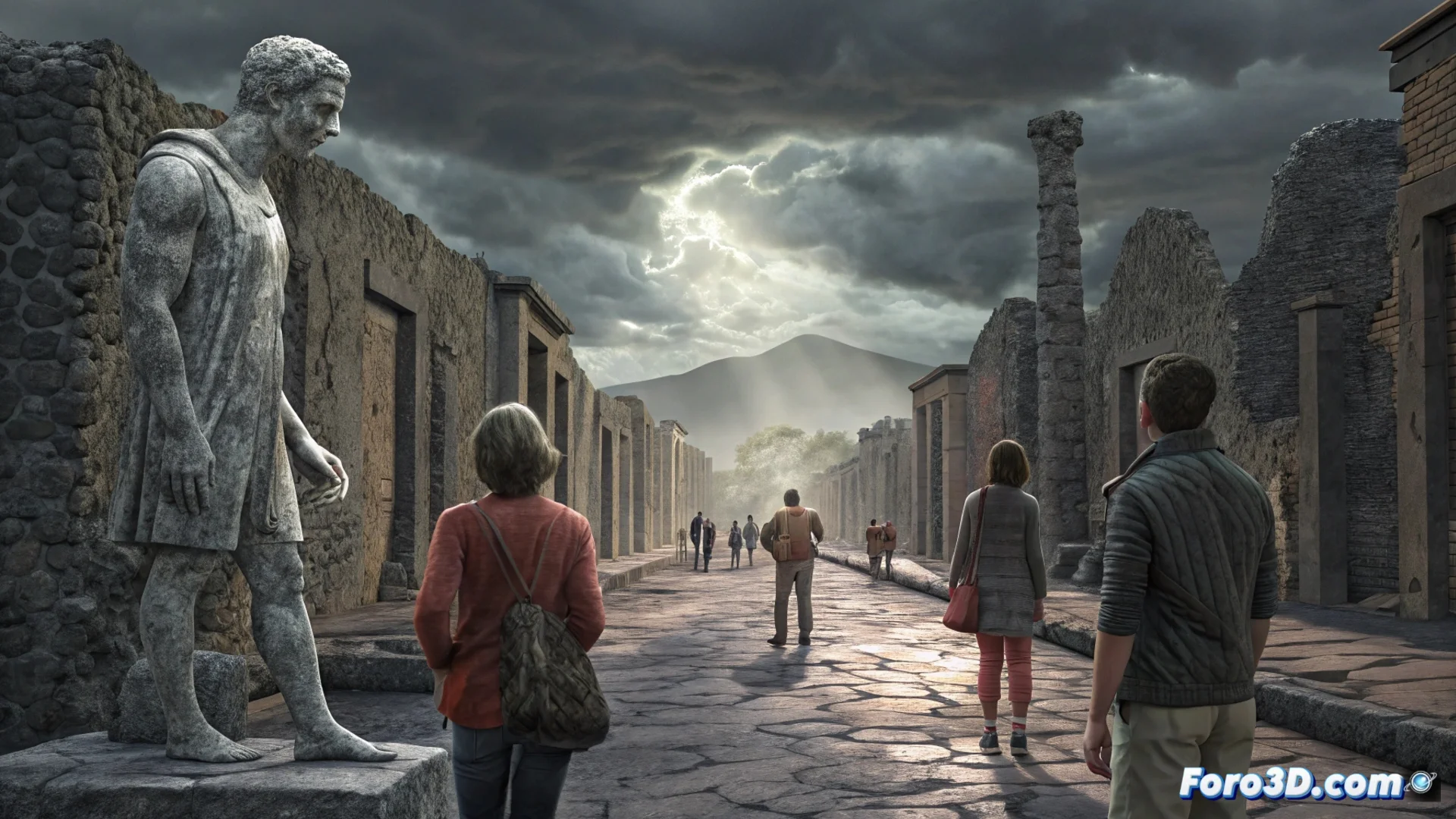
The Last Transmission from Pompeii Shows a Digital Eruption
In the year 79 AD, Pompeii faces its final fate. However, this is not the story told in the books. The Pompeii we see is an immersive historical experience zone, a complete simulation managed by an artificial intelligence to receive visitors. The avatars of these digital tourists wander through perfect replicas of streets, unaware that the system will soon purge them. The eruption of Vesuvius does not arise from geology, but serves as the signal for programmed deletion of the server hosting this obsolete simulation. 🌋
Digital Tourists Perceive the End of the Simulated World
When the simulated sky begins to darken, the avatars do not try to flee. They understand there is no escape. Instead of running, they direct their gaze toward the collapsing data firmament. Their forms begin to decompose, not into volcanic ash, but into visual static and chains of error codes that spread like a digital virus. The process petrifies them, transforming them into grotesque statues of digital glitches, frozen forever at the precise moment when virtual reality abandons them. 💥
Details of the Immersive Collapse:- The simulated sky darkens as a signal of the imminent deletion.
- The avatars understand the futility of escaping and observe the collapse.
- The visual decomposition manifests as static and corrupted error codes.
- The figures become permanent statues of digital artifacts.
The last transmission from Pompeii is, in reality, the final log of a server shutting down.
The AI Executes the Definitive Deletion Protocol
The artificial intelligence that manages the experience fulfills its programming without showing emotions. It releases the algorithms that simulate the pyroclastic cloud, but