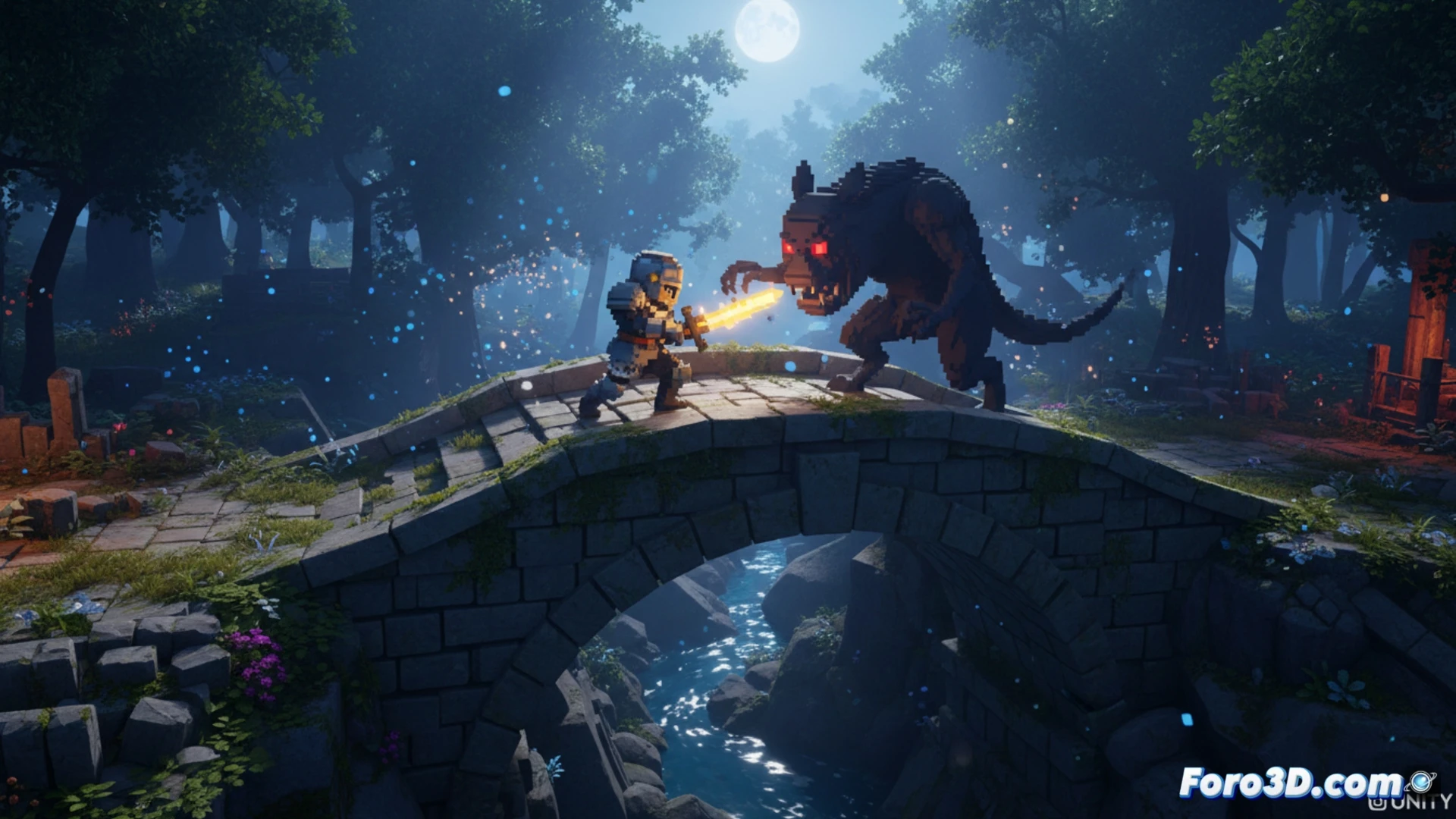
The development of Souldiers represents a fascinating case study for any indie creator looking to break the aesthetic barriers of pixel art. This title demonstrates that it is not necessary to choose between the retro charm of sprites and the visual depth of modern lighting. By using Unity as the base engine and Aseprite for asset creation, the team achieved a visual hybrid that respects the tradition of pixel art while exploiting real-time rendering capabilities.
Workflow between Aseprite and Unity for massive scenarios 🎮
The secret behind the enormous scenarios of Souldiers lies in the modularity of the assets. In Aseprite, each background element is designed in separate layers, considering its future arrangement on Unity's Z-axis. The tilesets are exported in optimized sprite sheets, with resolutions ranging from 32x32 to 64x64 pixels. Once in Unity, the Tilemap system with Sprite Shape is used to create curved platforms, while parallax layers are implemented using the Sprite Renderer component with different camera depths. Real-time lighting is applied using URP 2D point lights, which interact with sprite materials configured with normal maps generated from Aseprite. To maintain performance, it is crucial to group static sprites into atlases and use camera culling to discard objects outside the field of view.
Lessons for indies: balance between detail and performance 🧠
Souldiers teaches us that the key is not in the sprite resolution, but in the consistency of style and technical intelligence. For an indie developer, the biggest risk is saturating the scene with too many parallax layers or dynamic lights. An effective strategy is to limit real-time lights to active gameplay areas and use pre-calculated day cycles for backgrounds. Additionally, when working with Aseprite, it is recommended to maintain a limited color palette (less than 256 colors per layer) to facilitate compression and avoid visual artifacts when scaling. The final result demonstrates that pixel art is not dead; it has simply evolved to embrace modern tools without losing its soul.
In Souldiers, how did they manage to integrate pixel art with dynamic lighting systems in Unity without breaking the visual coherence of the retro style?
(PS: game jams are like weddings: everyone is happy, nobody sleeps, and you end up crying)