The electrical industry faces a constant dilemma: how to validate equipment when laboratory tests do not replicate reality. Two recent cases show that computational simulation can fill this gap. The first involves hardware for 500 kV lines or higher, where corona tests in single-phase configurations fail to predict three-phase behavior. The second addresses electromagnetic fields in submarine HVDC cables, essential for offshore wind farms.
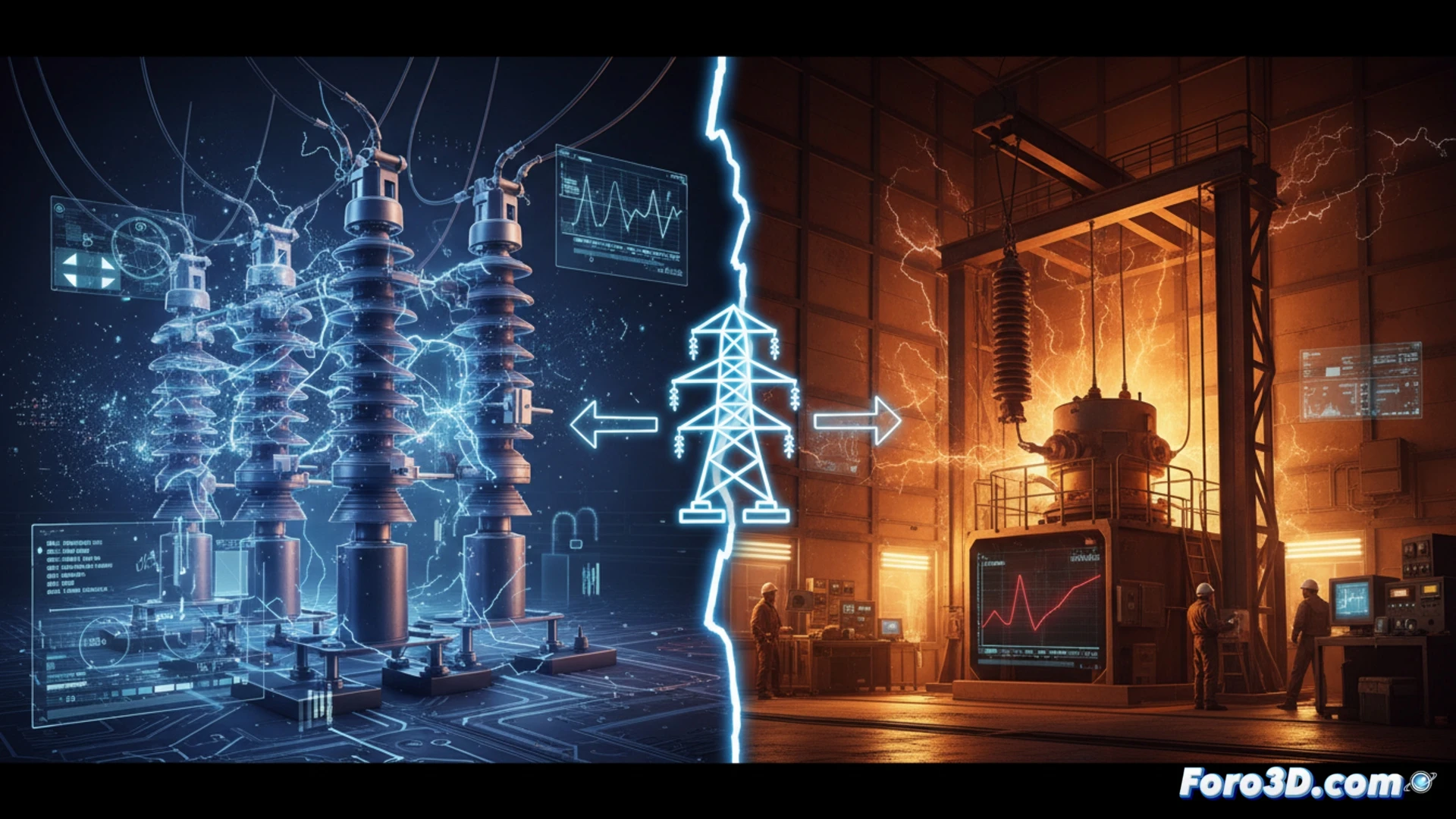
The leap from single-phase to three-phase in transmission lines ⚡
In high-voltage laboratories, space limits tests to a single phase. This creates uncertainty about the real performance of hardware under three-phase conditions, where electric fields interact differently. Numerical simulation solves this problem by modeling complete geometries and operating conditions. It translates single-phase test data into accurate three-phase performance, considering factors such as the effect of adjacent phases and the surface potential gradient. The result is a validation closer to real operation, without the need to expand test facilities.
The submarine cable that won't be measured (and simulation to the rescue) 🌊
Measuring electromagnetic fields in an HVDC cable 100 meters underwater is like looking for a lost cable in the dark: possible, but uncomfortable and expensive. Sensors rust, sea currents move equipment, and fish become uncooperative witnesses. That's why simulation has become the preferred alternative. It calculates field distribution accurately, without getting wet or having to bribe an octopus to hold the meter. In the end, the software does the work that previously required a diver and a lot of patience.