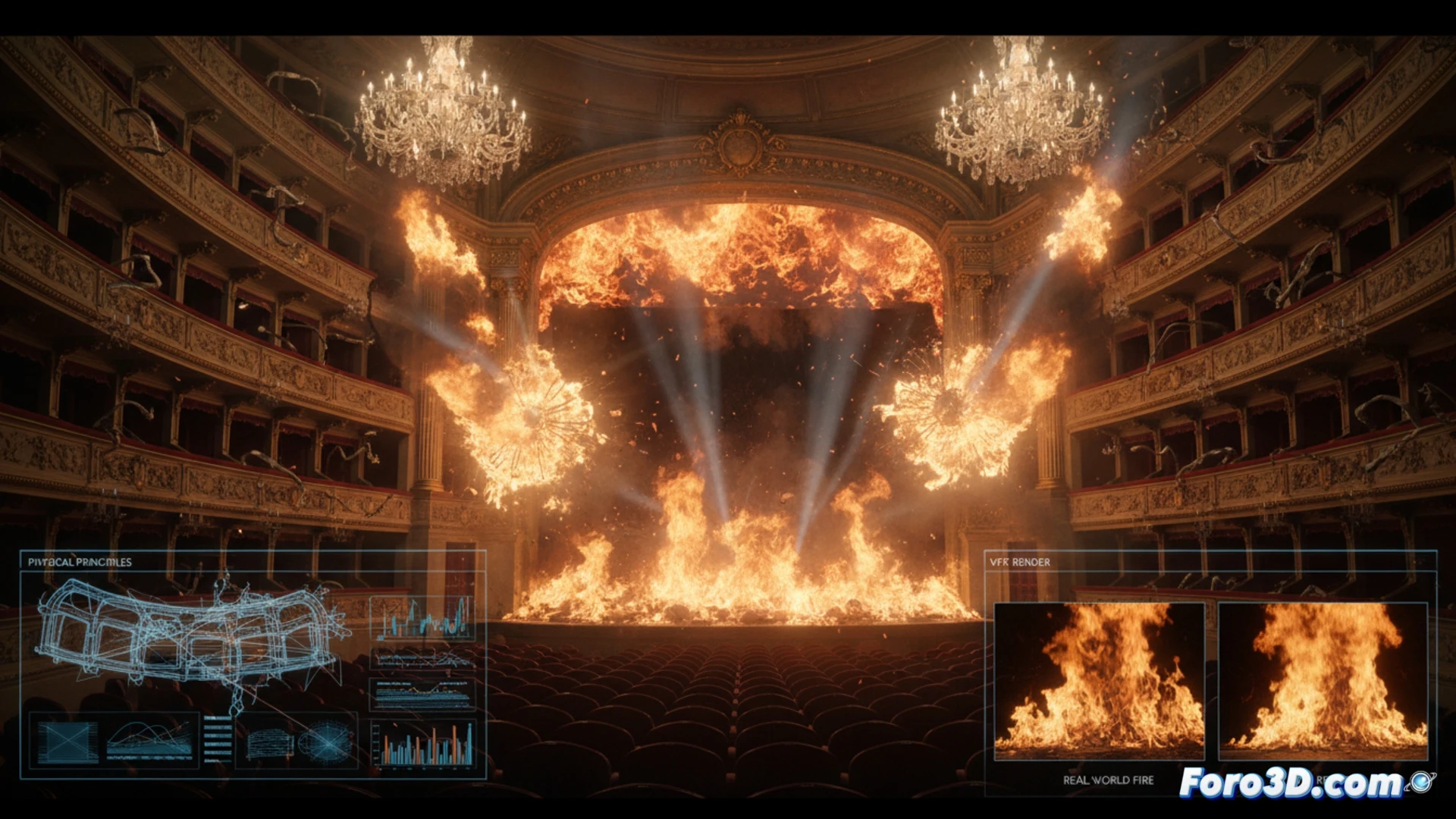
When a fire ravages an opera stage, the temperature not only melts the wax of the footlights but also tests the capacity of VFX pipelines. We are talking about a technical challenge that combines digital pyrotechnics, fluid dynamics, and structural destruction. In this article, we break down how a visual effects team would approach simulating a fire devouring a theater, from the previsualization phase to the final render, applying principles of computational physics to achieve realism that deceives the human eye.
Fluid Dynamics and Particle Systems in Houdini 🔥
To model the fire, the first step is to define the fuel. In an opera theater, the sources would be multiple: velvet curtains, stage wood, and lighting gas. In Houdini, a pyroclastic solver would be used that combines density, temperature, and fuel fields. The key lies in the simulation voxel; for a massive fire, we need a medium resolution of 1-2 cm per voxel. Smoke is treated with spectral turbulence (wavelet turbulence) to add detail without collapsing performance. In parallel, an independent particle system generates sparks and embers, with life and velocity attributes inherited from the vorticity field. Integration with the theater's 3D model requires layered collision meshes: one for the rigid structure (beams, seats) and another for combustible objects that deform or disappear, triggering procedural destruction events.
Cinematic Realism vs. Real-Time Efficiency 🎬
The big technical question is whether this spectacle of fire and smoke can be rendered in real-time for a video game or must go through offline rendering. For a game, volumetric physics are sacrificed for particle shaders with noise maps and animated billboards, achieving 60 FPS. In contrast, for a cinematic shot, simulation in Mantra or Arnold with volumetric scattering produces absolute realism, although each frame takes hours. The final decision depends on the computational budget and the desired visual impact. A fire in the opera is not just an effect; it is a character that consumes the scene.
As a VFX artist, what is the greatest technical challenge when simulating a fire that must behave realistically in an enclosed environment like an opera theater, considering factors such as smoke propagation and interaction with stage lighting?
(PS: VFX are like magic: when they work, no one asks how; when they fail, everyone sees it.)