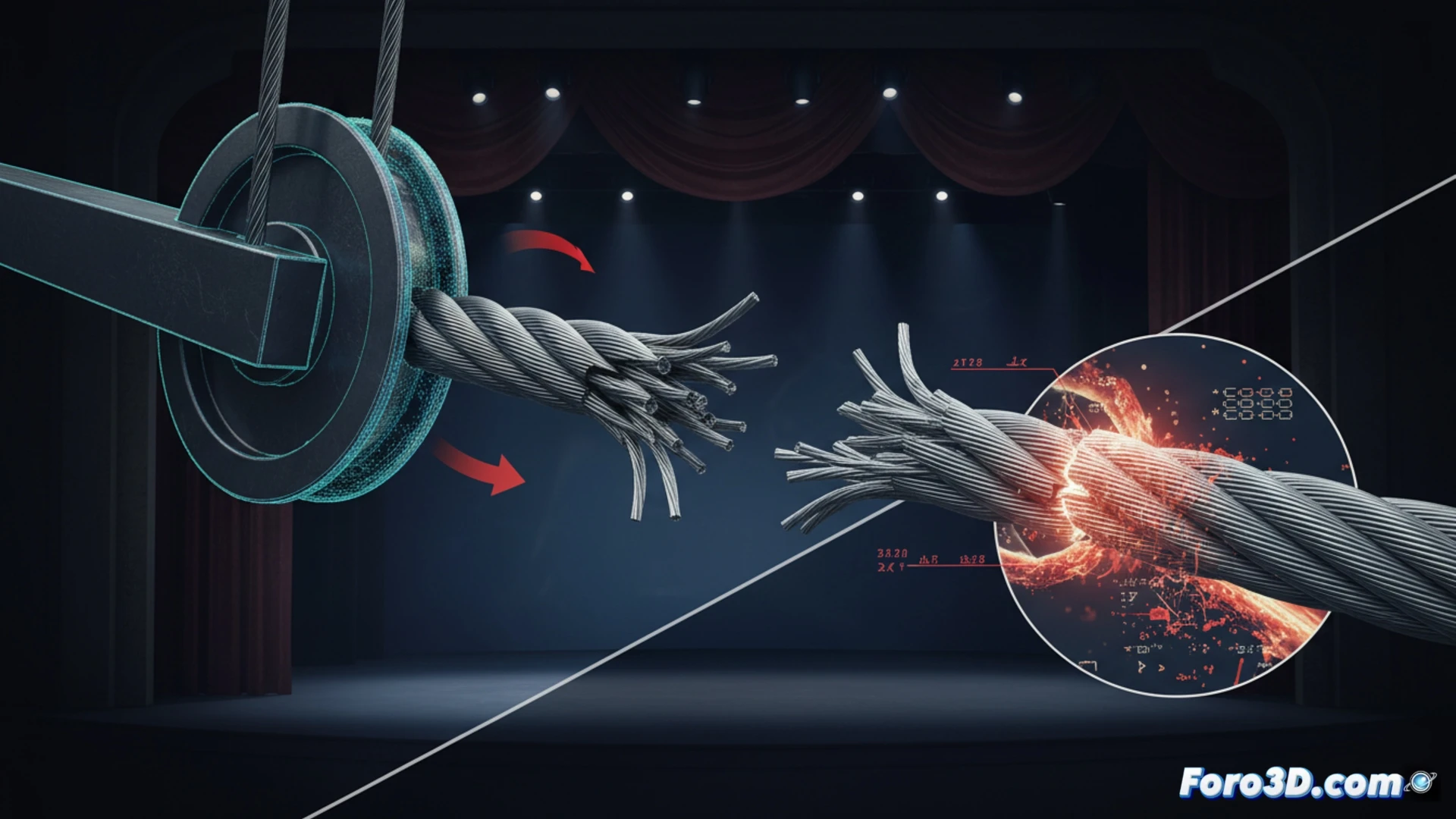
The breakage of a steel cable during a theatrical performance is not a simple accident, but an engineering problem that demands precise answers. In this case, the flight system failed when a suspended actor fell into the void. To determine whether the cause was shear due to motor misalignment or material fatigue, a workflow based on 3D scanning and mechanical simulation was applied, combining FARO Scene, GOM Inspect, and Autodesk Inventor.
3D Reconstruction and Fractography of the Failure 🎭
The process began with scanning the stage and pulley using FARO Scene, generating a point cloud that allowed recreating the exact geometry of the suspension system. Subsequently, macro-photogrammetry of the fractured cable and pulley was performed, importing the data into GOM Inspect for a detailed fractographic analysis. Here, striation marks and microcracks typical of cyclic fatigue were identified. Finally, in Autodesk Inventor, the cable's behavior under repetitive loads was simulated, applying conditions of angular misalignment and lack of lubrication, to compare the stress patterns with the actual marks.
Technical Lessons for Stage Safety 🔧
The simulation concluded that the failure was due to material fatigue accelerated by poor lubrication on the pulley, which generated micro-vibrations and stress concentration points. Misalignment, although present, was a secondary factor. To prevent these incidents, it is recommended to implement periodic inspections with 3D scanning, maintain cyclic load records, and apply specific lubricants for steel cables in theatrical flight systems. Fatigue simulation not only reconstructs the past but saves lives in the future.
Which finite element simulation methodology allows for more accurately predicting the service life of a steel cable subjected to variable cyclic loads in a stage environment like a theater.
(PS: Material fatigue is like yours after 10 hours of simulation.)