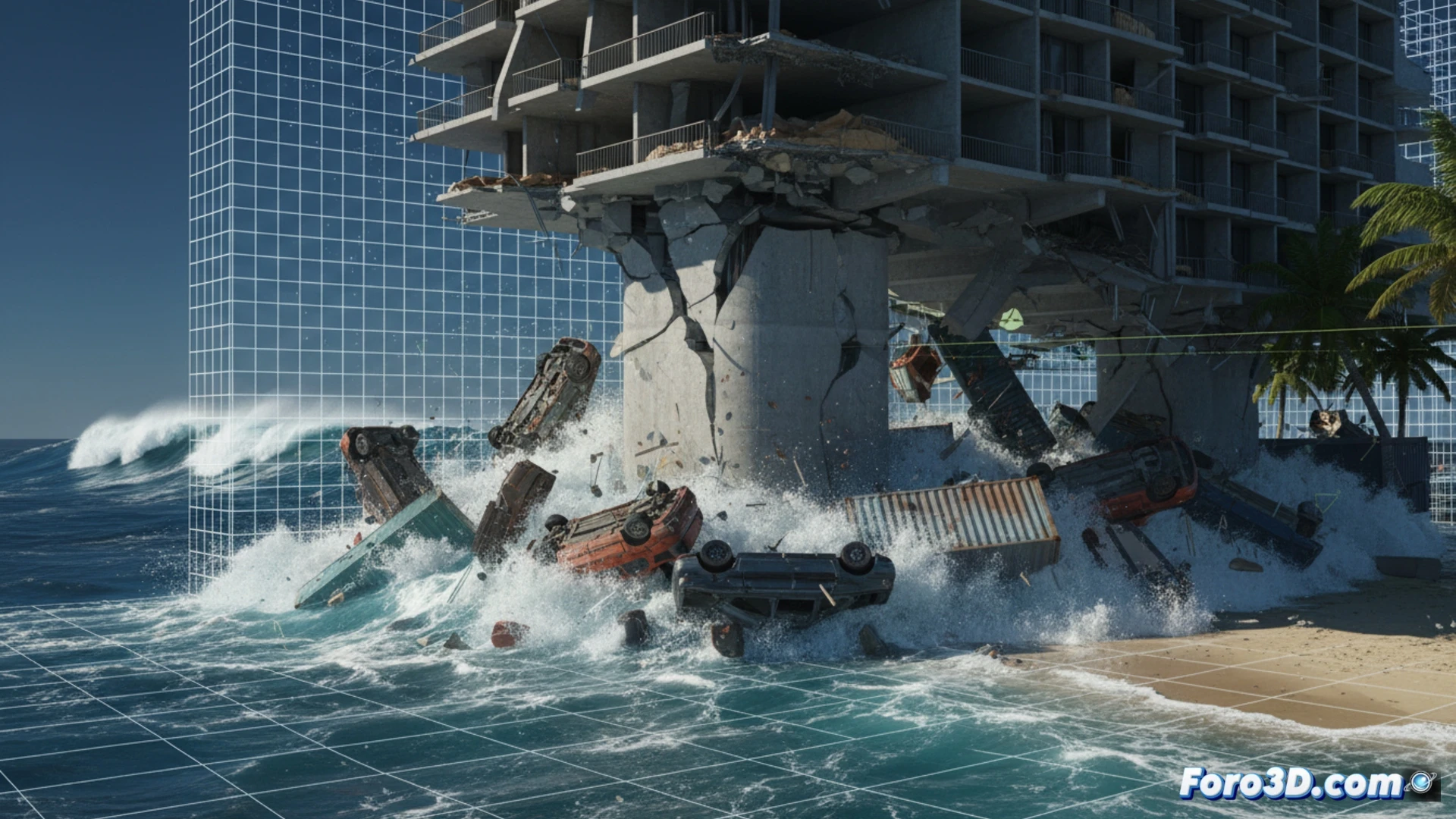
Forensic engineering has reached a new level of precision thanks to 3D simulation. After the devastating tsunami that struck a coastal hotel, researchers faced a key question: why did a specific pillar fail while others withstood the impact? The answer lay not in the wave height, but in the trajectory and mass of floating debris. Cars, containers, and street furniture, swept along by the current, acted as projectiles. Reconstructing that chaos required a multidisciplinary workflow combining hydrodynamics, structural modeling, and 3D animation.
Technical workflow: from Flow-3D to Tekla Structures 🛠️
The process began in Flow-3D, where the tsunami hydrodynamics were modeled. Wave data, current velocity, and local bathymetry were input to recreate the water's advance. Next, debris was incorporated as solid objects with variable mass and density. The software calculated their trajectories, impact velocities, and the forces exerted on the hotel structure. This model was exported to Autodesk Revit, where the building's digital twin was integrated. Finally, in Tekla Structures, the finite element analysis of the pillar in question was performed, simulating the dynamic load of the impact. Blender was used for the final visualization, allowing engineers to review the failure from any angle and in slow motion.
Forensic lessons for disaster prevention 🌊
The analysis revealed that the pillar collapsed not due to hydrostatic pressure, but from a multiple lateral impact by a container and two vehicles. The simulation showed that the pillar's position, in a corner of the lobby, created a debris funnel. This finding is crucial for future building codes in coastal areas. The integration of these tools now allows for designing perimeter barriers and reinforcing critical points based on real impact data, not estimates. The question is no longer whether a tsunami will strike, but whether our engineering is prepared for the floating debris it will bring.
How did the 3D simulation of the hotel pillar collapse allow identifying whether the structural failure was caused by a design error, by the tsunami overload, or by a combination of both factors?
(PS: Simulating disasters is fun until the computer crashes and you become the disaster.)