A team of astronomers has identified what could be the most massive pair of black holes known, with a combined mass of 60 billion suns. These objects are hidden in a dark region 3,200 light-years in diameter in the galaxy Abell 402-BCG, 4.4 billion light-years away. What in 2018 appeared to be a dust cloud, 2025 observations with the James Webb and the VLT confirm is a stellar void, likely caused by two ultramassive black holes spiraling together. 🕳️
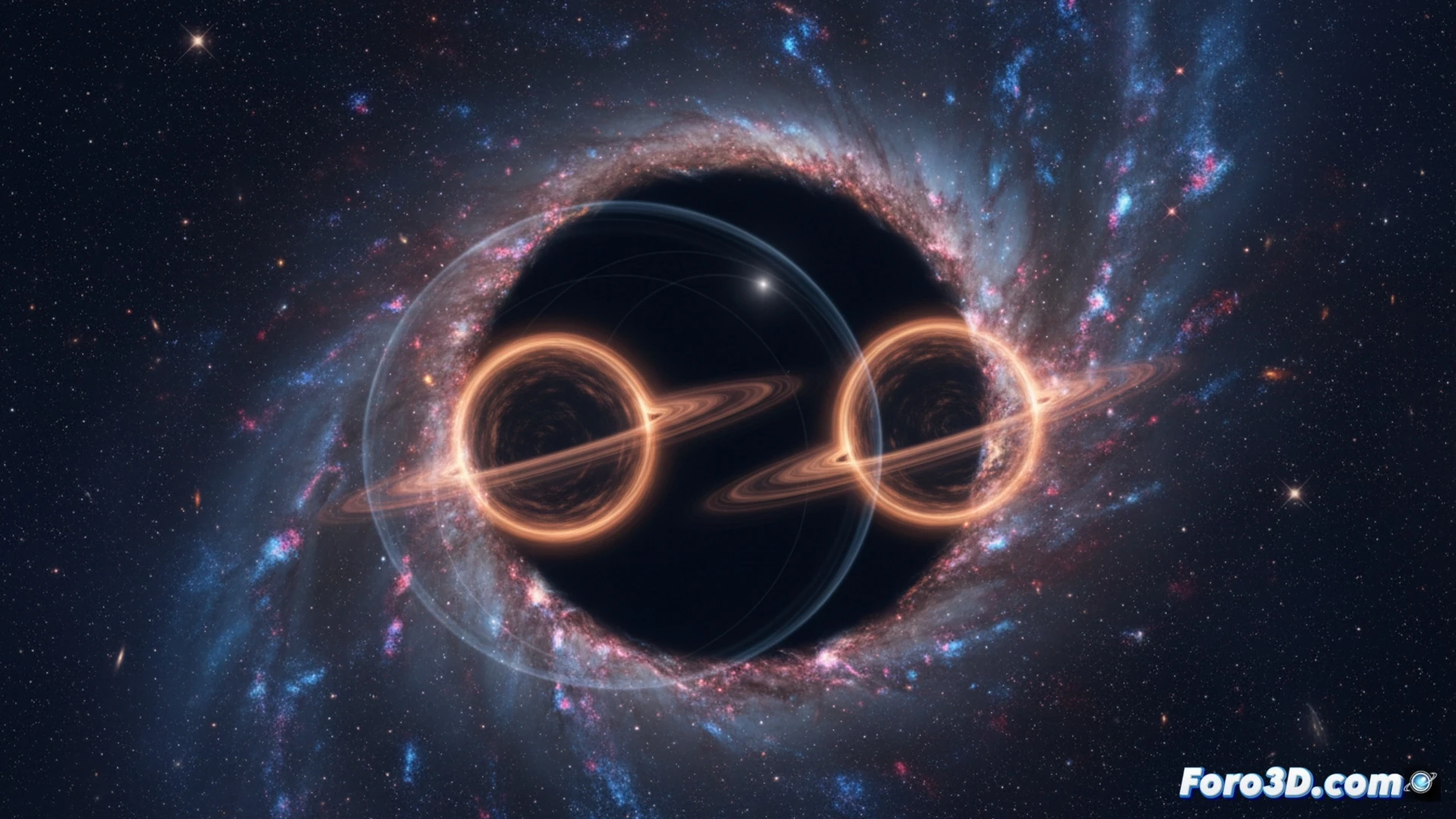
Scientific visualization pipeline for orbital dynamics and stellar ejection 🚀
To represent this phenomenon in 3D, it is necessary to build an N-body gravitational simulation model. The first step is to generate two mass points with a 1:1 ratio, each with 30 billion solar masses, orbiting in a common plane. The interaction region must scale to 3,200 light-years, using a Cartesian coordinate system where the center of mass is the origin. The void is explained by stellar ejection: as the black holes approach, nearby stars are ejected at hyperbolic speeds, creating a halo of trajectories moving away from the center. It is recommended to use test particles (stars) with a uniform initial distribution within the radius of influence, and apply a leapfrog integrator to maintain orbital precision. The camera should orbit the system to show the black holes' spiral, while the trails of ejected stars are rendered in cool colors to contrast with the central void.
Scaling the immeasurable: from the Solar System to 60 billion suns 🌌
The main technical difficulty is communicating the scale. The 3,200 light-year void is 20,000 times the diameter of the Solar System. An effective strategy is to include a comparison module: at the start of the simulation, show the solar system as a reference point, and then zoom out until the black holes occupy the center of the scene. The combined mass of 60 billion suns is difficult to visualize, but it can be represented by a density gradient in each black hole's sphere of influence, where the brightness of the accretion disk is directly proportional to the mass. This allows the viewer to perceive the magnitude of the discovery without needing abstract figures.
How can the gravitational interaction between the two supermassive black holes of Abell 402-BCG be modeled to visualize the distortion of spacetime in the surrounding stellar void?
(PS: modeling manta rays is easy, the hard part is making them not look like floating plastic bags)