The recent structural failure of an autonomous electric tractor has brought a critical problem in heavy vehicle design to the forefront: unforeseen torsion generated by the massive distribution of batteries. At first glance, the chassis seemed oversized, but forensic analysis revealed that the accumulated torque exceeded the material's fatigue limits in joint areas. This case demonstrates that, without advanced dynamic simulation, engineers can overlook the interaction between concentrated mass and the terrain's vibratory loads.
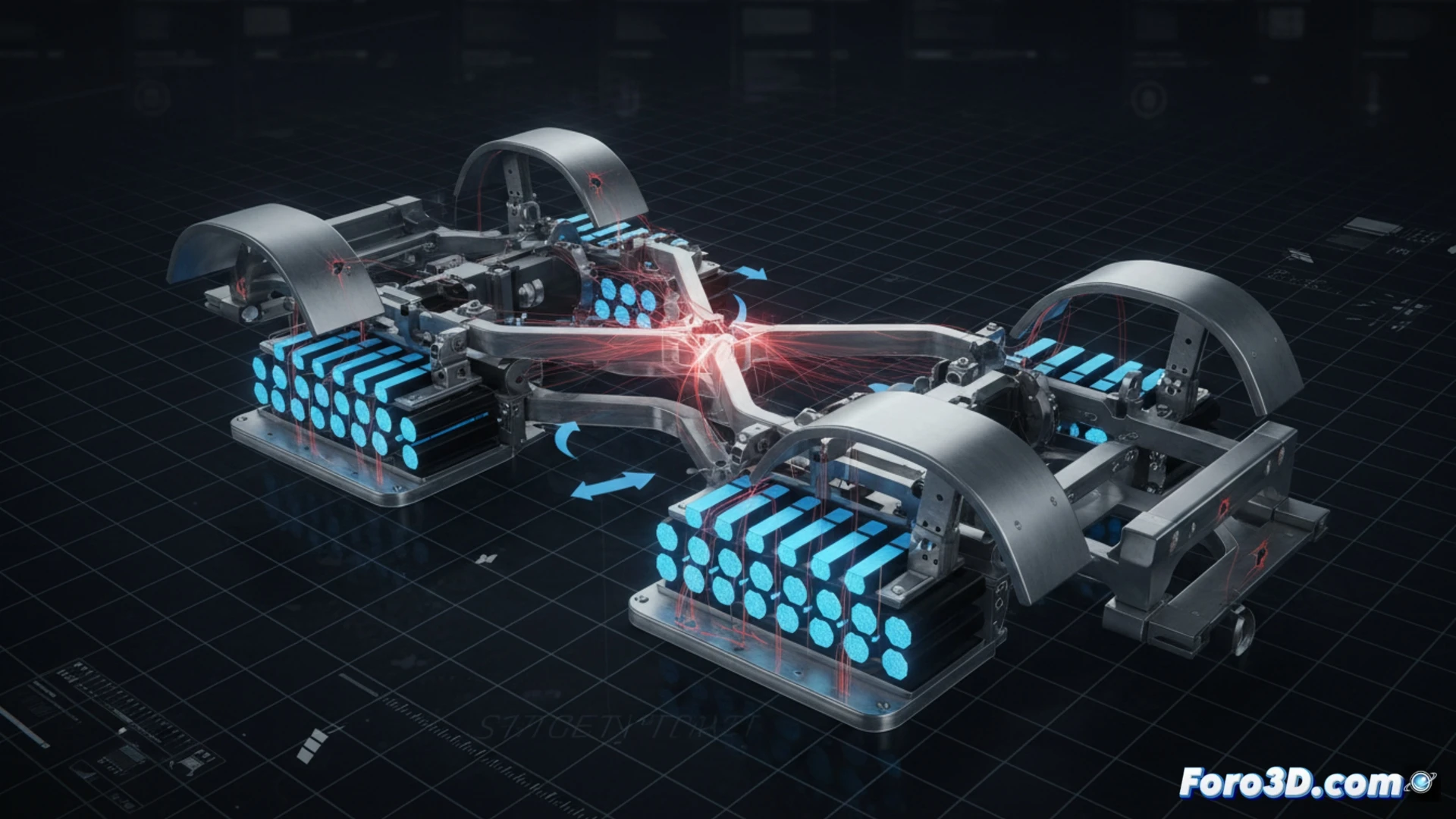
Stress modeling and critical point detection with Inventor and SAP2000 🔧
To predict this type of failure, the workflow begins in Autodesk Inventor, where the chassis is modeled with an exact representation of the battery modules as suspended point masses. The file is exported to SAP2000 for a finite element analysis (FEM) that considers both torsional stiffness and the natural frequencies of the assembly. The results show that the battery anchor points act as stress concentrators under cyclic torsional loads. Using Trimble RealWorks, the failed parts are scanned to validate the digital model, allowing adjustments to the thickness of the side rails and redistribution of the cell packs to reduce the torsional lever arm.
Lessons for modular chassis design 🚜
The main lesson is that fatigue does not forgive balance errors. In electric vehicles, the battery is not just a power source, but a mass that modifies the center of gravity and generates unforeseen torsion vectors during acceleration and braking. 3D simulation allows engineers to iterate over hundreds of anchor configurations before building a prototype, saving costs and preventing catastrophic failures in the field. The failed autonomous tractor is a reminder that simulation software must be integrated from the conceptual phase, not just as a final verification.
How can hidden torsional fatigue in electric vehicle chassis be detected and numerically modeled when dynamic loads are not transmitted directly to the main torsion axis?
(PS: Material fatigue is like yours after 10 hours of simulation.)