Shelf clouds are intimidating atmospheric formations that announce the arrival of severe storms. Their characteristic horizontal wedge shape and descending frontal motion make them a fascinating technical challenge for VFX artists. In this article, we will break down the process of recreating this meteorological phenomenon using Houdini's Pyro simulation, optimizing parameters to capture the essence of the gust front, and subsequently integrating the result into Unreal Engine 5 for real-time visualization.
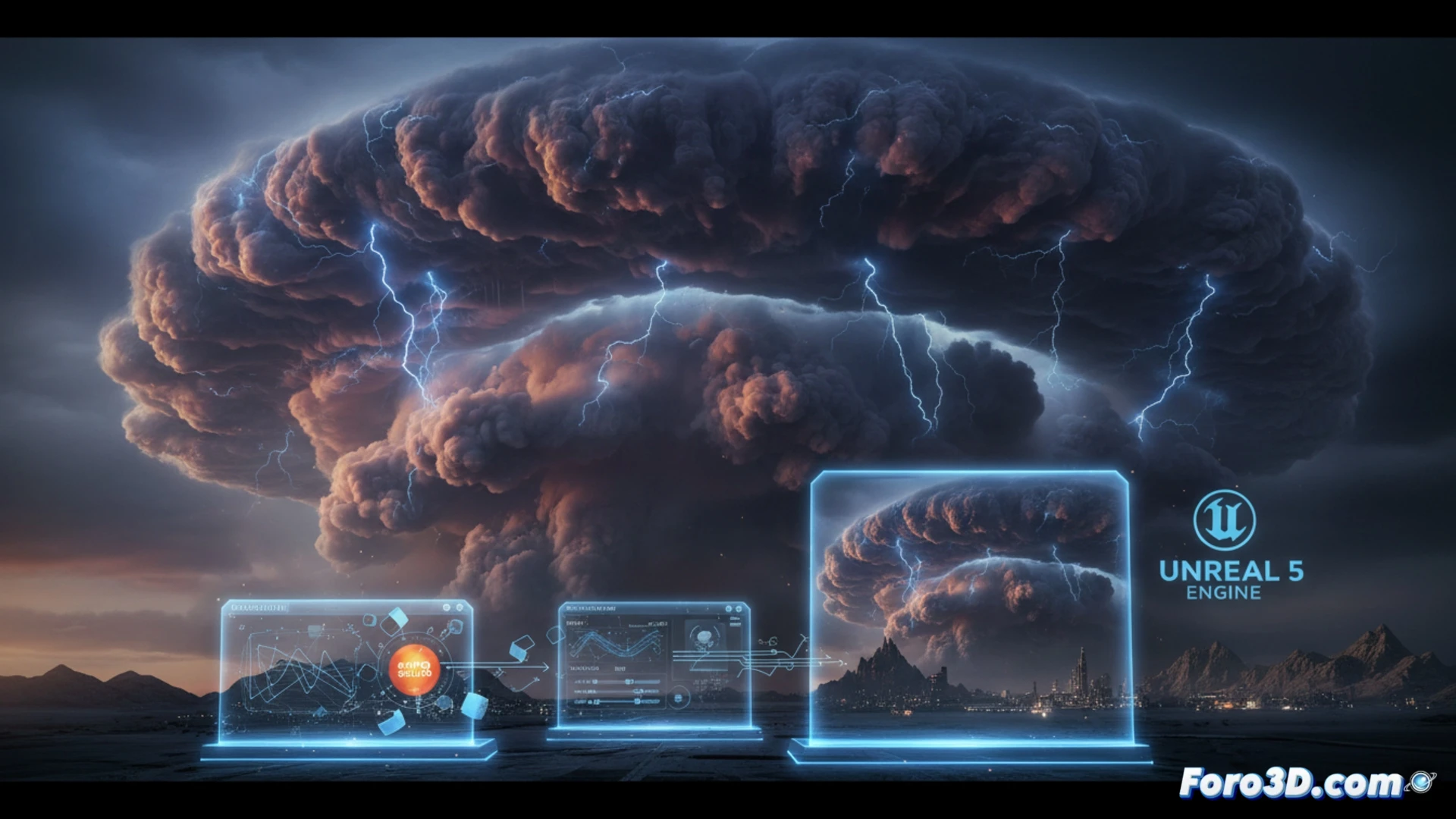
Gust front simulation with Pyro and WRF validation 🌩️
To emulate the dynamics of a shelf cloud, the secret lies in controlling the initial velocity field. In Houdini, we must create a vector field that pushes the smoke volume forward and downward, mimicking the downdraft that hits the ground. We will set up a Pyro solver with a density source shaped like an elongated arc. The key parameters are: Disturbance (for the turbulent texture of the lower edge) and Cooling Rate (to simulate the evaporation that generates the cold front). To validate the wedge shape, we can compare our simulation with cross-sectional data from a WRF (Weather Research and Forecasting) model, adjusting wind intensity and vorticity so that the cloud profile matches real observations of supercell storms.
From the volumetric cloud to the realistic world 🎮
Once the simulation is baked in Houdini as a VDB, the next step is integration into Unreal Engine 5. We will use UE5's Volumetric Cloud system, importing the density field as a 3D texture. The key to maintaining realism is translating the simulation's temperature and velocity data into lighting and animation parameters within the engine. By synchronizing the cloud with a dynamic lighting system that simulates the darkening before a storm, we make the viewer feel the imminence of the phenomenon, closing the loop between meteorological science and digital art.
What is the best strategy to maintain the characteristic shape of a shelf cloud in Houdini Pyro when exporting it to Unreal Engine 5 without losing detail or real-time performance?
(PS: VFX are like magic: when they work, no one asks how; when they fail, everyone sees it.)