A renowned audio brand launched premium headphones with single-layer graphene diaphragms that began to fail massively after weeks of use. The failure was not random: it occurred when playing content with ultra-low frequencies, between 10 and 30 Hz. The 3D forensic analysis team was hired to determine if the acoustic pressure generated a structural resonance that exceeded the material's elastic limit, causing catastrophic membrane rupture.
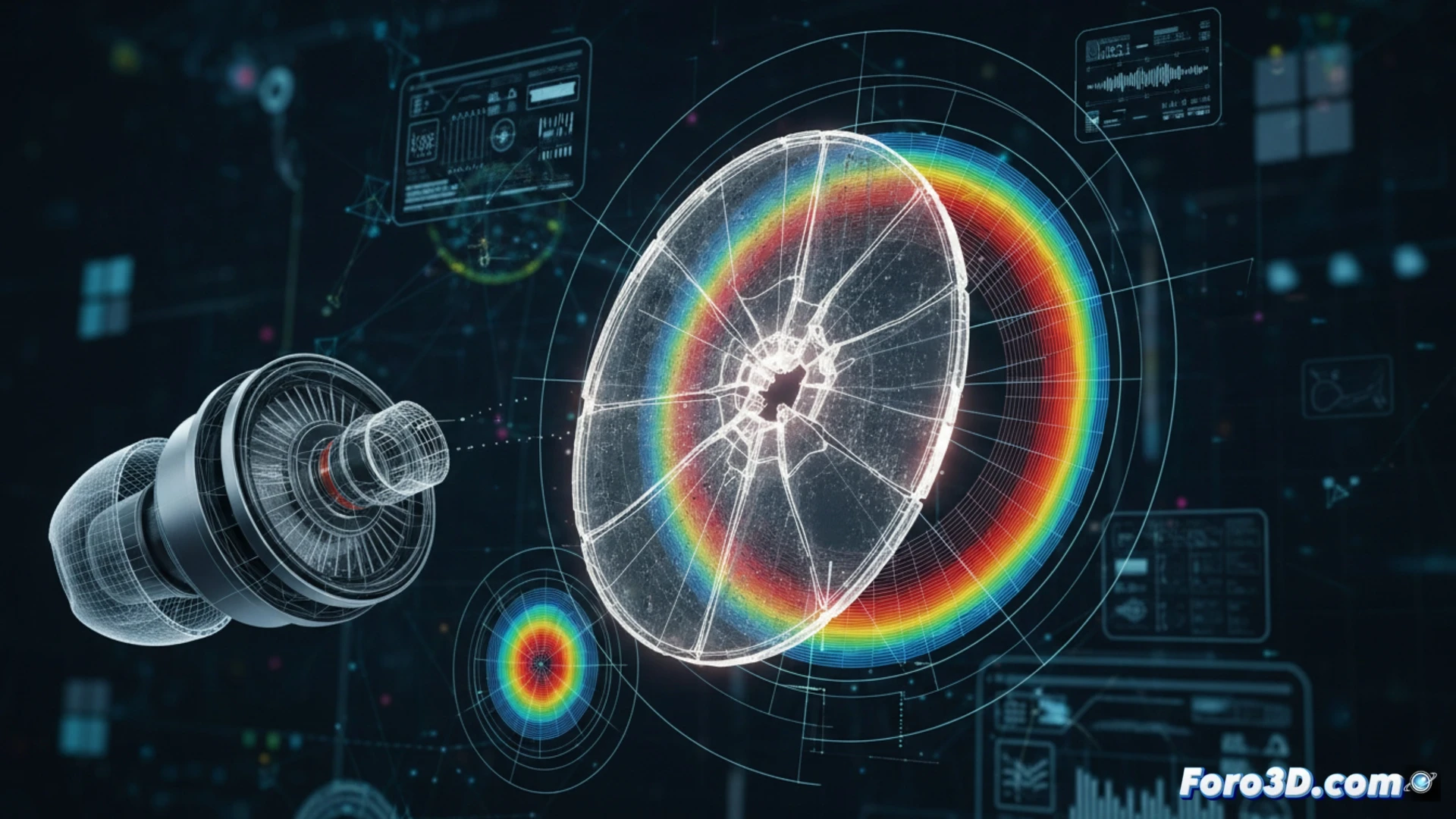
Acoustic modeling and fatigue simulation in COMSOL Multiphysics 🎧
An axisymmetric model of the membrane was built in COMSOL Acoustics, defining graphene as an orthotropic material with a Young's modulus of 1 TPa and a thickness of 0.335 nm. A variable harmonic pressure load of 90 to 120 dB SPL was applied in the 5 to 50 Hz range. Modal analysis revealed a resonance peak at 22 Hz, where the vibration amplitude reached 14 micrometers, exceeding the elastic strain limit of 0.2%. High-cycle fatigue simulation showed that after approximately 1500 cycles at that frequency, the localized stress at the fixed edge exceeded 130 GPa, initiating a crack that propagated radially in less than 0.3 seconds.
Forensic visualization and failure point validation 🔍
The displacement field data was exported to VGSTUDIO MAX for a volumetric deformation analysis, confirming that the maximum stress zone coincided with the rupture points observed in the actual headphones. In Blender, the resonant vibration modes were animated, overlaying color maps with the Von Mises scale. The final result was a video showing how the membrane progressively deforms until it cracks at the edge, demonstrating that the failure was not due to a manufacturing defect, but rather an acoustic design that ignored resonance in the infrasound range.
As an engineer analyzing failures in single-layer graphene membranes, what is the most effective protocol to replicate in COMSOL the resonance conditions that caused the fatigue, and how are the deformation data integrated into Blender to generate a forensic animation that evidences the exact point of rupture?
(PS: Material fatigue is like yours after 10 hours of simulation.)