A research CubeSat became completely inoperable after failing to deploy its solar panels. The 3D pipeline, integrating Siemens NX, Maya, and Ansys, analyzed the onboard camera video alongside the manufacturing blueprints. The conclusion was clear: a microscopic burr on the 3D-printed hinge blocked the torsion spring, preventing the panel from opening and dooming the mission due to lack of power.
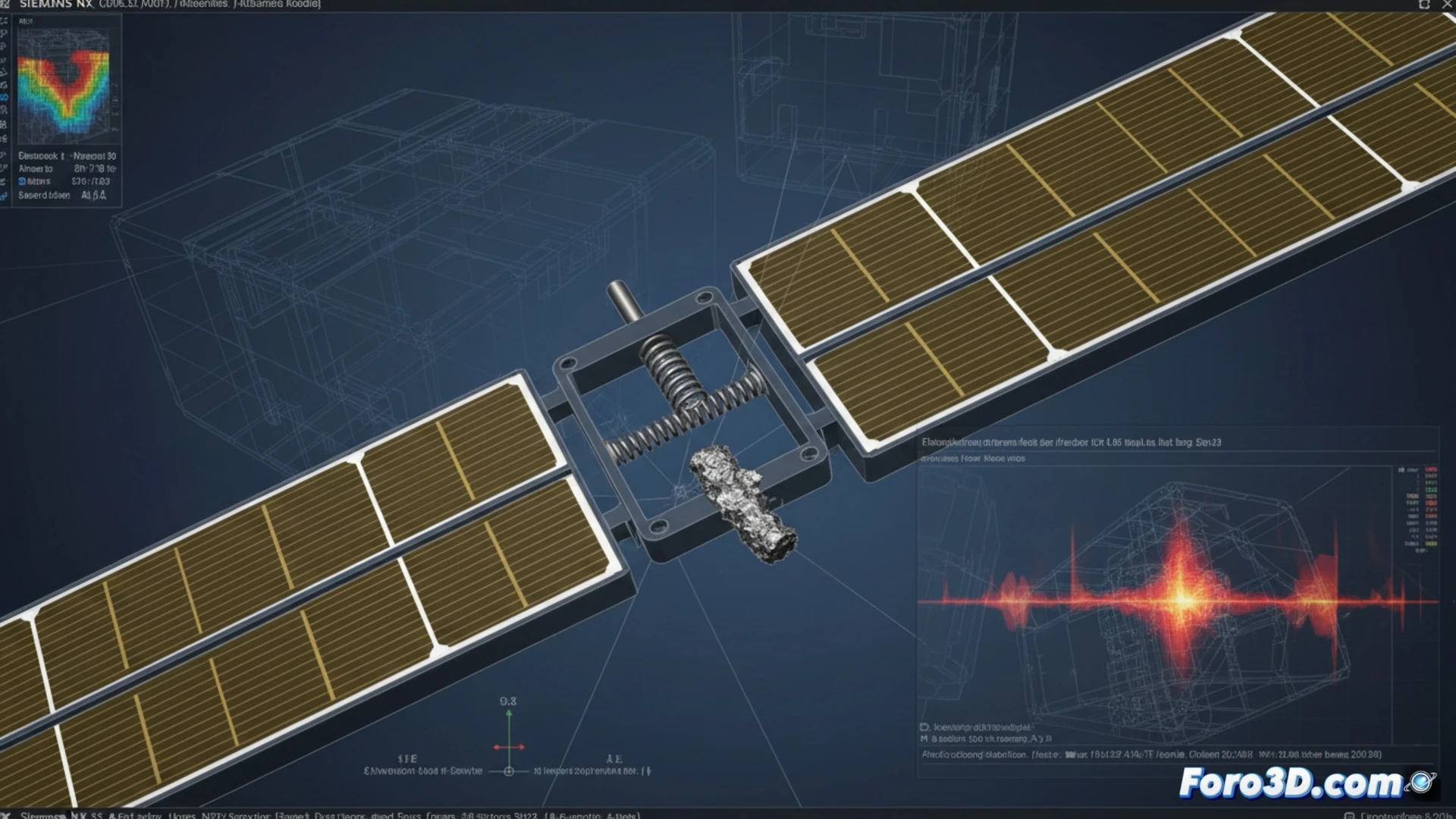
Digital reconstruction and fatigue simulation in Ansys 🛰️
The engineering team used Siemens NX to model the exact geometry of the hinge from the manufacturing blueprints. With Maya, a technical animation was generated that synchronized the panel's movement with the actual video footage, allowing the identification of the exact point where the spring lost tension. The critical step came with Ansys, where a material fatigue simulation was performed. The finite element analysis revealed that the burr, a common defect in 3D printing due to material accumulation on the final layer, acted as a physical stop that increased friction until it blocked the torsion spring. The simulation confirmed that, even with a manufacturing tolerance of 0.1 mm, the original design did not account for the possibility of post-processing residue, creating a premature fatigue failure point in the first cycle of use.
Lessons for space mission design 🔧
This failure underscores the importance of integrating fatigue simulation into the 3D pipeline from the initial design phases. An analysis in Ansys would have predicted the blockage by modeling the spring's behavior under load with manufacturing imperfections. For future missions, it is proposed to redesign the hinge with an internal chamfer that eliminates the possibility of burrs and add a solid lubricant coating. The lesson is clear: in space, a microscopic defect can be catastrophic, and digital simulation is the only tool to prevent it.
Since the burr on the hinge prevented the panel deployment, which fatigue parameters in the 3D hinge material should have been simulated in Siemens to predict that failure before printing?
(PS: Material fatigue is like yours after 10 hours of simulation.)