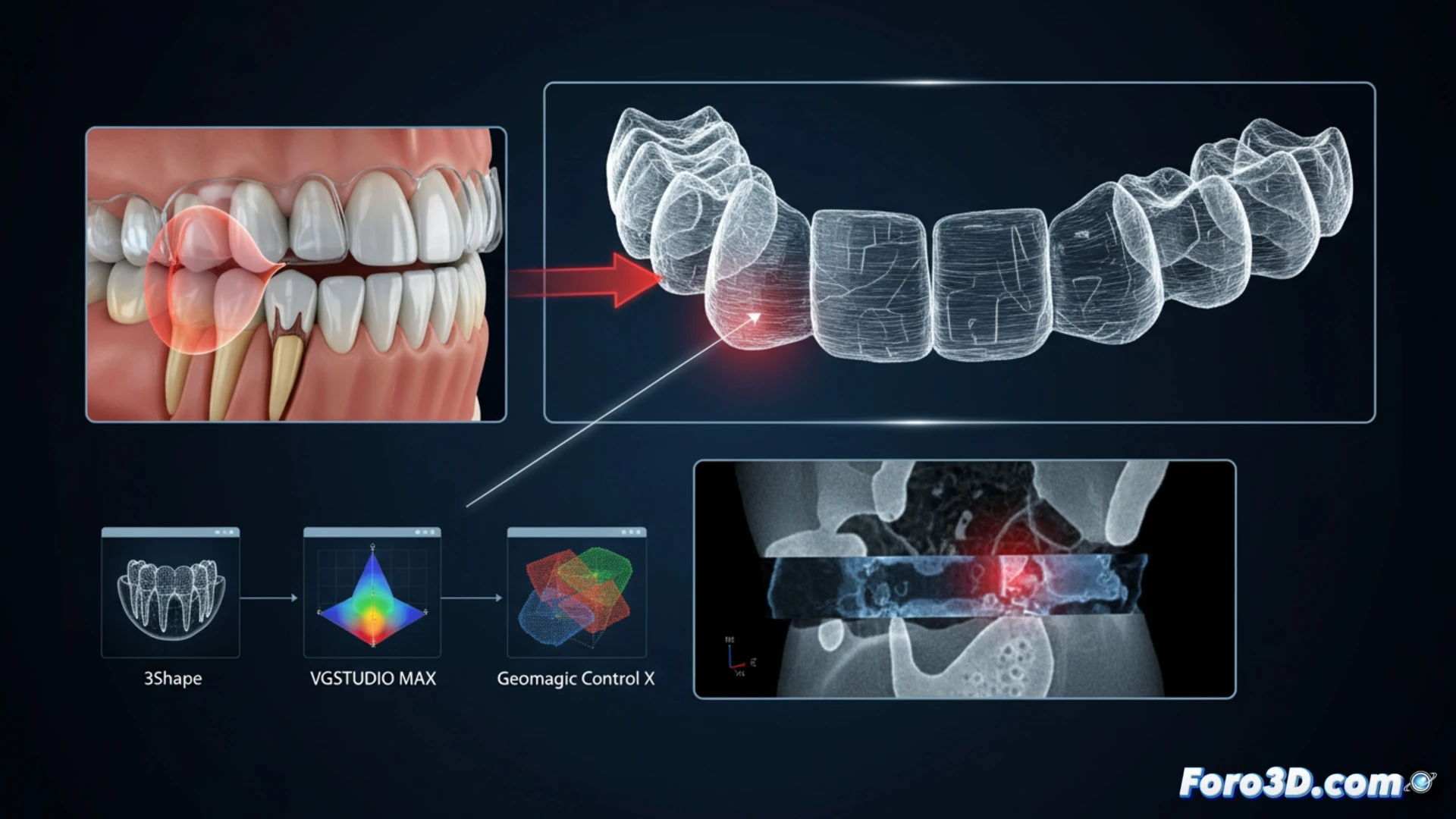
A patient treated with clear aligners developed severe root resorption in a lateral incisor. To clarify the cause, the aligner was digitized using Micro-CT and an intraoral scan of the dental arch was obtained. The 3D pipeline, executed in 3Shape, VGSTUDIO MAX, and Geomagic Control X, revealed torsional forces not anticipated in the aligner design, exceeding the biological limit of the periodontal ligament. This case demonstrates that apparent biomechanics does not always match vectorial reality. 🔬
Forensic pipeline: from voxelization to stress map 🦷
The workflow began with the patient's intraoral scan to capture the post-treatment root morphology. In parallel, the used aligner underwent a Micro-CT with 10-micron resolution. Both datasets were imported into VGSTUDIO MAX to align the geometries and perform a deviation analysis. The overlay revealed anomalous contact points on the palatal surface of the incisor. Using Geomagic Control X, a color map was generated showing an eccentric compression zone and a torsional vector not anticipated in the original 3Shape design. The retrospective simulation evidenced that the aligner applied a pure rotational moment on the root, violating the physiological range of the periodontal ligament.
The biomechanical lesson: simulation is not optional, it is ethical ⚖️
This case underscores an uncomfortable truth for clear aligner orthodontics: the aesthetics of the aligner do not guarantee the safety of its mechanics. The absence of prior finite element analysis allowed an imperceptible torsion, invisible to the human eye, to cause irreversible damage. Integrating tools like VGSTUDIO MAX and Geomagic Control X into the design phase is not just a matter of precision, but of clinical responsibility. The periodontal ligament does not forgive invisible vectors.
Would you print this model in resin or filament?