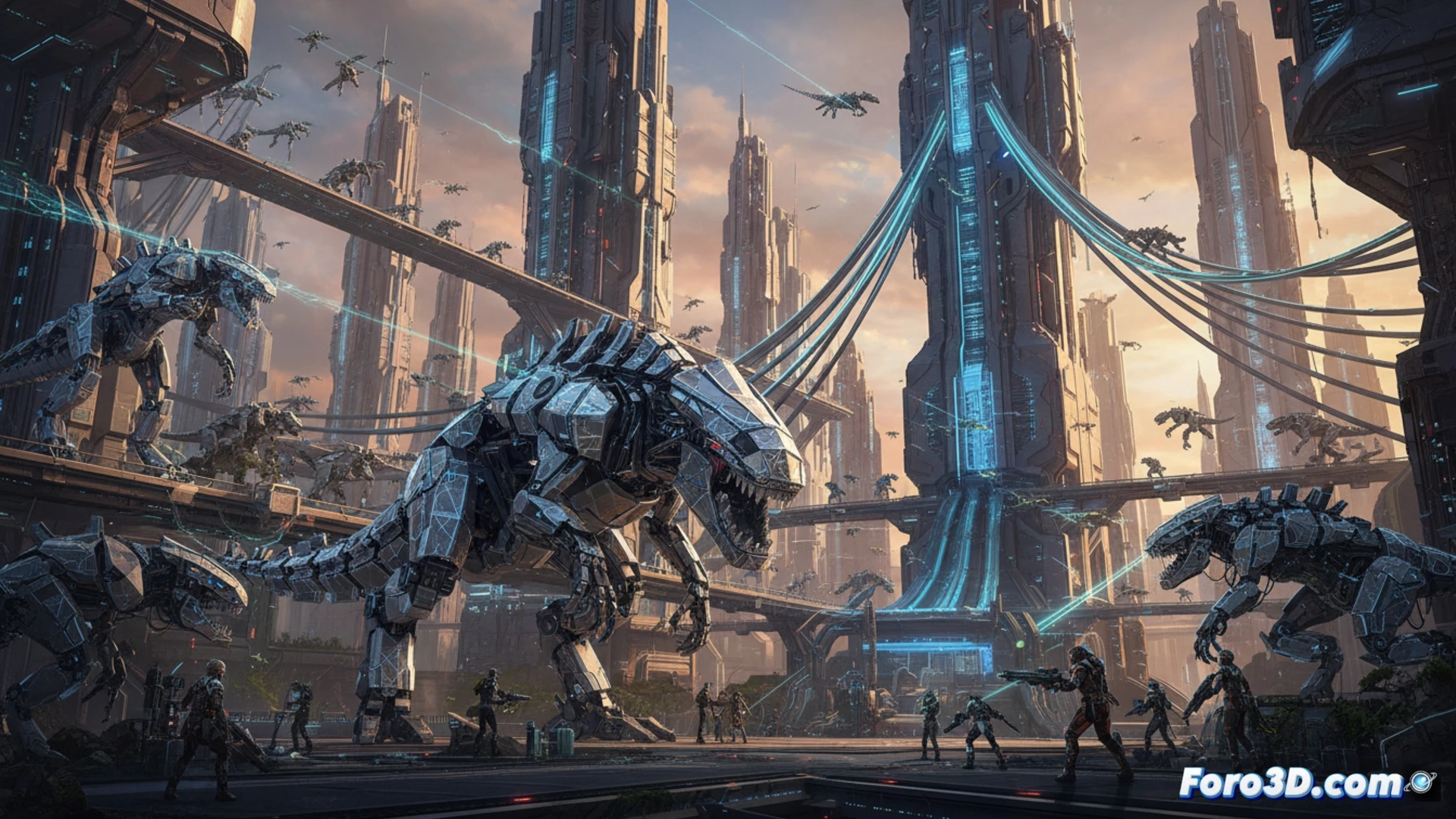
NCSOFT has taken a step forward in the MMORPG industry by announcing Project: Skyline, a title set in Sony's Horizon universe that uses Unreal Engine 5 as its base engine. The main technical appeal lies in recreating the iconic robotic machines with a level of geometric detail never seen in a massively multiplayer game. Thanks to Nanite, Epic Games' virtualized geometry technology, developers can import high-polygon models directly from modeling tools without needing to create normal maps or traditional LODs.
Workflow with shared tools from Guerrilla Games 🛠️
The technical integration process between NCSOFT and Guerrilla Games is a case study in cross-studio collaboration. It has been revealed that the Korean team is using Sony Interactive Entertainment's internal tools, originally designed for Horizon Forbidden West, for creating the skeletons and animation systems of the machines. In Unreal Engine 5, this data is processed through the Nanite pipeline, which converts high-resolution geometry into clusters of virtual meshes. The main challenge is not just visual fidelity, but memory management in a persistent open world. To address this, a dynamic streaming system has been implemented that prioritizes loading Nanite meshes based on the player's distance and the density of creatures on screen, avoiding performance drops in massive battles.
The impact of unlimited geometry in an open-world MMO ⚙️
The decision to use Nanite in an MMORPG implies completely rethinking traditional optimization. Unlike linear shooters, an MMO must maintain stable 60 FPS with dozens of players and machines simultaneously. Project: Skyline demonstrates that this is possible if virtualized geometry is combined with advanced culling techniques and deferred shading. The visual result is striking: every gear, cable, and armor plate of the creatures is rendered with microscopic precision, eliminating the texture popping that often plagues open worlds. This technical approach sets a precedent for future multiplayer titles seeking cinematic quality without sacrificing online gameplay.
How does Project Skyline manage to integrate Nanite technology from Unreal Engine 5 to scale the representation of Horizon's machines in an MMORPG environment, where object density and render distance pose a massive performance challenge compared to a single-player game?
(PS: a game developer is someone who spends 1000 hours making a game that people complete in 2)