Nexon Games has lifted the veil on Project: DX, an ambitious open-world title that fully exploits the capabilities of Unreal Engine 5. Based on the Durango IP, the project seeks to break the barrier between cinema and video games by recreating dinosaurs and jungle environments with a photorealistic level of detail. The studio has confirmed that the production pipeline relies on 3ds Max for high-polygon modeling and on Unreal Engine for simulating animal AI and interactive vegetation, marking a milestone in the real-time representation of prehistoric fauna.
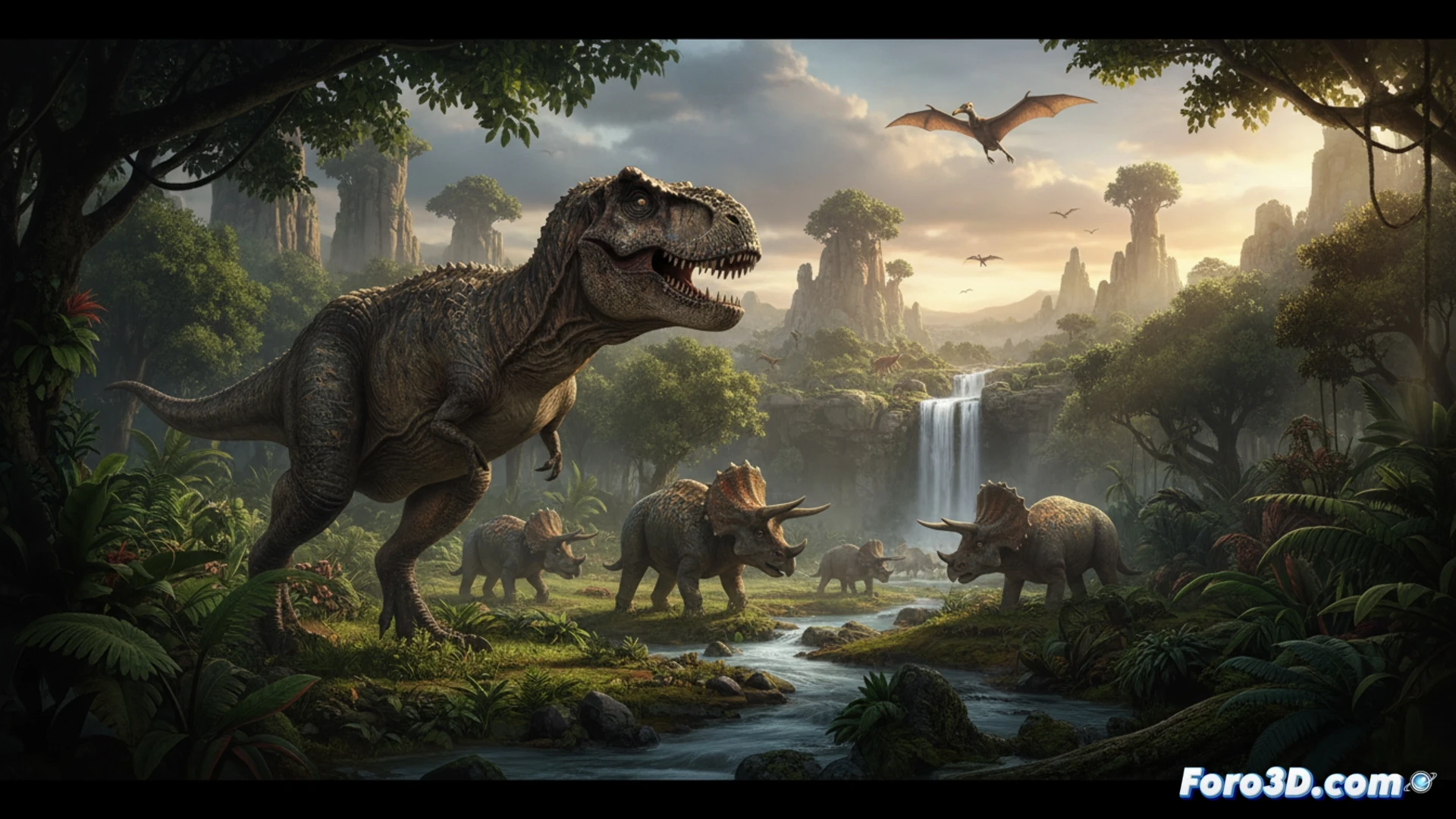
Technical Pipeline: Modeling in 3ds Max and Simulation in UE5 🦖
The asset creation process in Project: DX begins in 3ds Max, where artists build dinosaur meshes with extreme geometric resolution, using displacement maps and 8K textures to capture the texture of skin and scales. Subsequently, these models are imported into Unreal Engine 5, where the Nanite system is applied to manage geometry without performance loss. The true innovation lies in the animal AI simulation: the dinosaurs are not simple NPCs with predetermined paths. Nexon has implemented a behavior system based on machine learning that allows creatures to react to environmental stimuli, such as vegetation movement or climate changes. The vegetation, for its part, uses UE5's procedural system to be interactive, physically deforming as dinosaurs pass through. To optimize real-time performance, dynamic Lumen has been used for global illumination and occlusion culling techniques, ensuring that the dense jungle does not saturate the GPU even with full herds of creatures.
Lessons for Open World Development 🌿
Project: DX impresses not only with its photorealism but also with the technical intelligence behind its ecosystem. Compared to titles like ARK: Survival Evolved or The Isle, Nexon solves the problem of procedural emptiness: here, every bush and every dinosaur has a purpose within the simulated ecosystem. For developers, the key lesson is the vertical integration between 3ds Max and UE5, using Nanite to maintain the fidelity of the original modeling without compromising frames per second. If they manage to maintain this fluidity on current-generation consoles, Project: DX could redefine the standard for survival games with realistic fauna.
Considering the need to balance the photorealism of the dinosaurs with performance in open-world scenarios, what key technical compromises in the Unreal Engine 5 pipeline, such as the use of Nanite, Lumen, and polygon density, did Nexon Games have to make to ensure a smooth playable experience in Project: DX?
(PS: game jams are like weddings: everyone is happy, no one sleeps, and you end up crying)