A team of scientists has detected dust disks around supermassive black holes in distant galaxies. These rings, similar to those that form planets in solar systems, could contain enough material to create millions of rocky worlds, some even the size of stars. The finding suggests the cosmos is more fertile than we imagined.
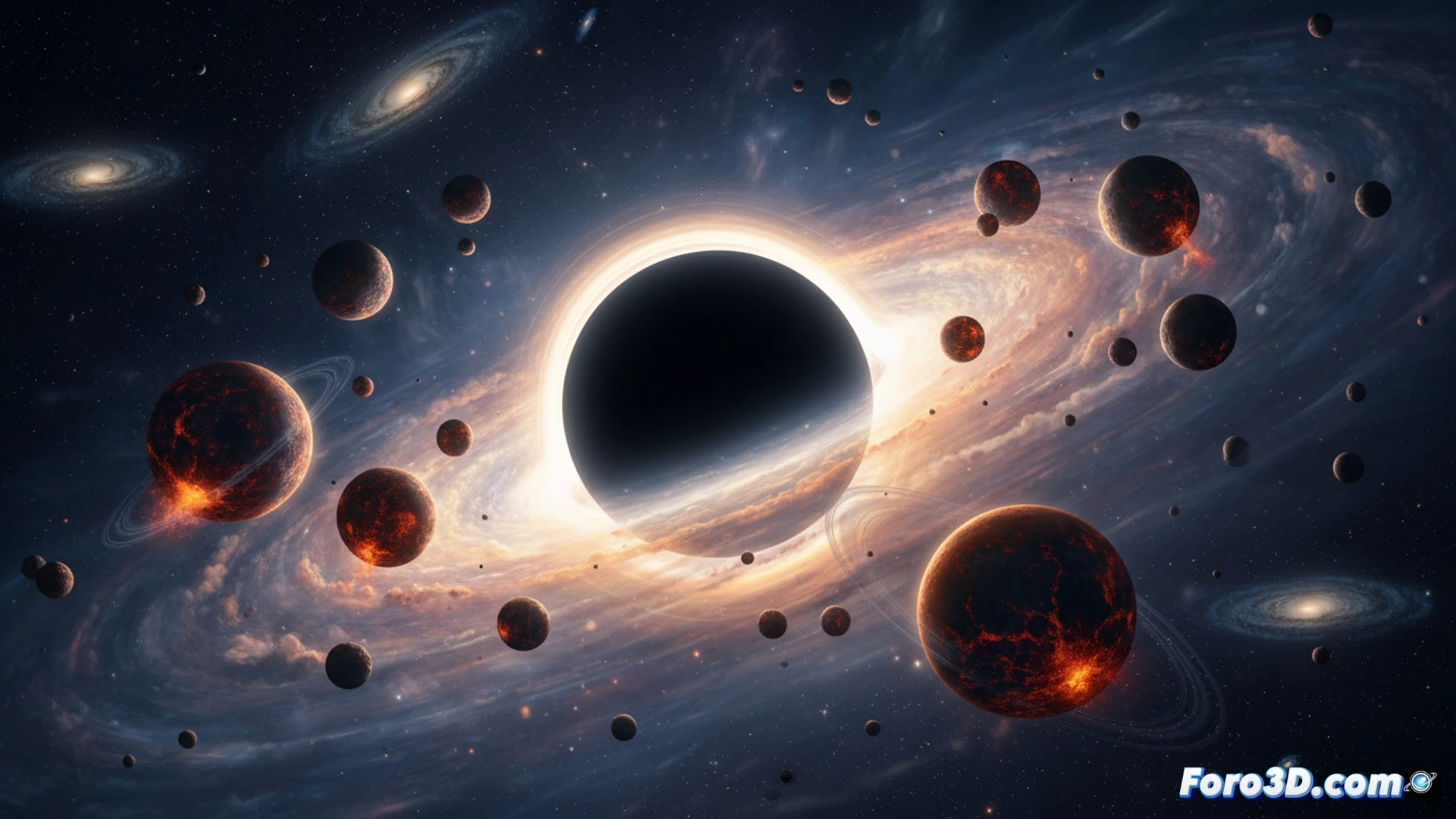
The Cosmic Forge: How Dust Becomes Worlds 🌌
The detected disks contain silicates and carbon, base materials for rocky planets. The black hole's gravity compresses the dust, forming clumps that can collapse into solid bodies. Unlike stellar protoplanetary disks, these environments are extreme: radiation and tidal forces are intense. Even so, models indicate the accretion process is viable, giving rise to massive worlds in chaotic orbits.
All Things Considered, Better Not Order a Pizza for Delivery 🍕
That a black hole can manufacture planets sounds great, but it's worth reading the fine print. If you move into one, forget about sunlight: gamma radiation doesn't tan, it disintegrates. And the neighborhood is noisy: plasma jets and gravitational tides. That said, the view of the event horizon promises to be spectacular. That is, until the landlord (the black hole) decides to collect the rent.