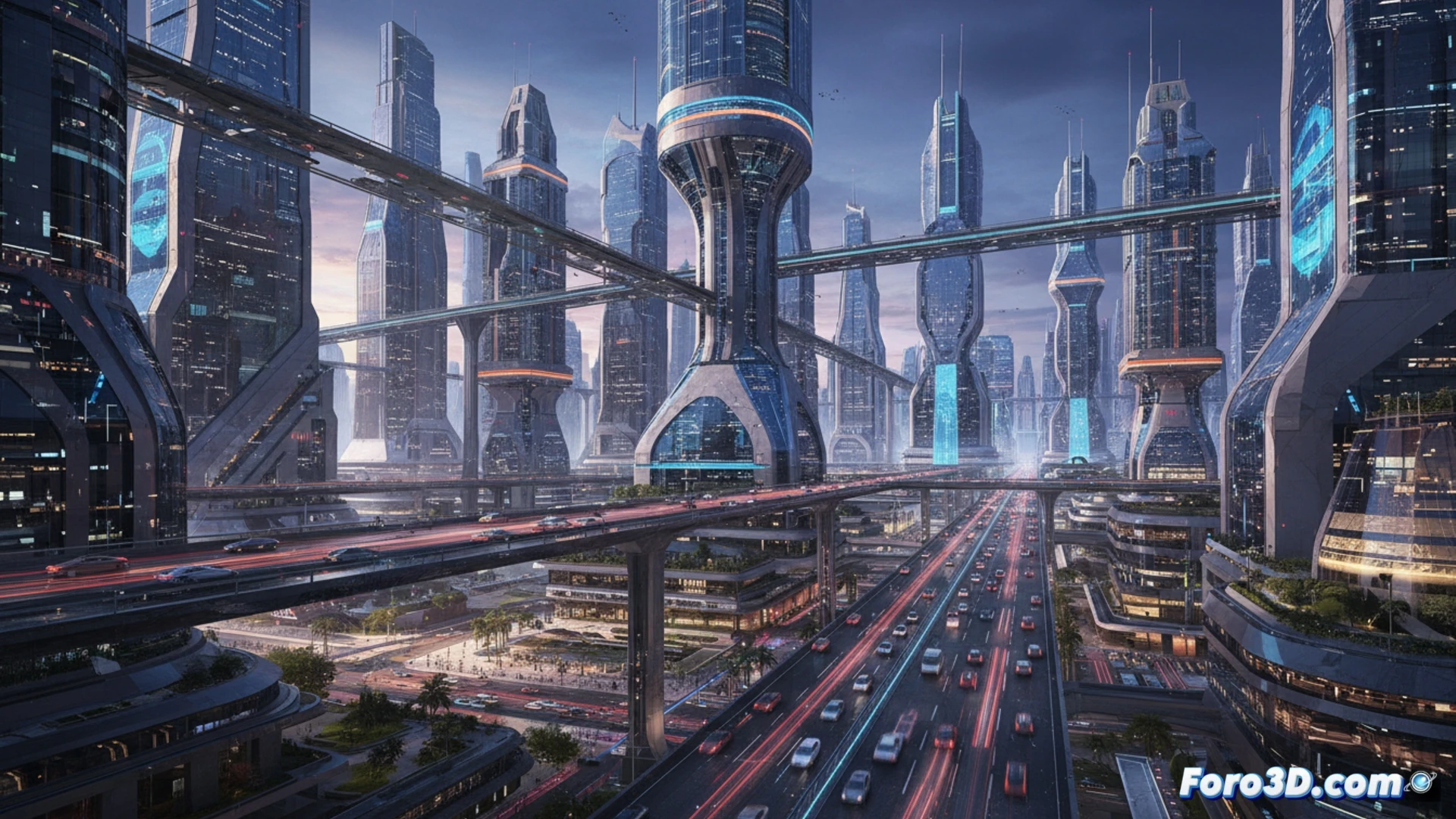
Hotta Studio has revealed technical details about the development of Neverness to Everness, an ambitious open-world title that fully exploits the capabilities of Unreal Engine 5. The project's key lies in combining Lumen for dynamic global illumination and Nanite for massive geometry management. This approach allows rendering entire urban districts with a level of architectural detail that, in previous engines, would have collapsed the rendering pipeline, all without sacrificing real-time fluidity.
Technical Pipeline: Maya, Houdini, and Custom Simulations 🏗️
The technical art team has structured a hybrid pipeline to populate the city. Maya is used as the central hub for creating hero assets and animating main characters, while Houdini handles the procedural generation of facades, street furniture, and road networks. However, the true differentiator is the proprietary traffic and pedestrian simulation software. This system, integrated directly into the Unreal Engine workflow, generates dynamic locomotion paths that interact with Lumen's lighting, avoiding the static feel of traditional video game cities. The biggest challenge has been synchronizing crowd simulation with Nanite data loading to prevent micro-stuttering at the busiest intersections.
The Paradox of Infinite Detail 🧩
Although Nanite eliminates the limitations of traditional LODs, the team has discovered that excessive detail in a city can saturate texture memory and streaming logic. The solution has not been technical, but rather design-oriented: learning to meter visual complexity. Neverness to Everness demonstrates that a powerful engine is not enough; rigorous art direction is required so that the player perceives a living metropolis instead of polygonal chaos. The true achievement is not displaying millions of polygons, but ensuring those polygons tell a coherent story.
How does Hotta Studio manage the dynamic loading of geometry and textures in real-time with Unreal Engine 5 to maintain detailed urban density without sacrificing performance in Neverness to Everness?
(PS: game jams are like weddings: everyone is happy, no one sleeps, and you end up crying)