The Kohler PureWash E930 represents a technical challenge for the 3D product designer. Its architecture combines an ergonomic vitreous ceramic seat with a sealed electronic module integrating proximity sensors, retractable nozzles, and a UV-C lamp for self-cleaning. We analyze its polygonal modeling, the transition between opaque and translucent materials, and the precise placement of internal components that ensure IPX4 moisture sealing.
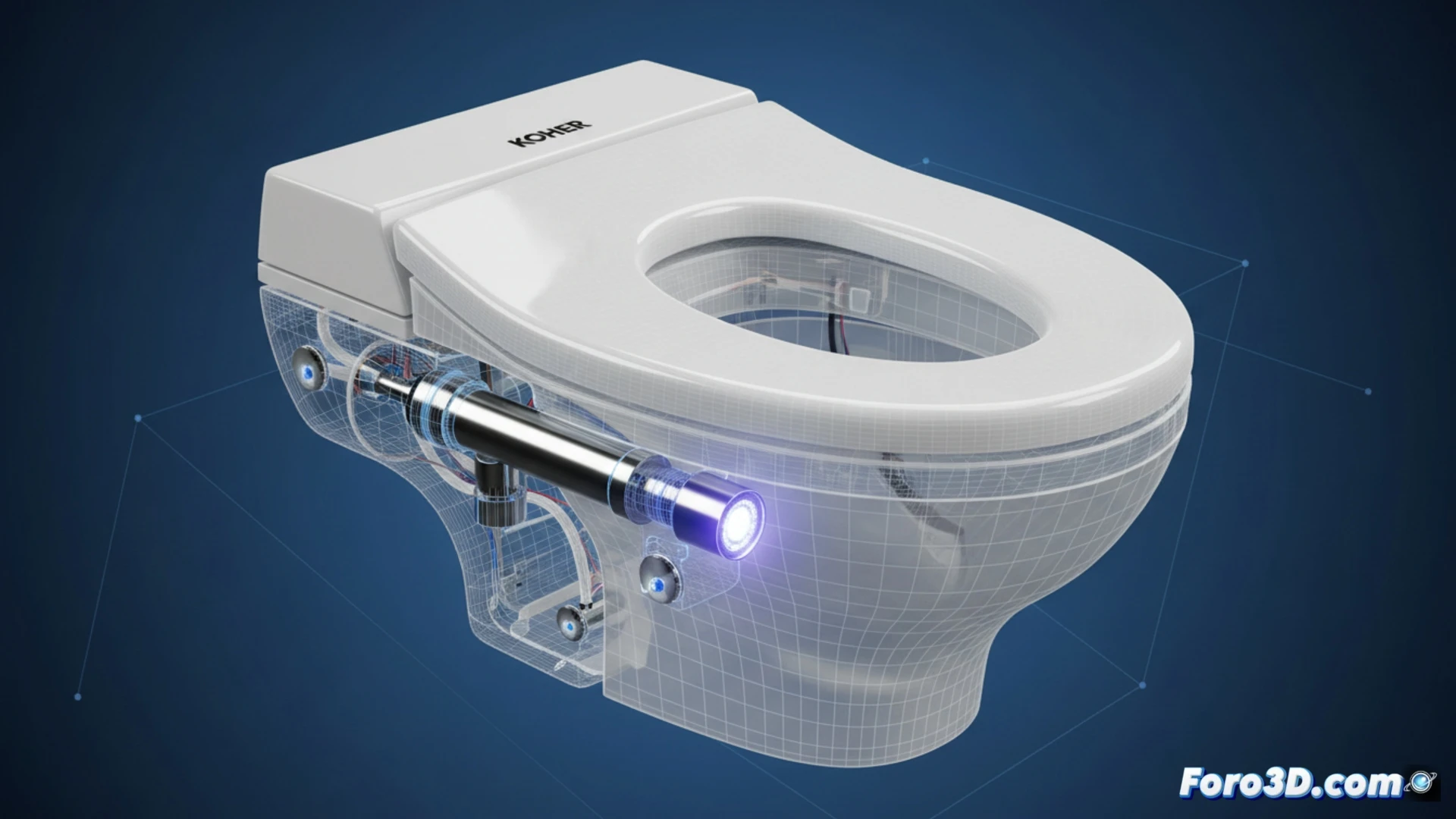
Technical breakdown of industrial design and material simulation 🛠️
Modeling the PureWash E930 demands precision in three key areas. First, the seat surface requires a smooth subdivision topology to replicate the anatomical curvature, with a displacement map simulating the anti-slip micro-texture. Second, the UV self-cleaning module must be modeled with high-density geometry to represent the parabolic reflector and quartz lamp, applying a material with volumetric emission in the render. Third, the side control panel and mobile app interface are simulated using extruded 3D wireframes on a high-gloss ABS plastic surface, with a layered shader combining specular reflection and controlled roughness to avoid a cheap plastic look.
Visualization and ergonomics challenges in the final render 🎯
The greatest visual challenge is the transition between the toilet's glazed ceramic and the smart seat's technical plastic. To achieve this, it is recommended to use a physically based renderer (PBR) with a roughness map varying from 0.1 on the ceramic to 0.4 on the plastic. Simulating running water during UV cleaning requires fluid particles with subsurface scattering. Additionally, seat ergonomics must be validated through a deformation analysis in the CAD software before exporting the mesh, ensuring that occupancy sensors do not create uncomfortable pressure points in the final 3D model.
How to 3D model the integration of sensors and the UV system in the ergonomic seat of the Kohler PureWash E930 without compromising functional precision or the aesthetics of industrial design.
(PS: Designing a product in 3D is like being an architect, but without having to worry about the bricks.)