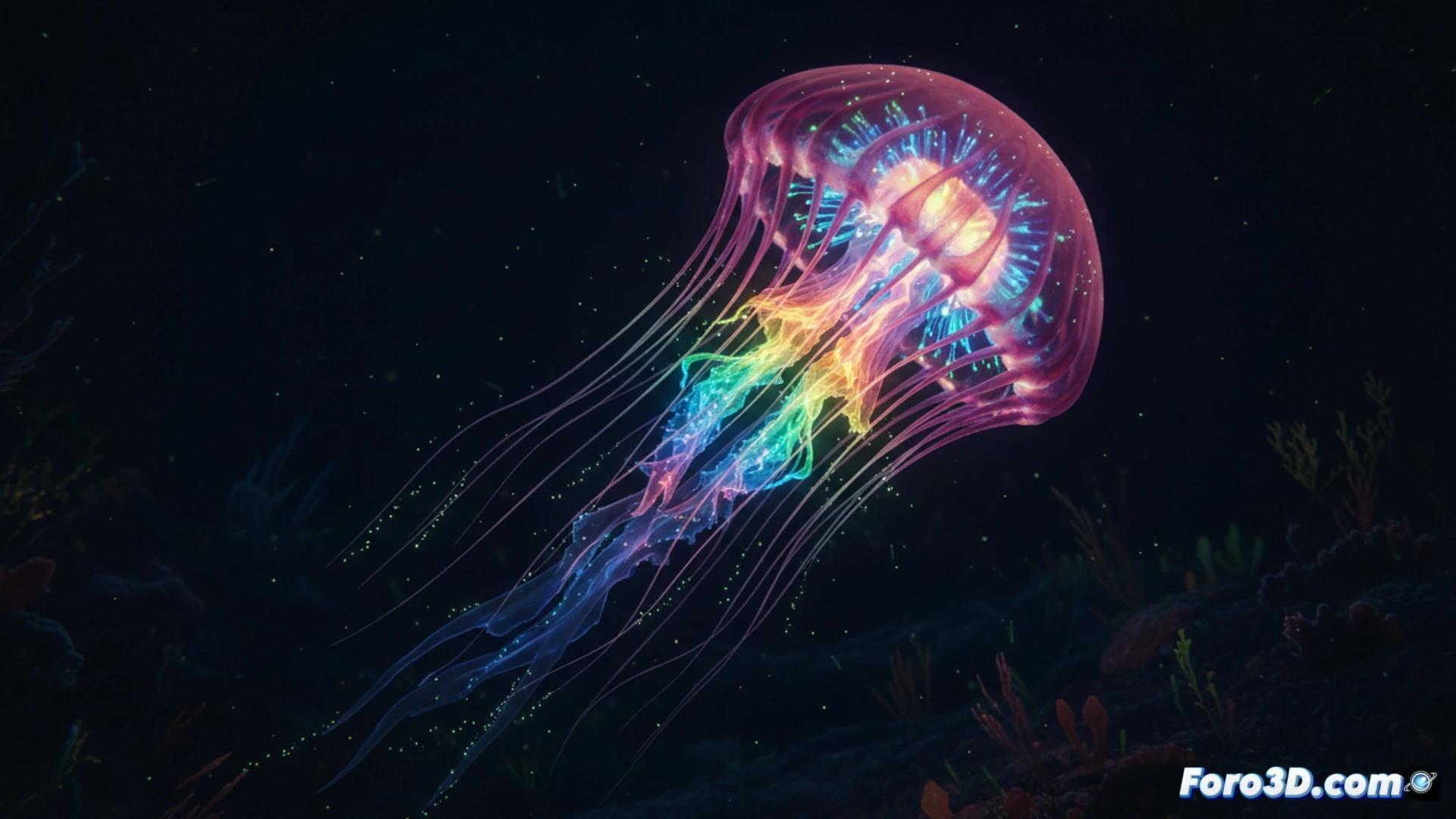
The 2024 scientific expedition in the Nazca Trench successfully captured high-definition footage of the jellyfish Halitrephes sp., known as the Firework Jellyfish. Its radial canals, which reflect light in explosive patterns, offer a unique opportunity for scientific visualization. This material allows for the generation of photorealistic 3D models that transcend simple observation, becoming key tools for anatomical study and the dissemination of abyssal species.
Underwater Photogrammetry and Radial Canal Rendering 🌊
The process to digitize the Halitrephes sp. begins with underwater photogrammetry, where multiple frames from the 4K video are aligned to reconstruct the three-dimensional geometry of the gelatinous body. Structure from Motion (SfM) algorithms calculate the position of each point, generating a dense point cloud. The true technical challenge lies in rendering the radial canals, which function as natural light guides. To achieve this, subsurface scattering (SSS) shaders are used to simulate how light penetrates and reflects within the translucent tissue, replicating the explosive color effect without the need for invasive artificial lighting. The result is a model that allows marine biologists to virtually rotate and dissect the specimen's anatomy from any angle.
The Value of the 3D Model in the Midnight Zone 🐙
Beyond aesthetics, these digital models solve a fundamental problem in marine biology: the impossibility of physically manipulating creatures from the midnight zone without damaging them. By possessing a digital twin of the Halitrephes sp., researchers can accurately measure the length of the radial canals, study the density of its nematocysts, and simulate luminescent behavior under different pressure conditions. For ocean outreach, the 3D file becomes an interactive piece that brings the general public closer to an ecosystem that would otherwise remain invisible, demonstrating that technology is the best vehicle for scientific conservation.
What specific technical challenges arose when 3D modeling the semi-transparent tentacles and bioluminescence of the Halitrephes sp. jellyfish from the high-resolution footage of the 2024 Nazca Trench?
(PS: modeling manta rays is easy; the hard part is making them not look like floating plastic bags)