The discovery in 2024 of the glass sponge Farrea in the Gascoyne Canyon has fascinated the scientific community due to its tubular silica skeleton, resembling crystal lace. For scientific visualization specialists, this organism represents a technical challenge: reconstructing in 3D a biological glass structure with submicrometric porosity. Below, the workflow for generating accurate digital models from X-ray microtomography and scanning electron microscopy data is described.
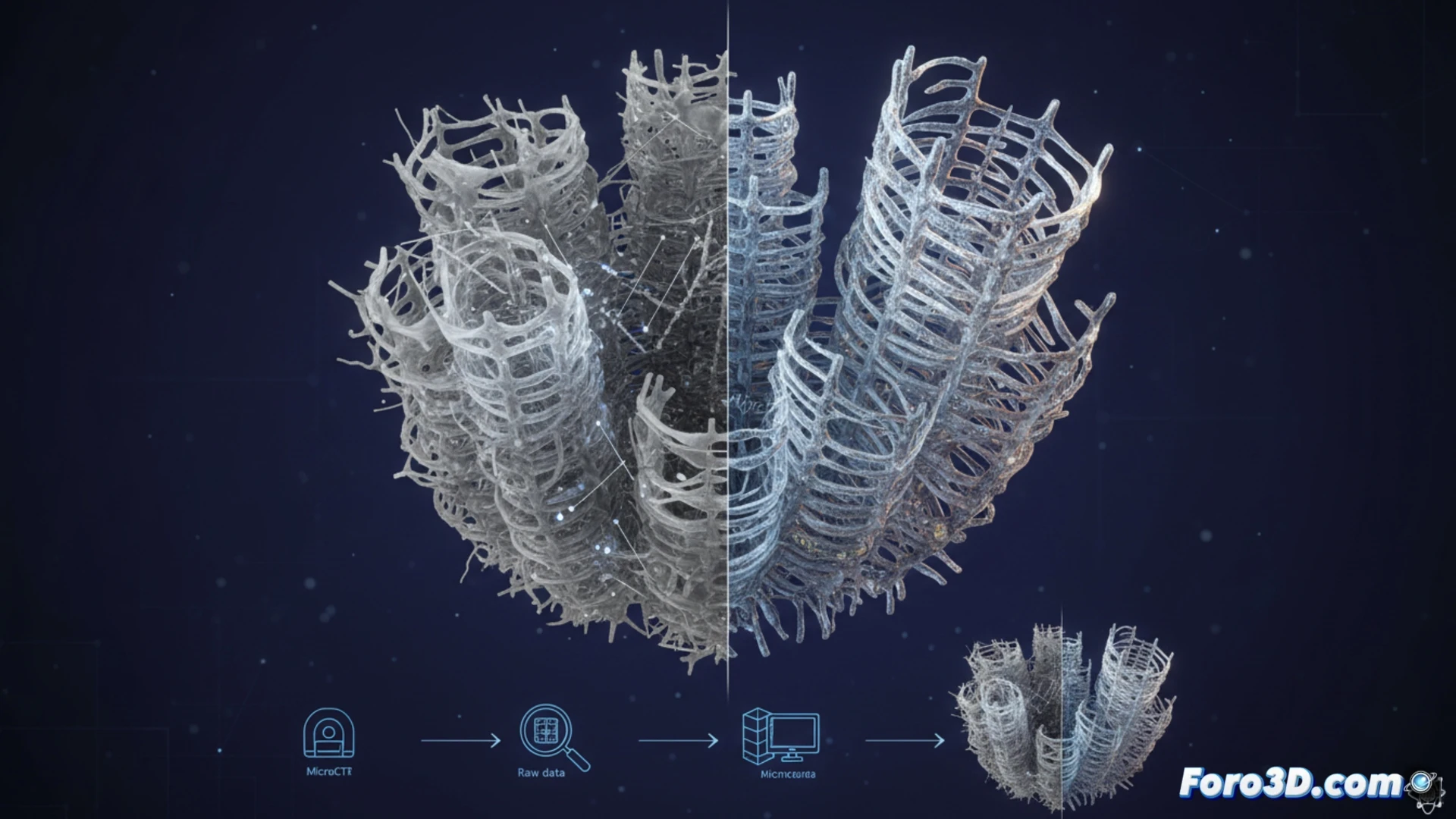
Volumetric reconstruction and meshing for biomechanical simulation 🧬
The process begins with the acquisition of image stacks using microCT (micro-computed tomography) with an isotropic resolution of 0.5 to 1 micrometer. These DICOM images are processed in software such as Dragonfly or Avizo to segment the silica spicules from the organic tissue. Density threshold segmentation allows isolating the mineral skeleton. Subsequently, a polygonal mesh is generated using marching cubes algorithms, which is simplified and smoothed in Blender or MeshLab to reduce noise without losing details of the tubular network. The resulting model, with millions of triangles, is exported to formats such as OBJ or PLY. This mesh is essential for finite element simulations in COMSOL Multiphysics, where the mechanical strength of the skeleton against ocean currents is studied, and for light scattering calculations in software like Lumerical, replicating the optical properties of biological glass.
The value of the 3D model in disseminating natural design 🌊
Beyond research, the 3D model of Farrea allows biologists and science communicators to interactively explore the fractal geometry of its skeleton. Tools like Three.js or Unity enable the creation of web visualizations where users can rotate and zoom into the sponge, appreciating how nature optimizes fragile materials like silica to build lightweight and resistant structures. This type of representation, free from conflicts or commercial interests, aligns perfectly with the scientific visualization niche, facilitating the understanding of a design that evolution has perfected over millions of years.
What technical challenges does the 3D reconstruction of the silica spicule network of the Farrea sponge from microCT data present, and how are resolution limitations solved to capture its fractal structure?
(PS: at Foro3D we know that even manta rays have better social bonds than our polygons)