A high-complication, limited-edition watch stopped working without showing any external damage. The technical expert assessment turned to a 3D Micro-CT to scan the anchor escapement and silicon springs at a micrometric scale. Volumetric reconstruction in VGSTUDIO MAX revealed a fatigue crack, invisible to the human eye. The origin of the failure was identified as an extreme thermal shock that induced internal stresses in the material.
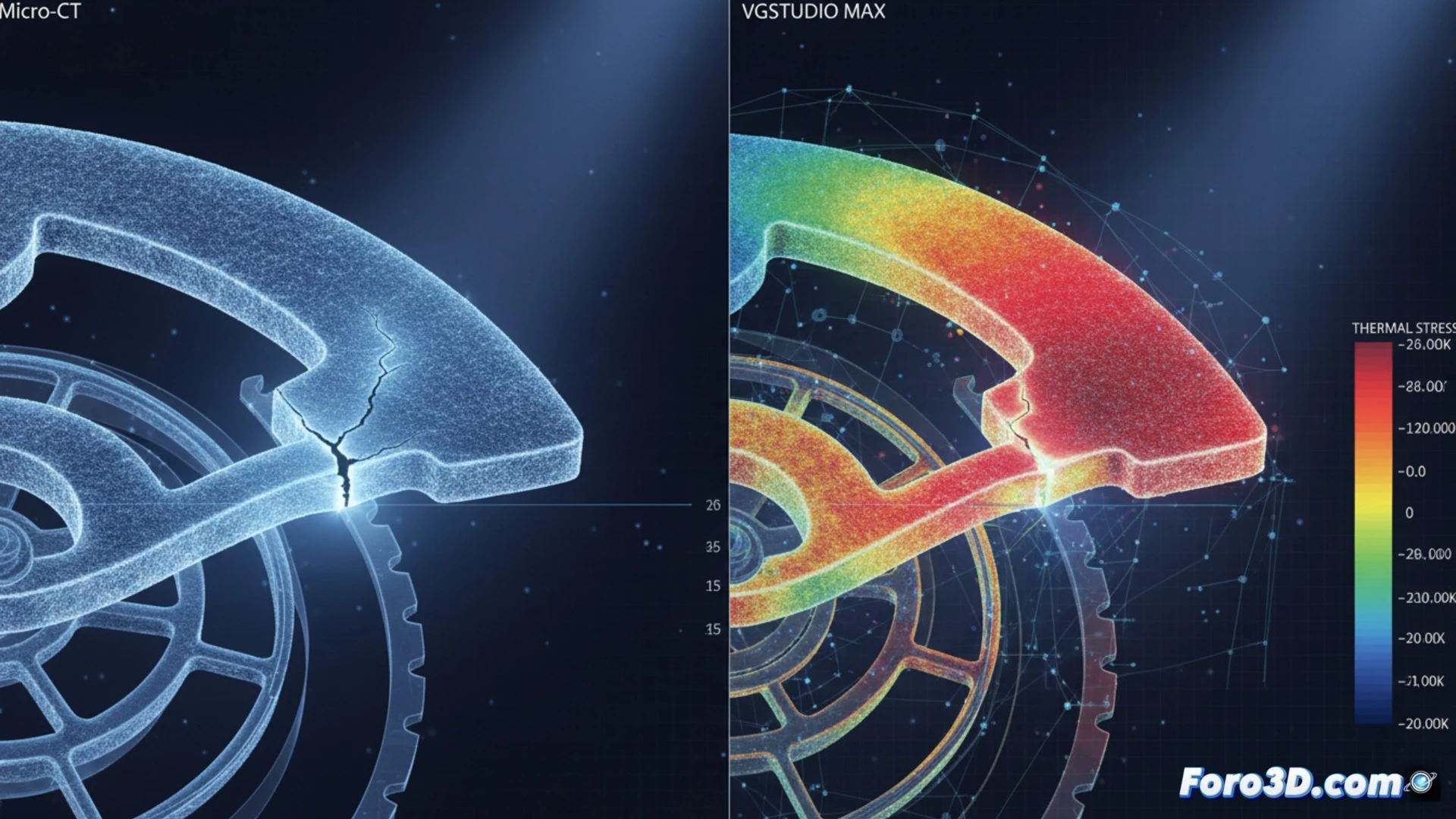
Volumetric reconstruction and stress analysis in MATLAB 🔬
The process began with data acquisition via 3D Micro-CT, generating a high-resolution point cloud. In VGSTUDIO MAX, segmentation and volumetric reconstruction of the silicon spring were performed, allowing the fractured area to be isolated. The geometry was exported to MATLAB to run a finite element simulation. The model loaded the thermal shock conditions, revealing a stress concentration point that exceeded the fatigue limit of silicon. The crack, barely 15 microns wide, coincided exactly with the area of highest simulated stress.
Micro-fatigue as a new standard in luxury expert assessment ⚙️
This case demonstrates that mechanical failures in high-end watchmaking parts are no longer resolved with just a magnifying glass and caliper. The combination of 3D Micro-CT, VGSTUDIO MAX for reconstruction, MATLAB for simulation, and ZBrush for micro-part modeling allows detecting fatigue fractures induced by extreme conditions. Silicon, although resistant to corrosion, is vulnerable to thermal shocks that generate internal cracks. For the industry, this approach establishes a forensic analysis protocol that prevents failures in future escapement designs.
Since thermal fatigue in a high-end watchmaking silicon escapement is not detectable externally or with conventional techniques, what specific parameters of the micro-CT analysis allow differentiating between a fatigue failure and a manufacturing defect in this type of material?
(PS: Material fatigue is like yours after 10 hours of simulation.)