A next-generation intervertebral disc prosthesis, made of hydrogel, catastrophically failed inside the patient. The implant disintegrated under torsional loads, generating particles that compromised the bearer's safety. The forensic analysis combined micro-CT with biomechanical simulation in Abaqus to determine whether the material's hydration rate altered its shear resistance, revealing a critical point in biomaterial design.
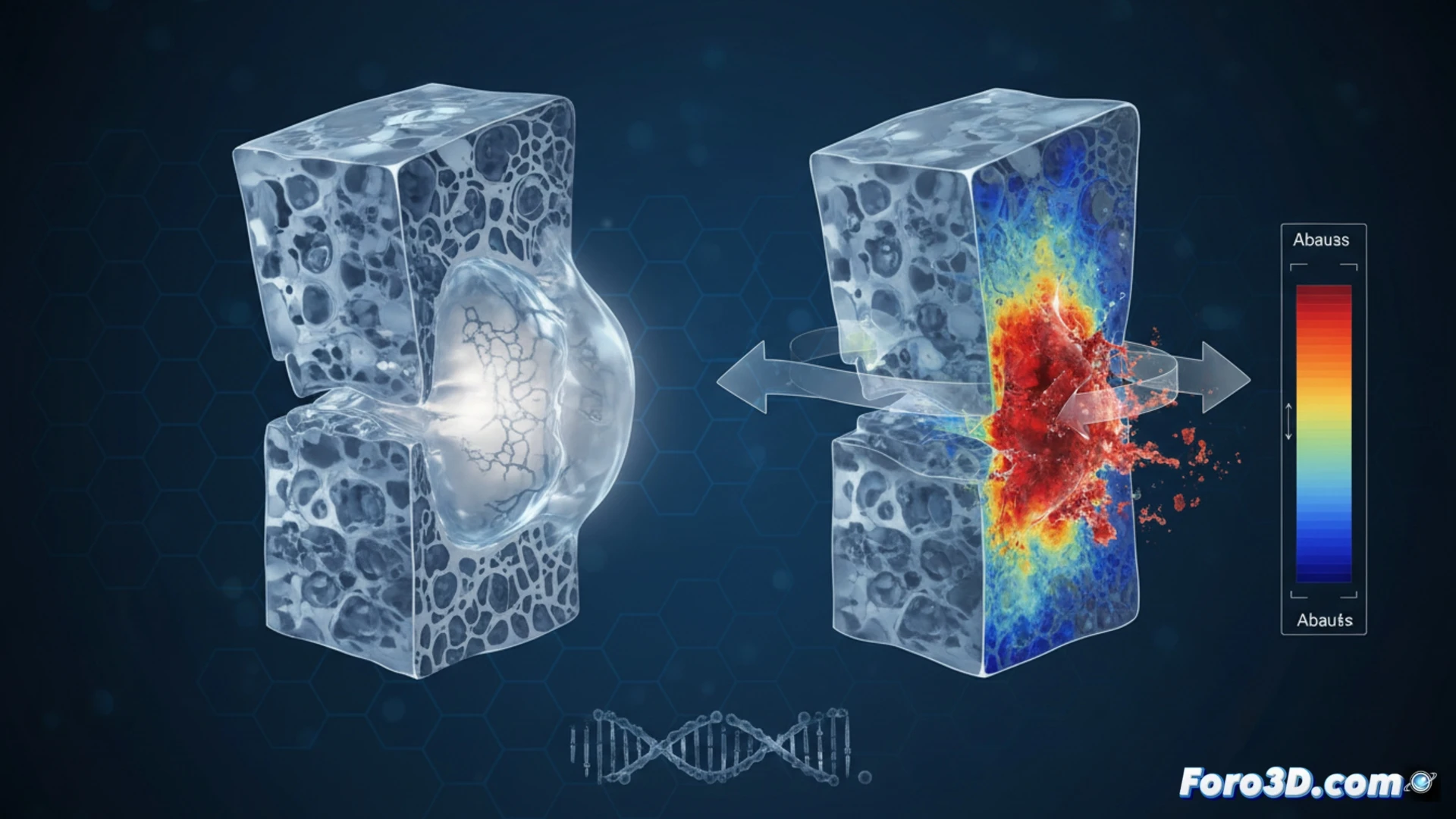
3D Reconstruction and simulation of shear wear 🔬
The forensic team digitized the explant using micro-CT in Volume Graphics, obtaining a high-resolution point cloud. Using Materialise Mimics, the fracture zones and wear particles were segmented. Then, in Abaqus, the hydrogel's behavior under cyclic torsional loads was modeled, varying the degree of hydration. The results showed that high hydration drastically reduces the material's shear modulus, causing microcracks that propagate until the complete disintegration of the implant. The finite element simulation exactly replicated the failure patterns observed in the micro-CT, validating the hypothesis.
Lessons for material fatigue in medical implants ⚙️
This case demonstrates that biomechanical simulation is not only useful for design but also for investigating real failures. The combination of micro-CT and Abaqus allows correlating the material's microstructure with its mechanical response under fatigue. For the industry, it is clear that the hydrogel's hydration rate must be rigorously controlled as a manufacturing parameter. A small change in water absorption can turn an innovative implant into a risk for the patient.
How are the cyclic fatigue parameters in the hydrogel, measured by in situ micro-CT, correlated with the hydration failure predictions obtained through the constitutive model in Abaqus?
(PS: Material fatigue is like yours after 10 hours of simulation.)