Apple has completely redesigned its most compact computer. The new Mac mini, equipped with M4 and M4 Pro chips, abandons the decade-old design to offer a significantly smaller chassis. But the real revolution for 3D artists isn't in the size, but in the hardware: the inclusion of hardware-accelerated ray tracing and, in the Pro version, Thunderbolt 5 ports that promise to double bandwidth for peripherals.
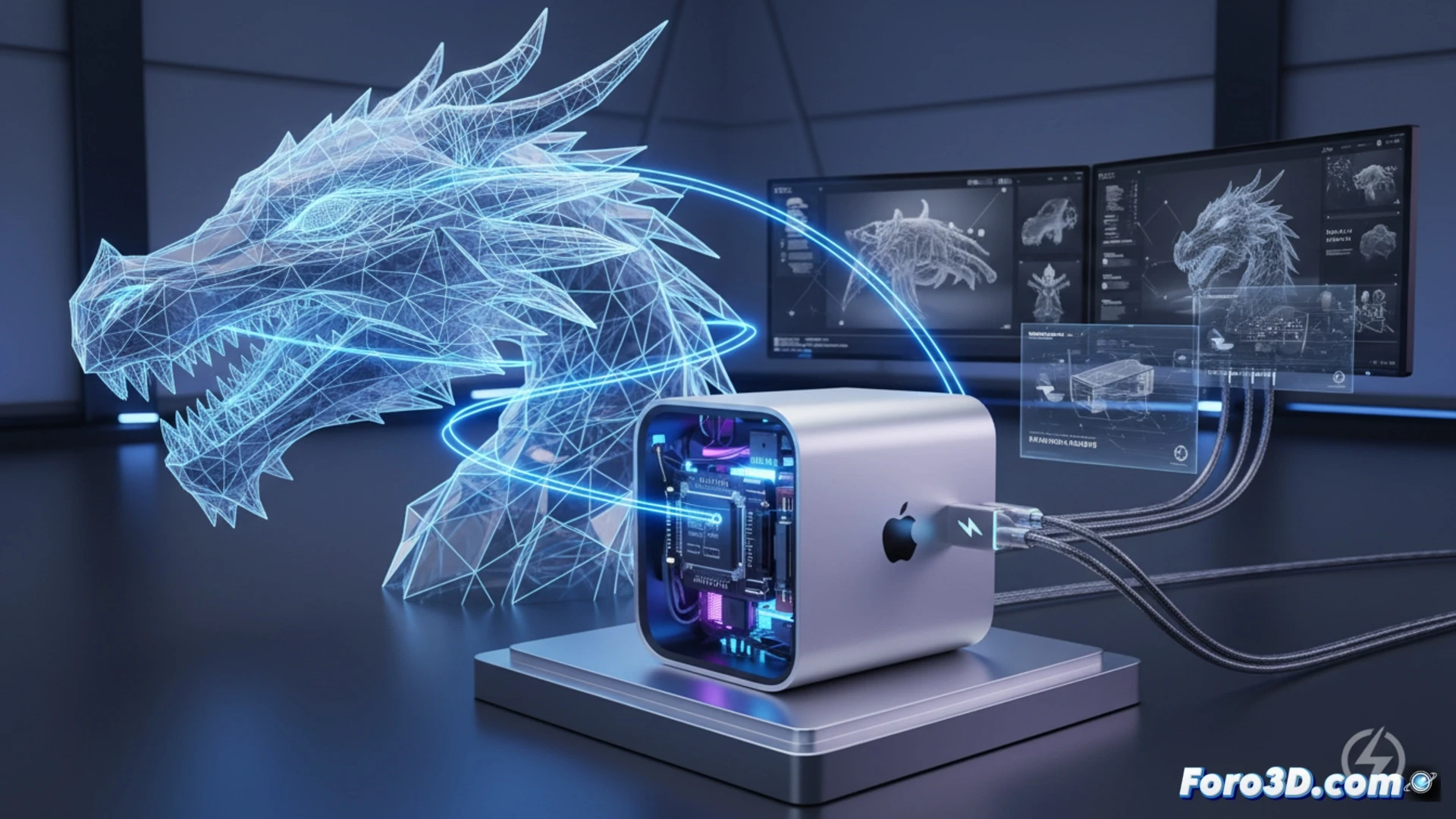
Technical analysis: Ray tracing and bandwidth in render engines 🚀
The generational leap from M4 to M4 Pro is critical for 3D workflows. Hardware ray tracing, absent in the M1 and M2, allows engines like Redshift, Octane, or Blender Cycles to calculate global illumination and reflections in real time without saturating the CPU. Early internal tests suggest the M4 Pro matches or exceeds a mid-range desktop GPU like the RTX 4070 in low-complexity scenes, although the CUDA ecosystem still dominates in particle and physics simulations. The true differentiator is Thunderbolt 5: with 80 Gbps of bandwidth, it allows connecting external NVMe storage that matches the speed of unified RAM, eliminating bottlenecks when working with 8K textures or VDB volumes. However, the lack of official eGPU support limits scalability, something PC users with RTX 4090s continue to exploit.
Reflection: Is the Mac mini M4 Pro a viable 3D workstation? 💡
For polygonal modeling and texturing in Substance 3D Painter, the M4 Pro is flawless: its thermal efficiency allows maintaining high frequencies without fan noise. But dynamic simulation (Cloth, Fluids) remains a weak point compared to an AMD Threadripper or Intel Core i9 CPU with more cores. Hardware ray tracing is a welcome advancement, but the Apple ecosystem still lacks the maturity of OptiX or HIP. The Mac mini M4 Pro is an excellent tool for the nomadic 3D artist or small studio prioritizing silence and size, but the user demanding final 4K renders with hundreds of lights will still find more performance per euro in a PC tower with NVIDIA.
Is the new ray tracing architecture of the Mac mini's M4 Pro capable of competing in render times with a mid-range dedicated GPU like the RTX 4060 in software such as Blender or Cinema 4D?
(PS: remember that a powerful GPU won't make you a better modeler, but at least you'll render your mistakes faster)