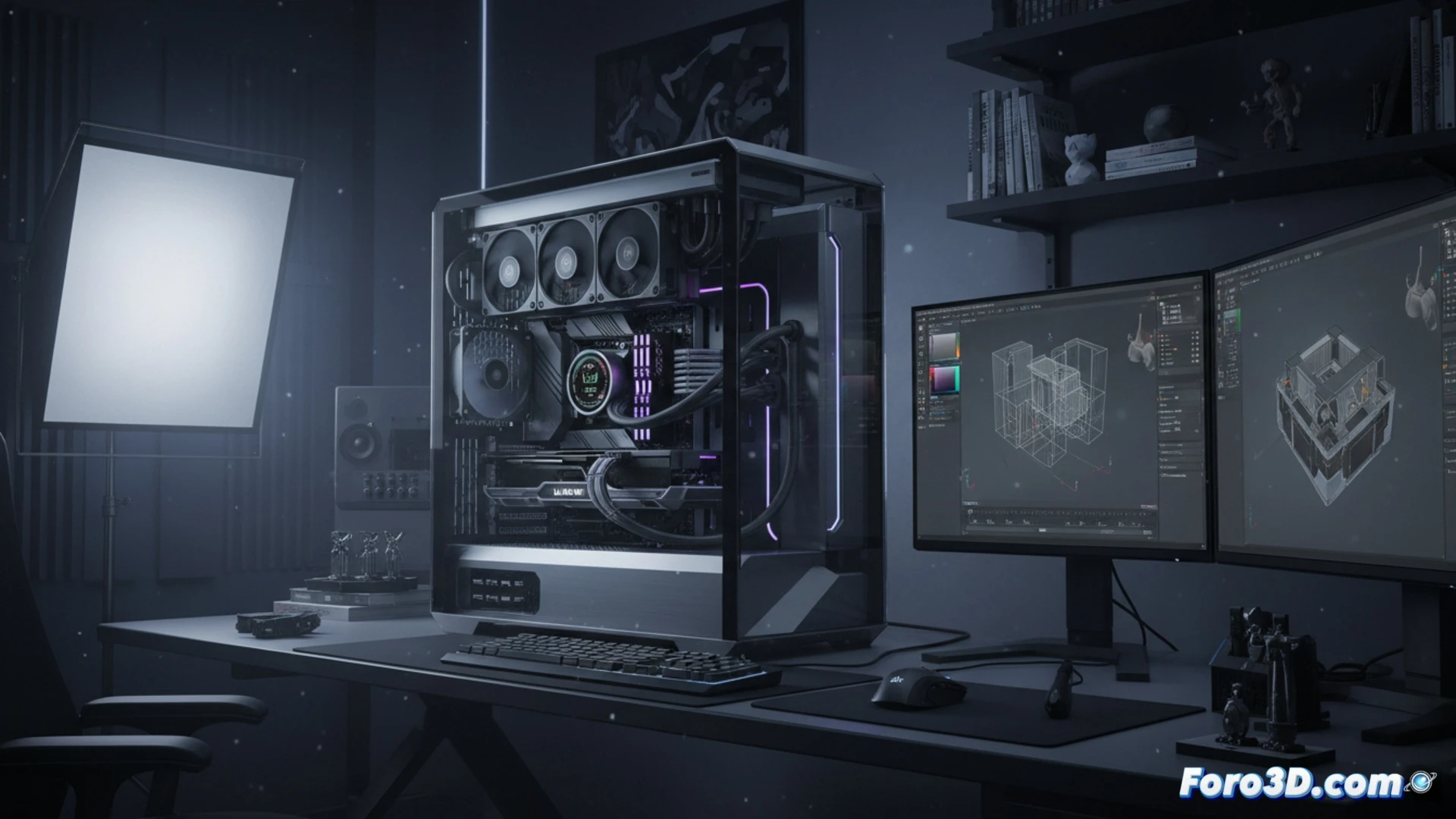
Lian Li has introduced the HydroShift LCD 360S, an all-in-one liquid cooling system that redesigns the hose routing. Instead of coming out of the water block, the tubes connect directly to the side of the radiator. This allows most of the wiring and tubing to be hidden, offering an extremely clean profile that benefits both airflow and the aesthetics of 3D modeling and rendering workstations.
Thermal performance under sustained CPU and GPU loads 🧊
For a 3D professional, thermal management during CPU rendering sessions or fluid simulations is critical. The HydroShift LCD 360S uses a 360mm radiator with a high-density microfin design and a nickel-plated copper block. Its main advantage over traditional AIOs is the reduction of airflow obstruction in the chassis. By moving the tubes to the side of the radiator, sharp bends are eliminated and aerodynamic resistance within the tower is minimized. This translates into more stable CPU temperatures during hours of work, allowing Turbo frequencies to be maintained on processors like an Intel Core i9 or an AMD Ryzen Threadripper without thermal throttling. Additionally, the adjustable-speed ceramic pump offers an optimal balance between flow rate and silence, a differentiating factor in studio environments where turbine noise can interfere with concentration.
Functional aesthetics for multi-GPU setups 🛠️
In 3D workstations that integrate multiple GPUs for real-time rendering (such as NVIDIA RTX A6000 or RTX 4090), interior space is gold. The HydroShift LCD 360S's side tube design frees up the front area of the CPU block, preventing hoses from rubbing against graphics card backplates or interfering with power connectors. This not only improves the visual appearance but also facilitates maintenance and cabling. For the professional looking for a system that looks like a precision tool, this AIO represents a logical evolution: less clutter, better dissipation, and a customizable IPS LCD screen for monitoring temperatures in real-time without resorting to third-party software.
As a user of a 3D workstation with sustained workloads in rendering and simulations, how does the redesigned tube routing of the Lian Li HydroShift LCD 360S affect thermal efficiency and long-term reliability compared to traditional AIOs?
(PS: remember that a powerful GPU won't make you a better modeler, but at least you'll render your mistakes faster)