Mathematicians work with abstract concepts that are often difficult to visualize on a blackboard or screen. 3D technology allows these ideas to be materialized into physical objects, facilitating their understanding and teaching. For example, a Riemann surface, such as that of a complex function, can be printed to show its multiple layers and branch points.
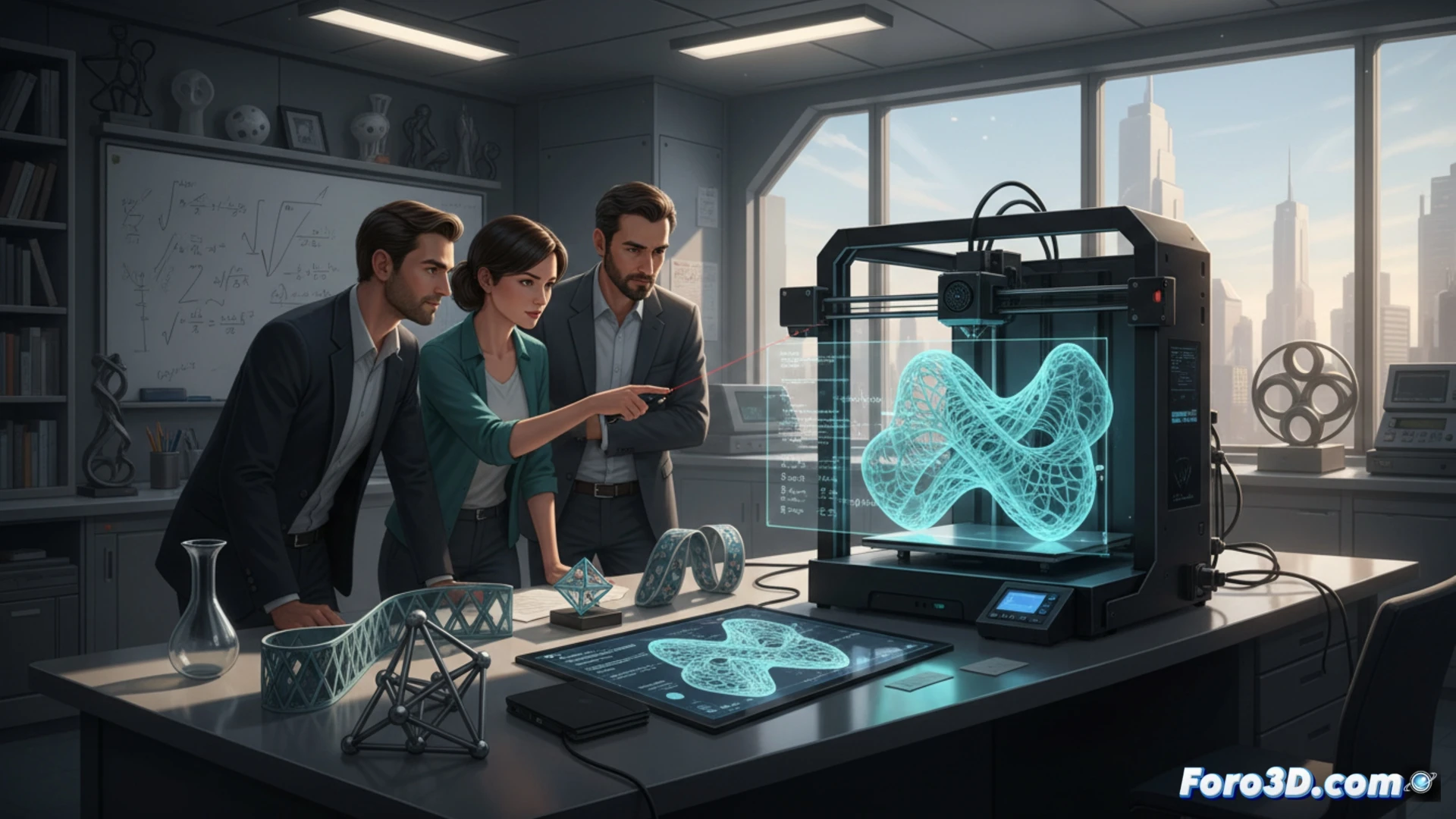
Tactile modeling of complex surfaces 🖐️
To create these models, mathematical software like Mathematica or MATLAB is used to generate the numerical data of the surface. Then, 3D modeling programs such as Blender or Rhino 3D convert that data into a printable mesh. The final step is to use a slicer like Cura or PrusaSlicer to prepare the STL file for the printer. With this, a topology theorem becomes an object that can be held in your hand.
Goodbye to napkins with doodles 📝
Finally, mathematicians can stop drawing twisted spheres on coffee napkins to explain homology. Now they print a torus with holes and toss it onto the meeting table. Of course, the problem remains that nobody understands what it's for, but at least the object looks nice on the desk and can be used as a paperweight. Just don't lend it to an engineer, or they'll take it to test if it can withstand a hammer blow.