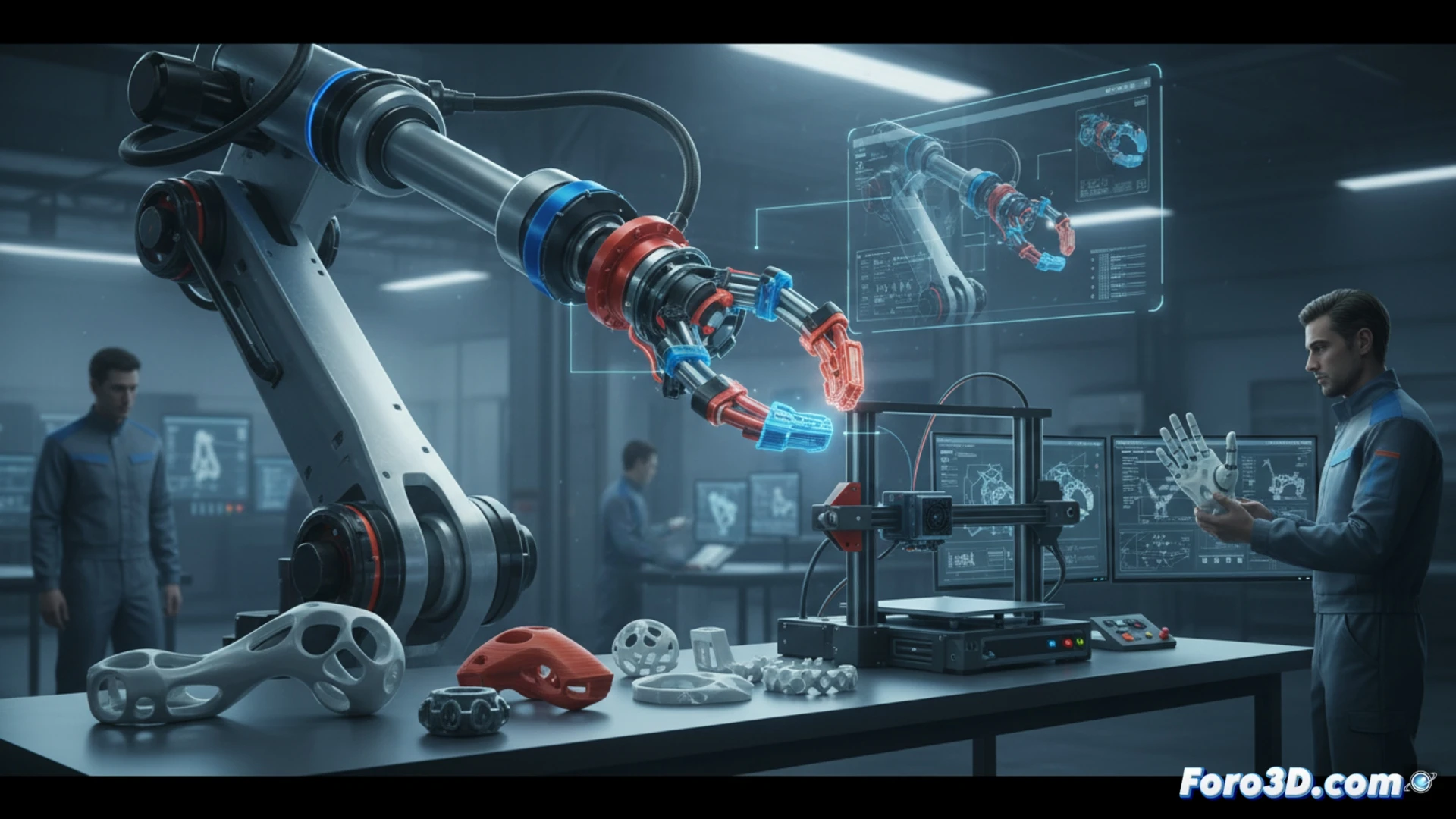
Robotics demands functional prototypes in short timeframes. Additive manufacturing allows engineers to go from a CAD model to a mechanical part in hours. This accelerates the validation of grippers, joints, or sensors before mass production. A clear example is the design of a custom end effector for an assembly line, tested the day after its design.
Key software for simulating and manufacturing robotic parts 🤖
The typical workflow combines Fusion 360 or SolidWorks for parametric component modeling. ANSYS or the SolidWorks simulation module is used to simulate stresses and deformations. Print preparation falls to Ultimaker Cura or PrusaSlicer. All of this allows printing in materials like PETG or reinforced Nylon, resistant to cyclic loads in lightweight robotic arms.
When the robot prints itself (and asks for a vacation) 😅
There comes a point when the engineer, proud of their creation, programs the robot to pick up the newly printed part and place it elsewhere. The problem arises when the robot, with its millimeter precision, decides that the print support is an annoying obstacle and crushes it. That's when you realize you need to add a force sensor or, better yet, a pause button so the machine doesn't make existential decisions.