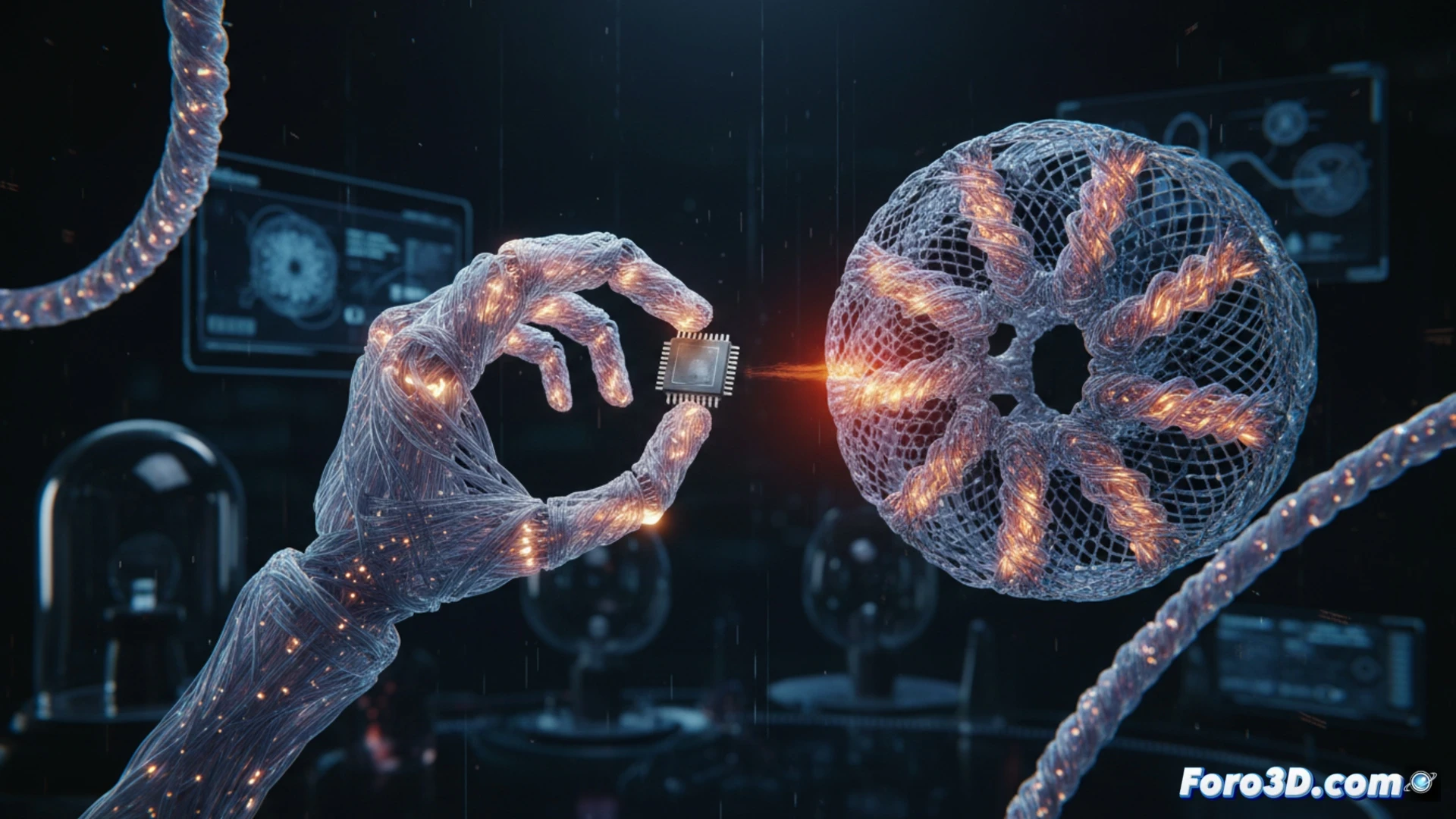
Researchers at Harvard have developed a 3D printing technique that creates soft filaments capable of bending, twisting, or contracting when heated. These filaments act as artificial muscles, opening new possibilities for soft robotics and medical devices. The method, called multimaterial rotational 3D printing, allows the material's deformation to be programmed during manufacturing.
Rotating nozzle writes deformation into the filament 🔧
The technique extrudes two materials side by side through a rotating nozzle: an active liquid crystal elastomer, which contracts with heat, and a passive elastomer that remains stable. By rotating the nozzle, a helical molecular alignment is generated in the 100-micron-diameter filament. This programs its movement without the need for subsequent steps. The filaments have already been used to build thermosensitive filters and grippers that grab objects when heated.
Printer muscles: the gym is no longer necessary 💪
Finally, a technique that promises muscles without sweating or lifting weights. These filaments bend on their own just by bringing a hairdryer close. Of course, don't expect to use them to lift your sofa: for now, they can only grab small objects. But hey, for opening the fridge without getting up from the couch, it's a promising advance. Of course, if your partner asks for help moving furniture, say you're waiting for version 2.0.