The arrival of the LASERTEC 65 DED hybrid 2 from DMG MORI UK marks a milestone in the convergence of additive manufacturing and digital twins. By integrating directed energy deposition, 5-axis machining, and 3D scanning into a single platform, this system enables the generation of precise virtual replicas of metal components. The key lies in its ability to capture dimensional data with an accuracy of 4 microns throughout the entire process.
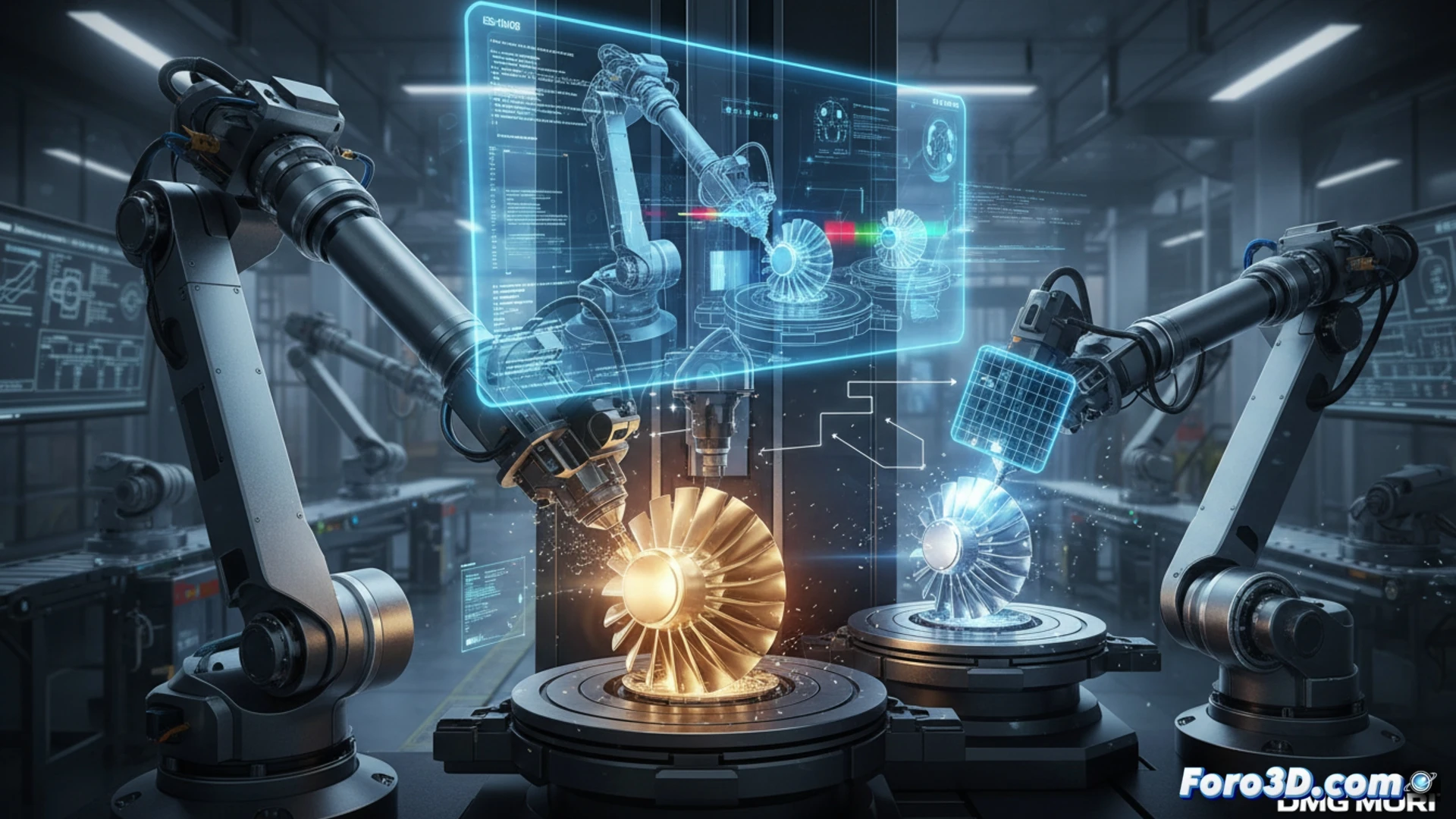
Real-time simulation and monitoring of the DED process 🔧
The digital twin of a part manufactured on the LASERTEC 65 DED hybrid 2 is not a simple static representation. The integration of 3D scanning and VCS Complete technology allows a virtual model to be fed with real-time measurement data. This is crucial for simulating the thermal and mechanical behavior of the material during deposition. Engineers can predict deformations, residual stresses, and the quality of the metallurgical bond before an error occurs, optimizing repair and hard material coating strategies directly from the digital environment.
From predictive repair to regenerative design 🔄
The ability to accommodate parts up to 840 mm in diameter and a build volume 170% larger than its predecessor expands the scope of digital twins. It is now feasible to create a complete digital history of a worn component, from its initial scan to the application of the coating and final milling. This transforms repair into a predictive process, where the virtual model dictates the optimal deposition and machining path, closing the loop between the original design and the physical regeneration of the component.
How can a digital twin optimize the hybrid manufacturing parameters of the LASERTEC 65 DED 2 in real time to prevent defects in material deposition?
(PS: My digital twin is currently in a meeting, while I am here modeling. So technically, I am in two places at once.)