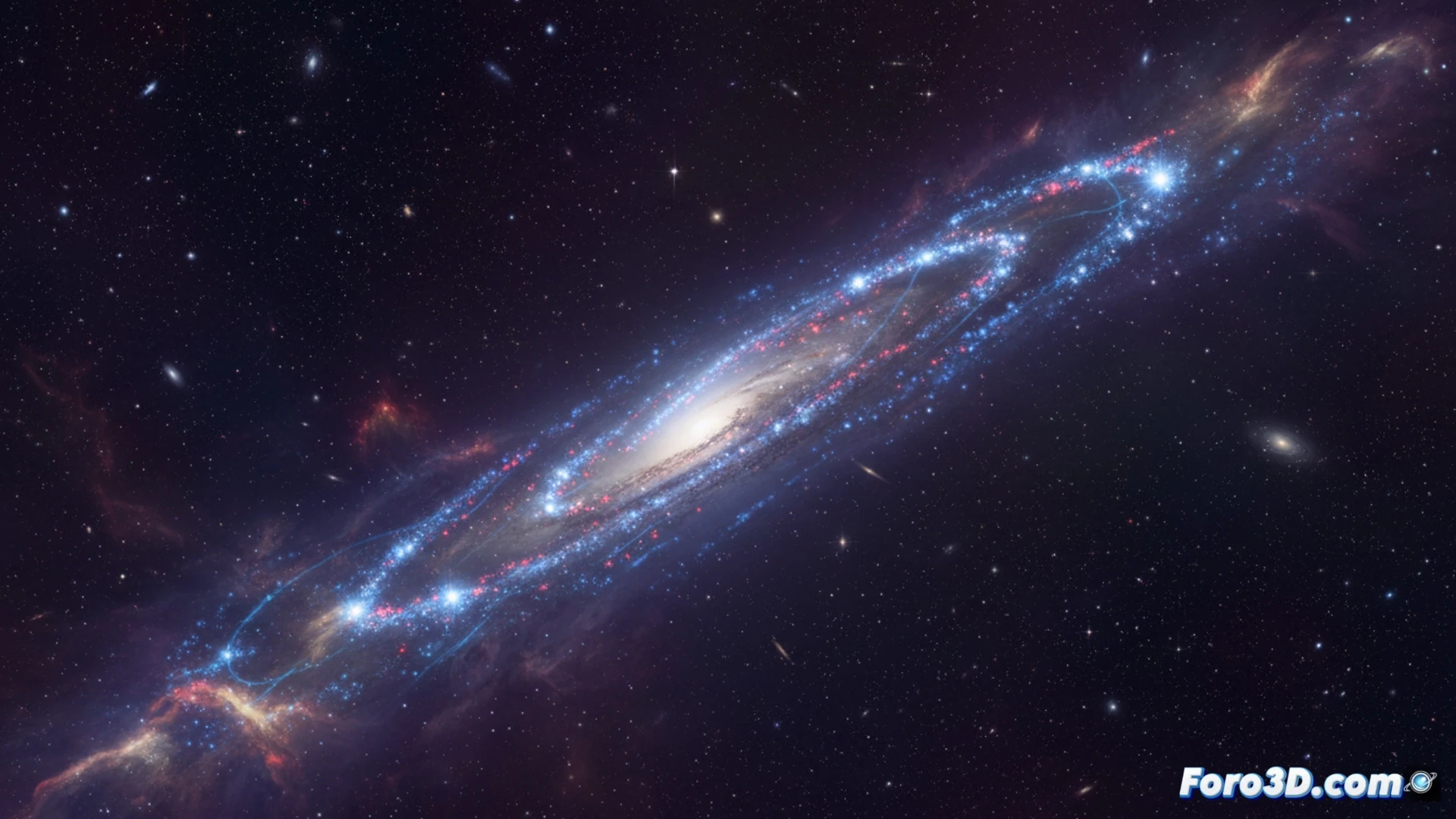
A group of Japanese scientists has detected an extremely thin galaxy that existed about 800 million years after the Big Bang. This finding allows a glimpse into the era of Population III stars, primordial celestial bodies composed only of hydrogen and helium, whose existence had been elusive due to their faint light and enormous distance.
The telescope that unveiled the early universe 🔭
The team used data from the James Webb Space Telescope and image processing techniques to isolate the faint signal of this galaxy, named JD1. Its elongated shape and low mass suggest it hosts clusters of Population III stars. The observation was achieved thanks to the gravitational lensing of a nearby galaxy cluster, which magnified the light from the ancient object.
Stars that lived fast and died young 💫
These Population III stars were so massive that they lived only a few million years, like a celebrity in a reality show. They are believed to have exploded as supernovae, scattering heavy elements across the cosmos. But at least now we know they existed, even if their legacy is just a pile of stardust and a couple of scientific papers.