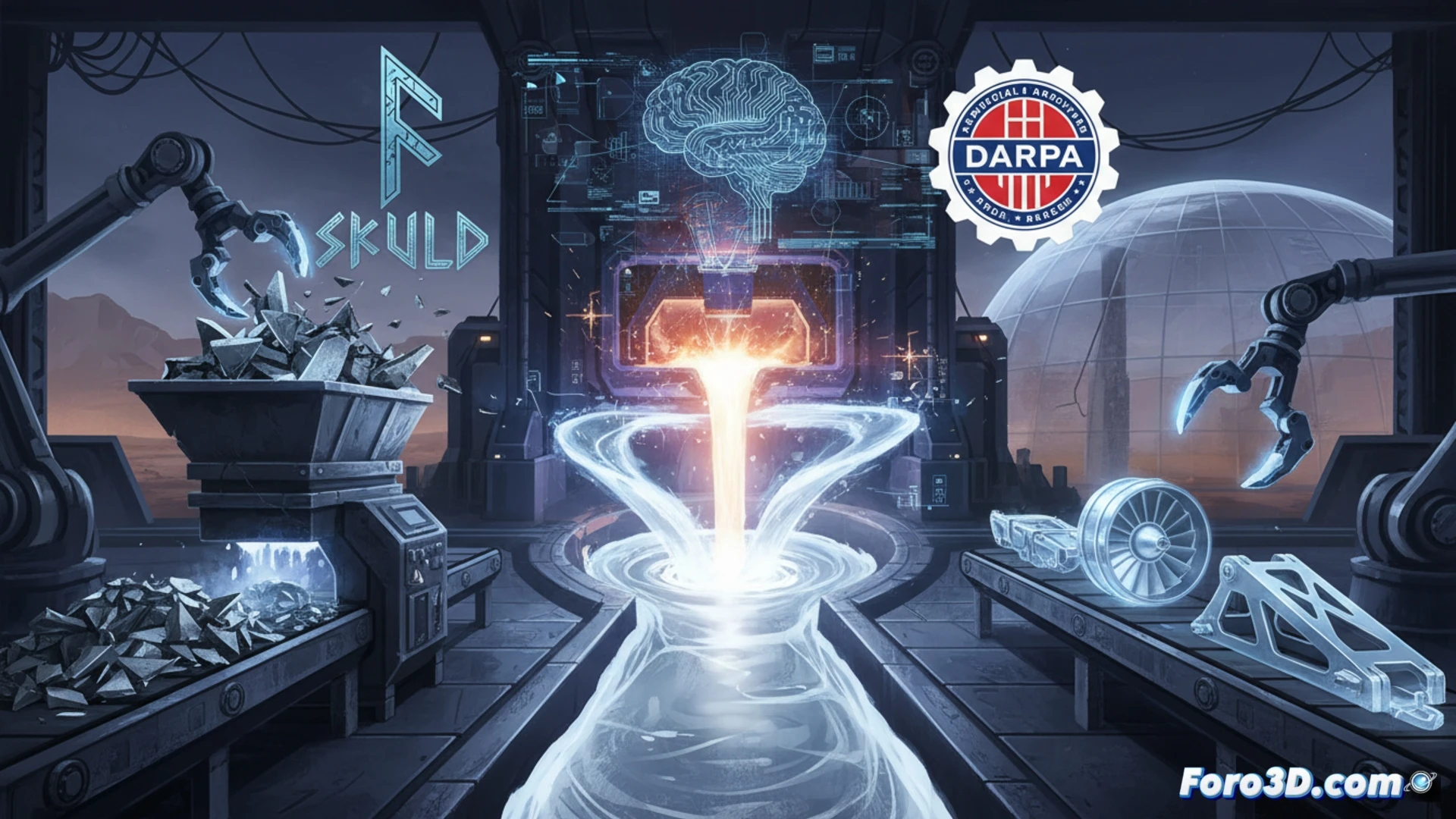
The company Skuld leads DARPA's Rubble to Rockets (R2R) program, which aims to transform scrap metal into high-performance structural parts. Its key innovation is a patented process that melts wrought aluminum alloys, such as 6061 and 7075, directly from waste, eliminating mill processing. This breakthrough enables the manufacture of critical components in remote environments without relying on conventional supply chains, a paradigm shift in defense and exploration logistics.
Characterization of unknown alloys and microstructure prediction 🔬
The program addresses three technical challenges: identifying the composition of the scrap, predicting its mechanical behavior, and producing useful parts. For identification, Skuld uses artificial intelligence-assisted spark testing, analyzing the light spectrum emitted when polishing the metal. This method allows classifying unknown alloys in seconds. The prediction of microstructure and performance under load is handled by WPI and MatMicronia, which model how crystalline phases and precipitates evolve during solidification. Recent experiments eliminated cracks in complex geometries, achieving wrought-level strength with only casting and heat treatment.
AMEC: the bridge between scrap and aerospace-grade parts 🚀
The process is called Additive Manufacturing Evaporative Casting (AMEC). It combines 3D-printed patterns with lost foam molds, eliminating the need for hard and expensive tooling. By directly casting wrought alloys from scrap, the material life cycle is closed. This approach represents a qualitative leap in materials science: a mill is no longer required to refine the alloy, but artificial intelligence and spectral characterization guarantee quality at the point of manufacture. The question that arises is whether this technology can be scaled for civilian applications, such as construction in disaster zones or distributed manufacturing of aerospace components.
What do you think about this breakthrough?