Last month, an electric air taxi (eVTOL) in the testing phase suffered a fire in its battery pack during a parking maneuver. Initial investigations point to an uncontrolled thermal runaway. Now, a team of forensic engineers is using 3D reconstruction and multiphysics simulation to determine whether a structural failure in the liquid cooling system was the trigger of the catastrophe, modeling the heat propagation cell by cell.
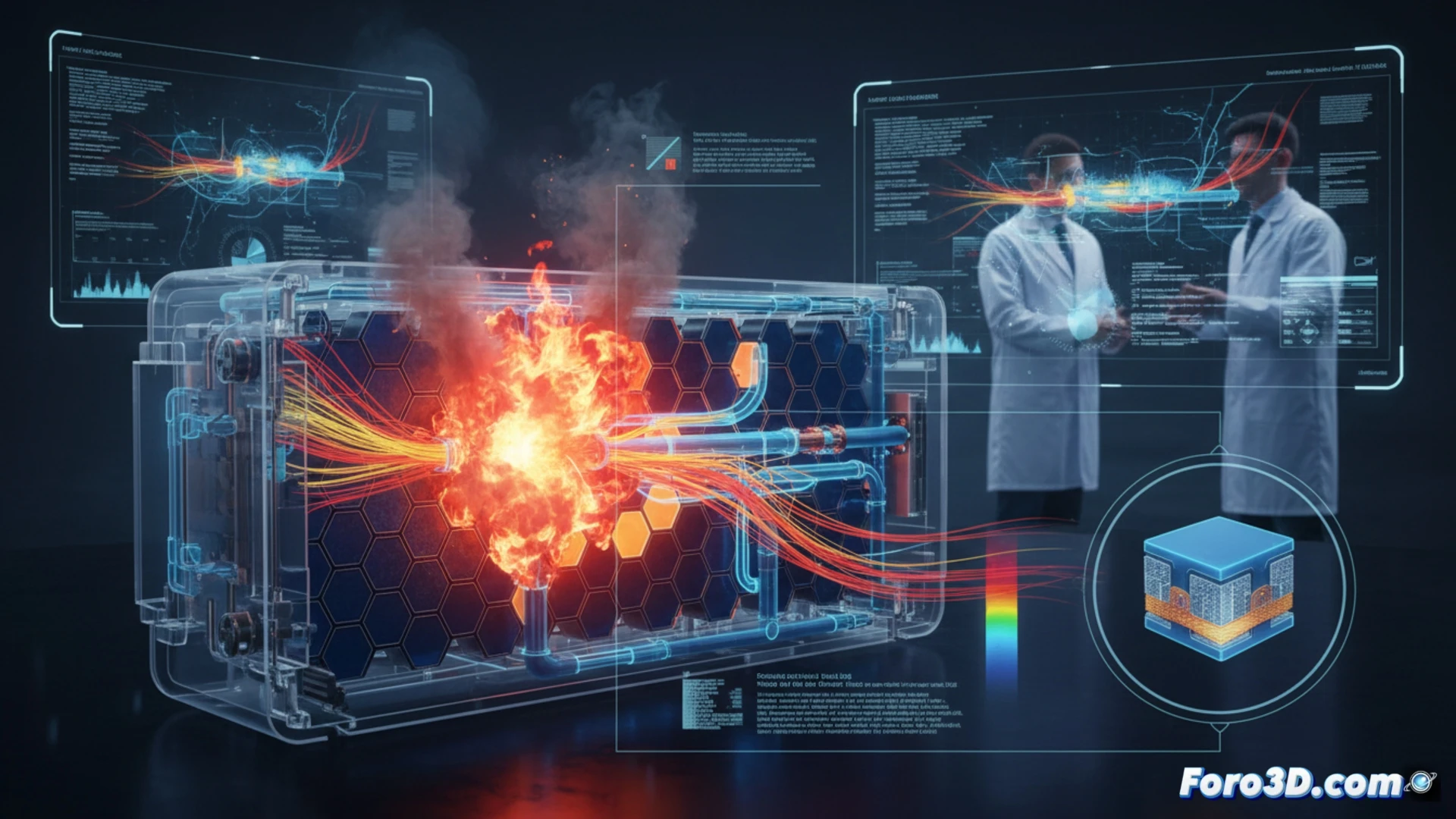
FSI Analysis and Thermal Propagation in COMSOL and Star-CCM+ 🔥
The forensic process combines RealityCapture to generate a precise digital twin of the damaged pack from photogrammetry of the debris. On this mesh, a Fluid-Structure Interaction (FSI) analysis is run in COMSOL Multiphysics, simulating the pressure and flow of the coolant at the moment of duct collapse. In parallel, Star-CCM+ models the fluid dynamics of hot air and radiative transfer among the 186 cells. The results reveal that a microcrack in the cooling manifold, amplified by rotor vibration, allowed the dielectric fluid to leak, eliminating the critical thermal barrier between adjacent cells and accelerating the chain combustion.
Lessons for Electric Aircraft Certification ✈️
The simulation shows that, in an ideal safety scenario with intact cooling, the maximum temperature would not have exceeded 80 degrees Celsius. However, the leak allowed a localized peak of 450 degrees in less than 12 seconds. This virtual catastrophe underscores the need to integrate real-time pressure sensors in liquid cooling circuits, as well as ablative barriers between modules. The 3D reconstruction not only solves the incident but redefines design standards to prevent heat from becoming the executioner of urban air mobility.
What immediate lessons for the design of cooling systems in eVTOL can be drawn from the 3D reconstruction of the thermal runaway propagation pattern in this failure?
(PS: Simulating catastrophes is fun until the computer melts down and you are the catastrophe.)