The fracture of the Bucket Wheel in open-pit mining is a catastrophic failure that halts production and generates millions in costs. Forensic analysis reveals that the origin is not classic cyclic fatigue, but an overtightening of the connecting bolts. This excess torque generates striations on the bolt surface, which act as stress concentrators, embrittling the steel and causing the buckets to detach. In this technical article, we break down the simulation and validation process using 3D metrology and finite element tools. 🔧
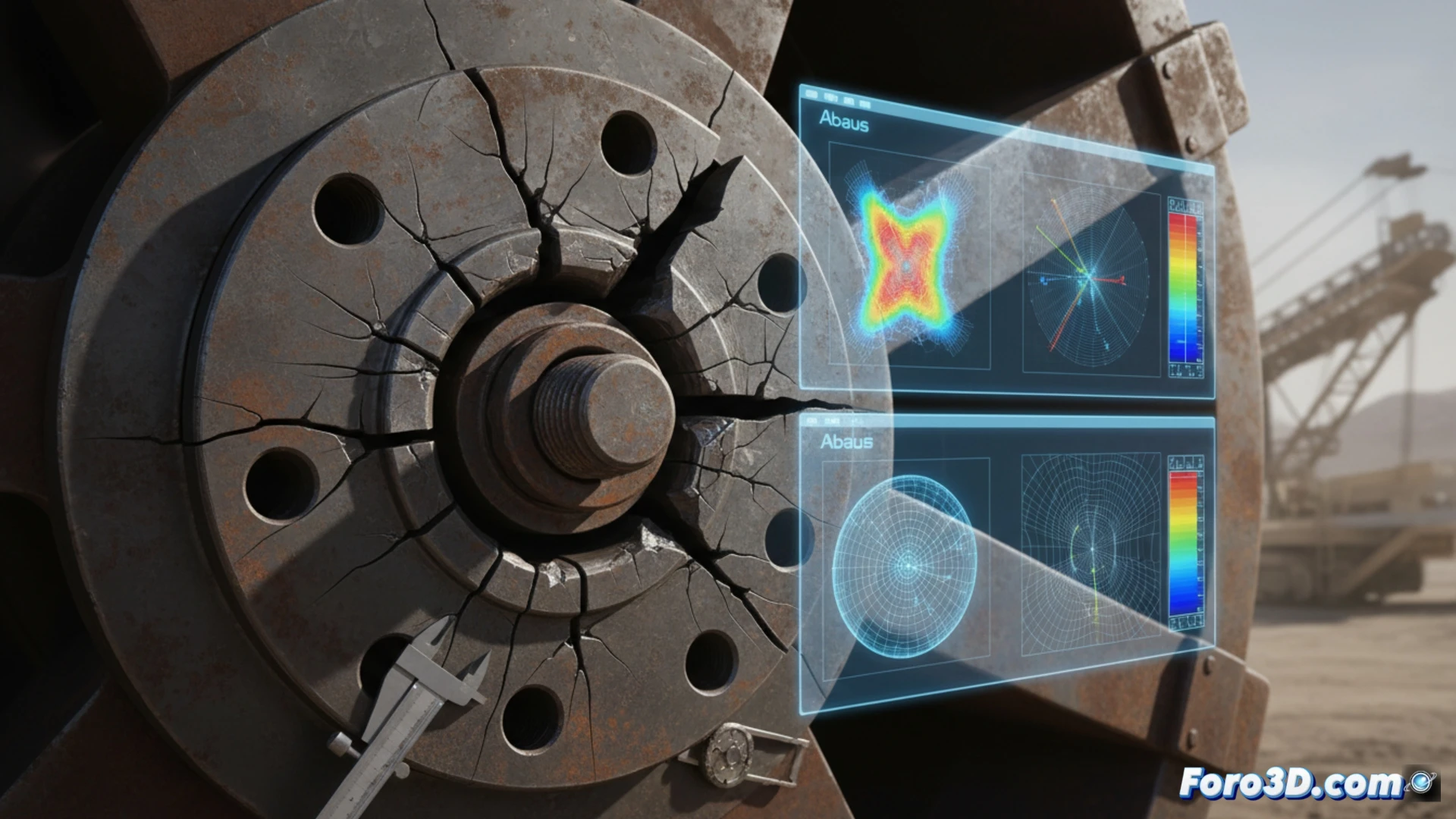
Damage Simulation: From GOM Inspect to Abaqus 🖥️
The workflow begins with a high-precision 3D scan using a Zoller & Fröhlich scanner to capture the actual geometry of the fractured bolts and the contact marks on the flange. We import the point cloud into GOM Inspect to create a surface deviation map, identifying areas with plastic deformation and the characteristic striations of overtightening. These imperfections are modeled as boundary conditions in Abaqus. There, we run a residual stress analysis using an elastoplastic model. The results show that the excessive tightening torque generates a localized tensile stress that exceeds the material's breaking point, initiating a crack that progresses in a brittle manner until the complete detachment of the bucket.
Lessons for Failure Prevention 🛠️
The simulation reveals that the embrittlement is not a defect of the base material, but a direct consequence of incorrect maintenance operations. Visualizing the fracture process through Abaqus animations allows engineers to understand how a simple torque error escalates to a structural failure. Cross-validation with GOM Inspect data confirms that the marks on the bolt coincide with the simulated maximum stress zones. The conclusion is clear: implementing torque control with torque sensors and a periodic scanning protocol for the joints can prevent future detachments, extending the wheel's service life.
As a simulation engineer, how could you accurately model the residual stress distribution in a bucket wheel hub to predict the exact point of fracture initiation due to overtightening before the catastrophic failure occurs?
(PS: Material fatigue is like yours after 10 hours of simulation.)