Last month, a blown glass facade in a museum collapsed abruptly with no apparent impact. The failure, classified as brittle fracture due to thermal shock, occurred after a sudden temperature change. An engineering team used 3D scanning and finite element simulation to reconstruct the event, identifying that the extreme thermal gradient generated differential internal stresses that exceeded the material's strength limit.
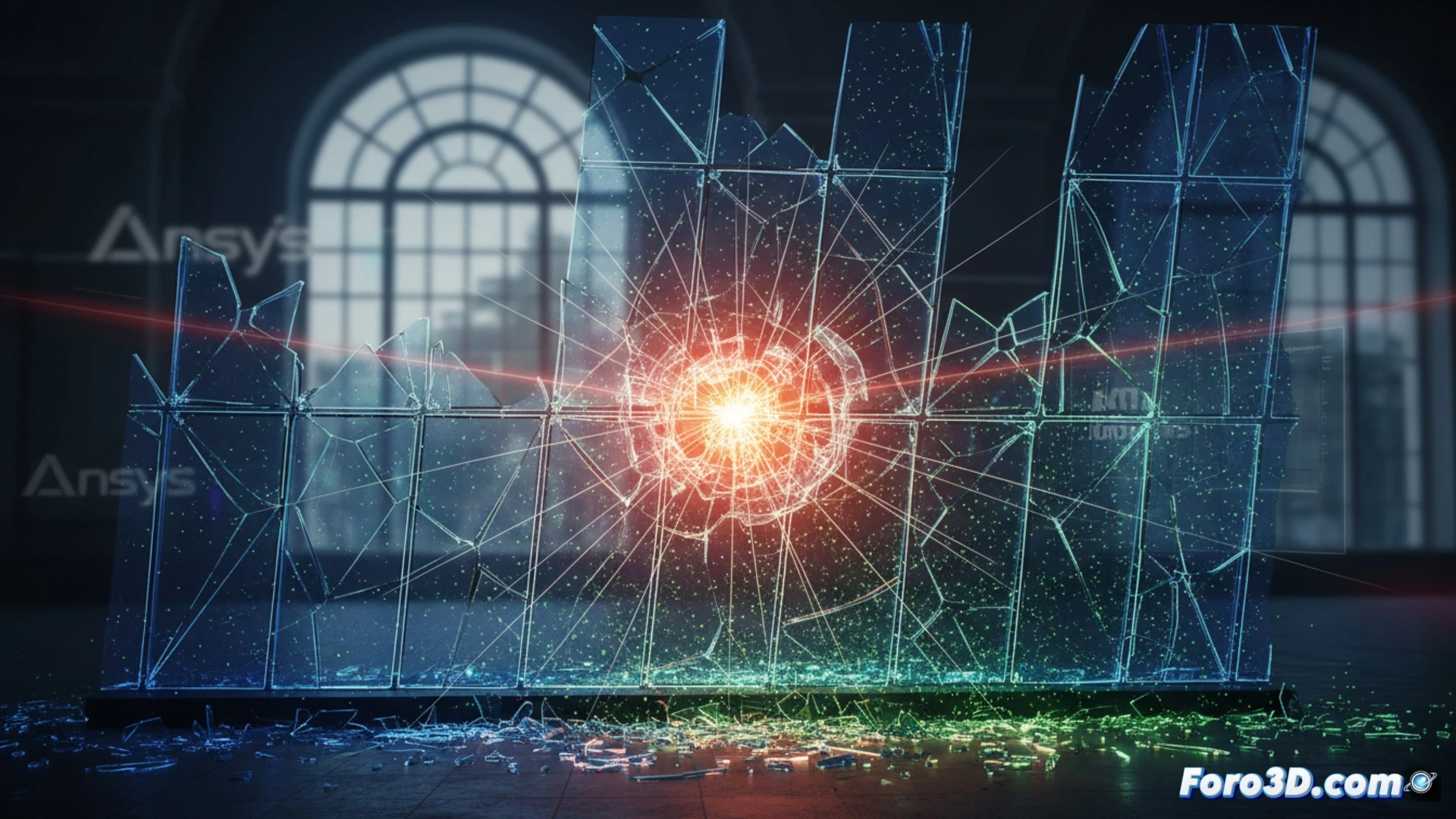
Modeling the thermal gradient and stress simulation in Ansys 🔥
The reconstruction began in Geomagic Design X, where the geometry of the fragments was digitized to create an undeformed solid model. This model was imported into Ansys to apply thermal boundary conditions: one face exposed to 65 degrees Celsius from solar radiation and the opposite face to 10 degrees from interior shade. The steady-state simulation revealed a gradient of 55 degrees over just 12 millimeters of thickness. The resulting Von Mises stress reached 48 MPa, exceeding the fracture limit of blown glass (35 MPa). The critical zone was located at the panel edge, where differential expansion generated microcracks that propagated the catastrophic failure.
Instantaneous fatigue and lessons for facade design ⚡
Although the glass did not undergo repeated load cycles, the event illustrates a case of static fatigue due to thermal stress: the stress accumulated instantaneously until fracture. The animation in 3ds Max showed how the crack originated at the edge and branched out in seconds. For future projects, it is recommended to use laminated glass with a controlled expansion coefficient and avoid rigid anchors that prevent natural dilation. 3D forensic simulation allows understanding these failures and preventing them in high thermal stress environments.
As a forensic engineer, what would be the most accurate method to differentiate, through 3D finite element simulation, between a fracture caused by thermal shock and one caused by prior mechanical fatigue in blown glass with no impact history?
(PS: Material fatigue is like yours after 10 hours of simulation.)