The bending failure of a pedestrian bridge printed in advanced polymers has brought the reliability of layer-manufactured structures to the center of the debate. The collapse, which occurred during load testing, was not abrupt but progressive, revealing a fatigue process accelerated by the incorrect orientation of the reinforcing fibers. The subsequent forensic analysis focused on two critical points: delamination between layers and the deviation of the stress flow from the original design.
Structured light scanning and digital twin for the failure 🔍
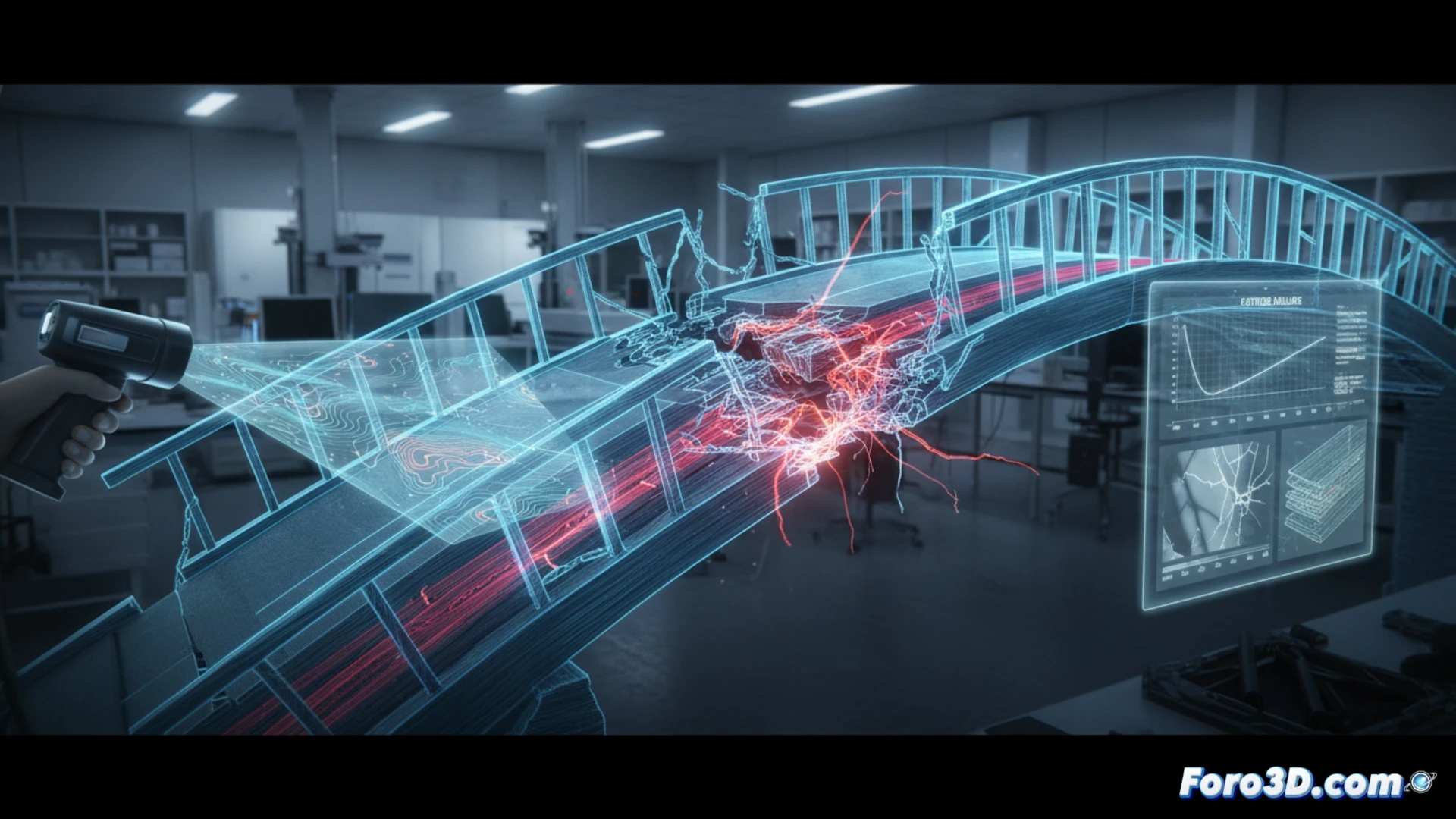
To determine the root cause, engineers applied structured light scanning to the fractured surface. Using GOM Inspect, a high-precision point cloud was generated, revealing micro-separations between layers, areas where adhesion failed due to cyclic fatigue. This digital model was imported into Ansys Composite PrepPost, where the actual fiber orientation was mapped. The simulation showed that the fibers were aligned in the wrong direction relative to the beam's neutral axis, concentrating stress at the layer edges and causing progressive delamination. The digital twin allowed comparing the actual behavior against the ideal design from Autodesk Fusion.
Parametric lessons for fatigue in 3D printing ⚙️
This case demonstrates that fatigue simulation cannot ignore the anisotropy of the additive process. The solution is not just to reinforce the material, but to redesign the fiber orientation and layer deposition pattern so they work in favor of bending. Integrating tools like KeyShot to visualize hot spots and adjusting parameters in Fusion allows creating structures that distribute load evenly. The fracture of this bridge is a technical reminder: in 3D printing, strength lies not only in the polymer, but in the intelligence of parametric design.
To what extent can a high-resolution 3D scan of the fracture surface, combined with finite element simulations, reveal hidden printing defects that cyclic fatigue would have overlooked in a traditional visual analysis?
(PS: Material fatigue is like yours after 10 hours of simulation.)