A 60-meter-high panoramic Ferris wheel suffered an emergency stop after an anomalous vibration was detected in its central axle. The forensic analysis, initiated with a 3D scan using Leica Cyclone, revealed a residual torsion of just a few millimeters in the steel. This seemingly minor data point triggered a finite element simulation in SolidWorks Simulation to reconstruct the dynamic load history and determine if gusty winds exceeded the fatigue limits of the original design.
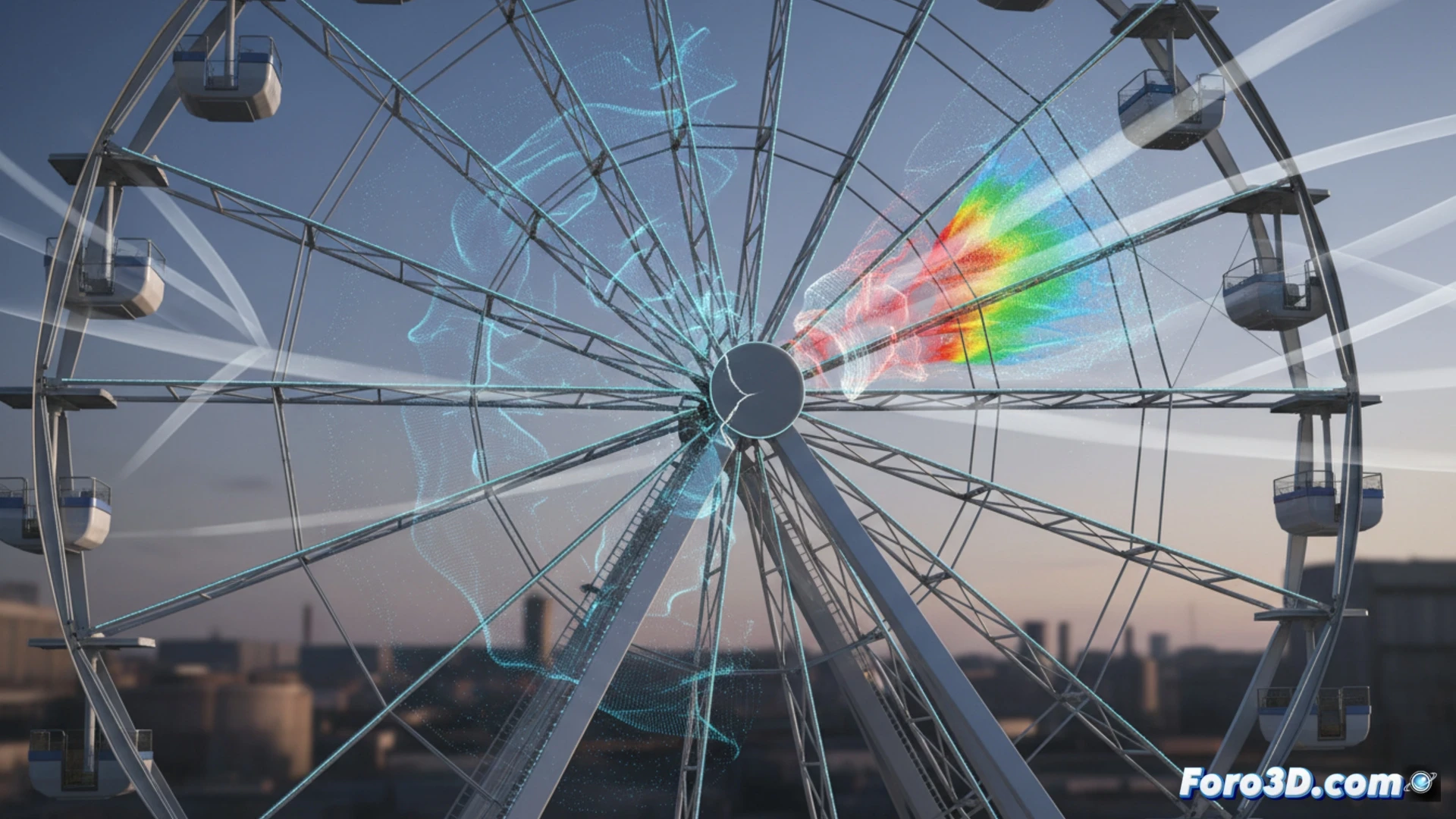
Forensic reconstruction: from point cloud to stress map 🛠️
The process began with capturing the deformed geometry using Leica Cyclone, generating a high-density point cloud that PolyWorks processed to obtain an accurate CAD model of the torsion. This model was imported into SolidWorks Simulation, where historical load conditions recorded by the Ferris wheel's sensors were applied. The FEA analysis allowed comparing the actual stress distribution against the original design, identifying a stress concentration point in the fracture zone. Stress-strain graphs showed that under wind gusts of 90 km/h, the material reached the yield point, accumulating fatigue damage with each torsion cycle.
The unforgiving thousandth of a degree ⚙️
The simulation not only confirmed the failure but also revealed an insufficient safety margin for gusty wind loads with variable direction. The axle, designed for pure torsion, did not account for the combination of bending and torsion induced by lateral gusts. This case demonstrates that, in large-scale structures, material fatigue must be modeled with extreme weather scenarios, and that millimeter-precision 3D scanning is the key forensic tool to validate or correct the assumptions of the original design.
What finite element simulation methodology did they apply to correlate the 3D scan of the incipient crack with the actual torsion limit of the axle, considering the Ferris wheel's cyclic load history?
(PS: Material fatigue is like yours after 10 hours of simulation.)