Last month, a fire truck with an articulating ladder suffered a critical chassis fracture during a rescue maneuver. Fortunately, there were no casualties, but the incident raised an alarm in emergency vehicle engineering. The break, located on the rear side member, was not a sudden failure but the result of years of accumulated torsional stresses in the steel. Now, digital analysis using virtual twins seeks answers in the welding and material fatigue.
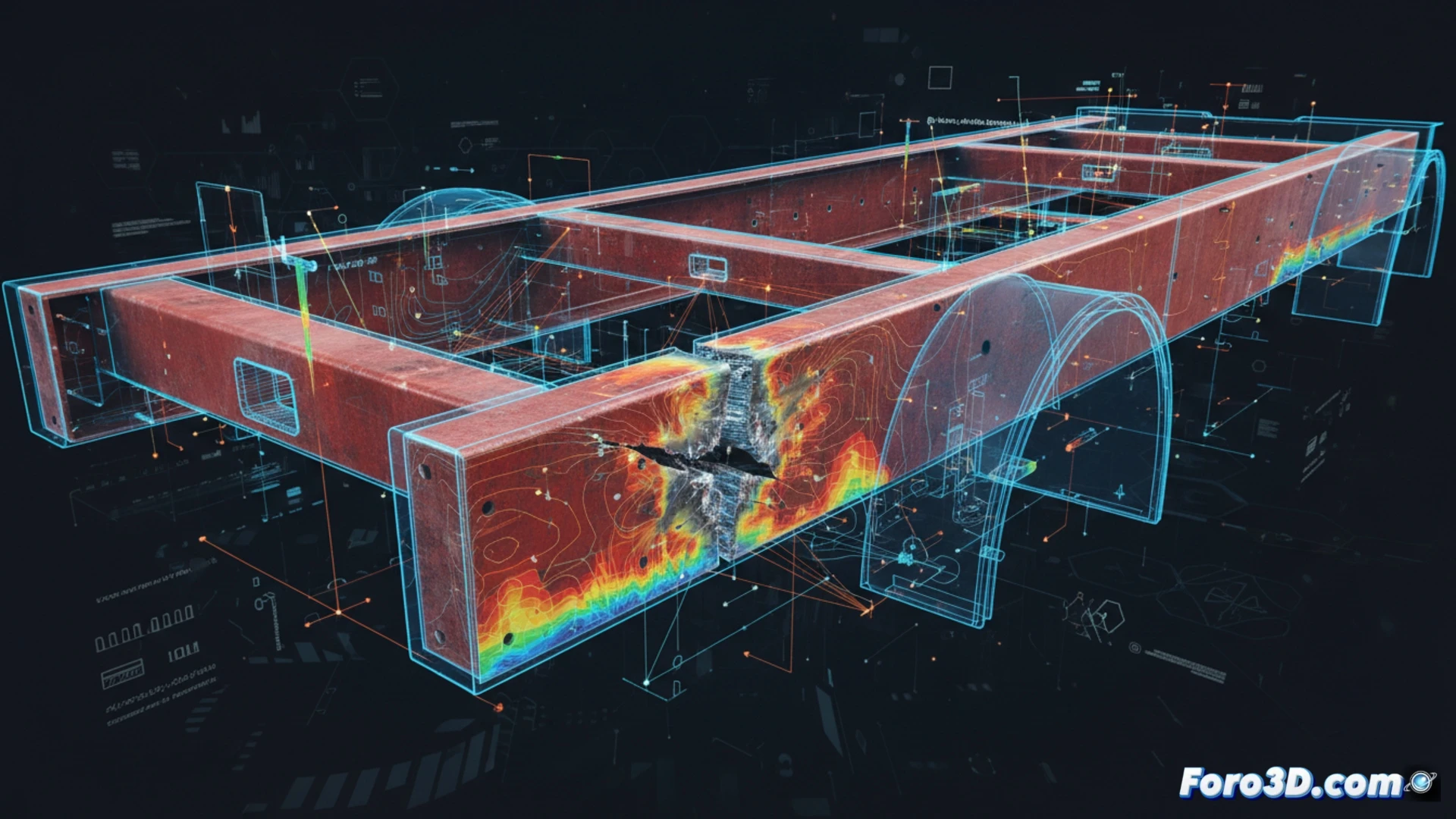
FEM Simulation in Siemens NX and Deformation Scanning 🛠️
The investigation process began with the digitization of the damaged chassis using GOM Inspect, generating a high-precision point cloud that captured every plastic deformation. This model was imported into Siemens NX, where a finite element analysis (FEM) was applied to recreate the typical torsional loads of a turn with the ladder extended. The results revealed a concentration of cyclic stresses in the fracture zone, exceeding the fatigue limit of the steel. Concurrently, ultrasonic data was integrated into Autodesk Fusion to locate hidden microcracks in the weld beads, defects that acted as failure initiators.
Digital Prevention to Save Lives on Wheels 🚒
This chassis fracture is not just a mechanical problem; it is a reminder that emergency vehicles operate at the limit of their design. Integrating 3D scanning and fatigue simulation allows predicting where and when the steel will fail before an accident occurs. Tools like Cinema 4D help visualize these critical areas for maintenance teams. In the end, technology not only repairs but anticipates, ensuring that those who risk their lives for us do so on a structure that does not break.
As a simulation engineer, what multiaxial fatigue parameters did you consider critical for predicting the failure in the fire truck chassis, and how did you validate that data with the post-mortem analysis of the fracture?
(PS: Material fatigue is like yours after 10 hours of simulation.)