The collapse of an articulated arm during the transfer of liquid ammonia at a port terminal generated a toxic cloud that halted operations. The failure, located in the swivel joints, poses a technical dilemma: was it cavitation or a cryogenic water hammer that exceeded the steel's resistance? To resolve this, a multidisciplinary analysis was employed using Siemens NX, OrcaFlex, and SolidWorks Simulation, aiming to replicate the extreme pressure and temperature conditions.
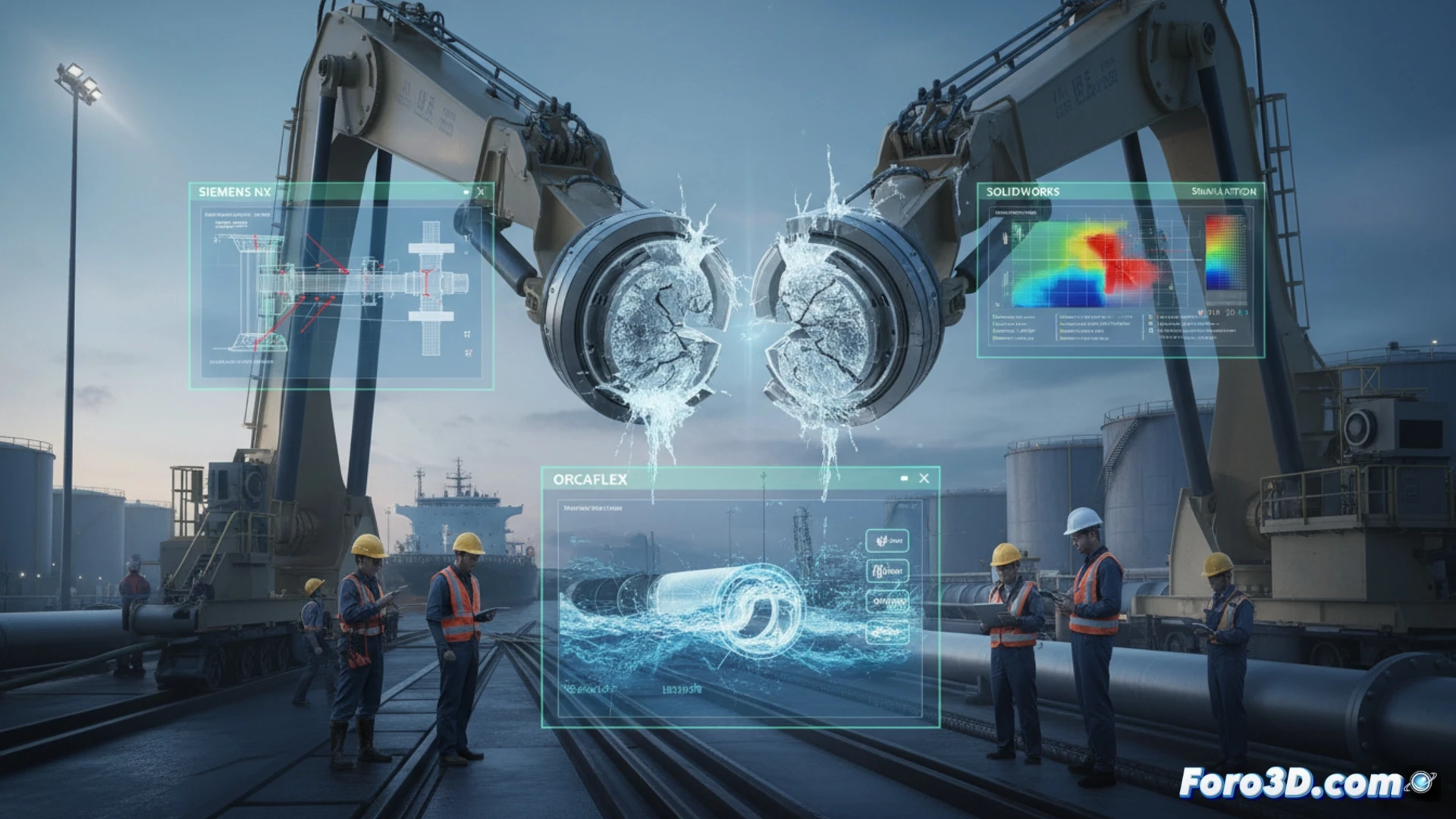
Transient modeling of swivel joints under cryogenic loads 🔧
In Siemens NX, the parametric model of the joint was built, integrating material properties at -33°C and elastomeric seals. OrcaFlex simulated the fluid dynamics in the pipe, capturing the water hammer generated by the sudden closure of a valve; pressure peaks reached 2.5 times the nominal value. This data was imported into SolidWorks Simulation for a multiaxial fatigue analysis. Cavitation, modeled as collapsing bubbles, induced high-speed microjets that eroded the seal surface, while the water hammer generated a stress wave of 400 MPa in the joint pin, exceeding the fatigue limit of 316L stainless steel.
Lessons for failure simulation in cryogenic infrastructure ⚠️
The study demonstrated that the joint failed due to high-cycle fatigue combined with a punctual overstress from the water hammer, not from pure cavitation. Cavitation acted as an initiator of surface cracks, but the water hammer propagated the fracture catastrophically. For future designs, it is recommended to integrate pulsation dampeners in the ammonia line and use steels with low-temperature toughness. 3D simulation, by linking fluid dynamics and structural fatigue, consolidates itself as an indispensable tool to prevent disasters in port terminals.
How to accurately model the behavior of the heat-affected zone in an austenitic stainless steel weld under cyclic loads at cryogenic temperatures to predict brittle fracture in ammonia loading arms?
(PS: Material fatigue is like yours after 10 hours of simulation.)