The Flat Man, or Flatman, created by John Byrne, possesses the ability to compress his body to a two-dimensional thickness. This ability, which in the comic allows for stealth and infiltration, becomes a powerful metaphor for digital activism. We analyze how 3D art can reinterpret this condition to criticize the loss of identity in the era of surveillance and visual homogenization.
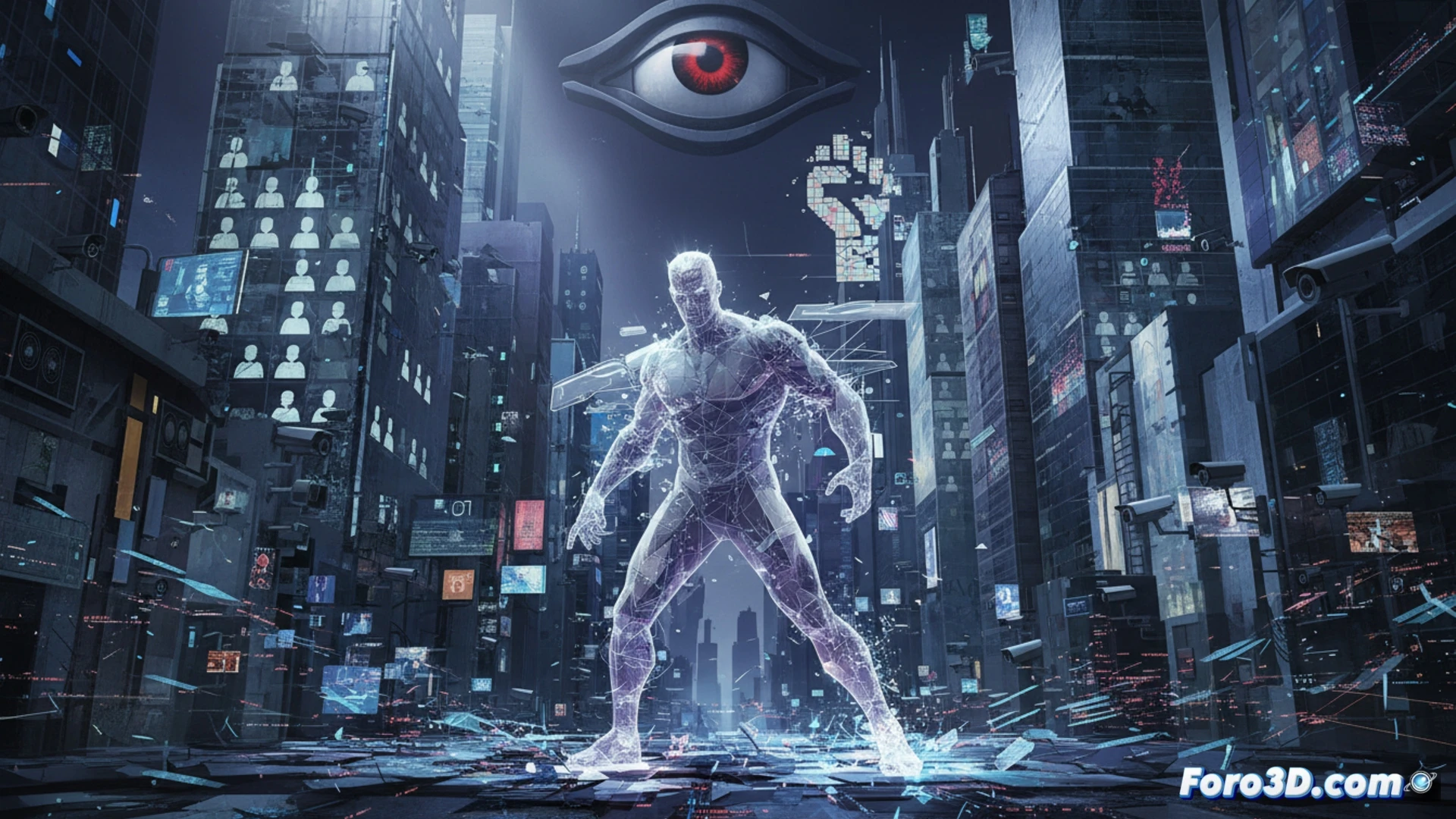
Modeling and animation: from physical compression to social abstraction 🎨
To develop a conceptual piece, the first step is to model a base human body in software like Blender or ZBrush. The technical key lies in node-based deformation: applying a non-uniform scale modifier on the Z axis (thickness) until it is reduced to 0.001 units. The lighting must be extremely lateral so that the silhouette almost disappears, generating an edge texture reminiscent of a video game sprite. The animation, using inverse kinematics, would show the character sliding through urban crevices, losing volume and color until becoming a line of pixels, symbolizing how the system reduces people to flat data.
Two-dimensional invisibility: a critique of digital identity 👁️
The final work, consisting of a looping animation and a series of renders, seeks to make the viewer feel uncomfortable with the disappearance of human volume. Just as Flatman becomes invisible in profile, social media users flatten their identity to fit into algorithms. The visual activism here lies in showing that loss as a grotesque anomaly: a body that ceases to be three-dimensional to become mere visual data, a direct critique of the homogenization forced by digital platforms.
How can Flatman's ability to become two-dimensional transform physical invisibility into a tool of visual protest within digital activism?
(PS: if your virtual reality installation doesn't change the world, at least let it not lag)