An international team of researchers has documented an unexpected phenomenon in fluid dynamics: water droplets deposited on lubricated surfaces can undergo repeated Coulomb fissions during evaporation. Published in Proceedings of the National Academy of Sciences, the study reveals that a 1 µL droplet can generate more than 60 fission cycles in 30 minutes, producing liquid jets that fragment into tens of microdroplets. This finding opens the door to new nanoscale fabrication techniques.
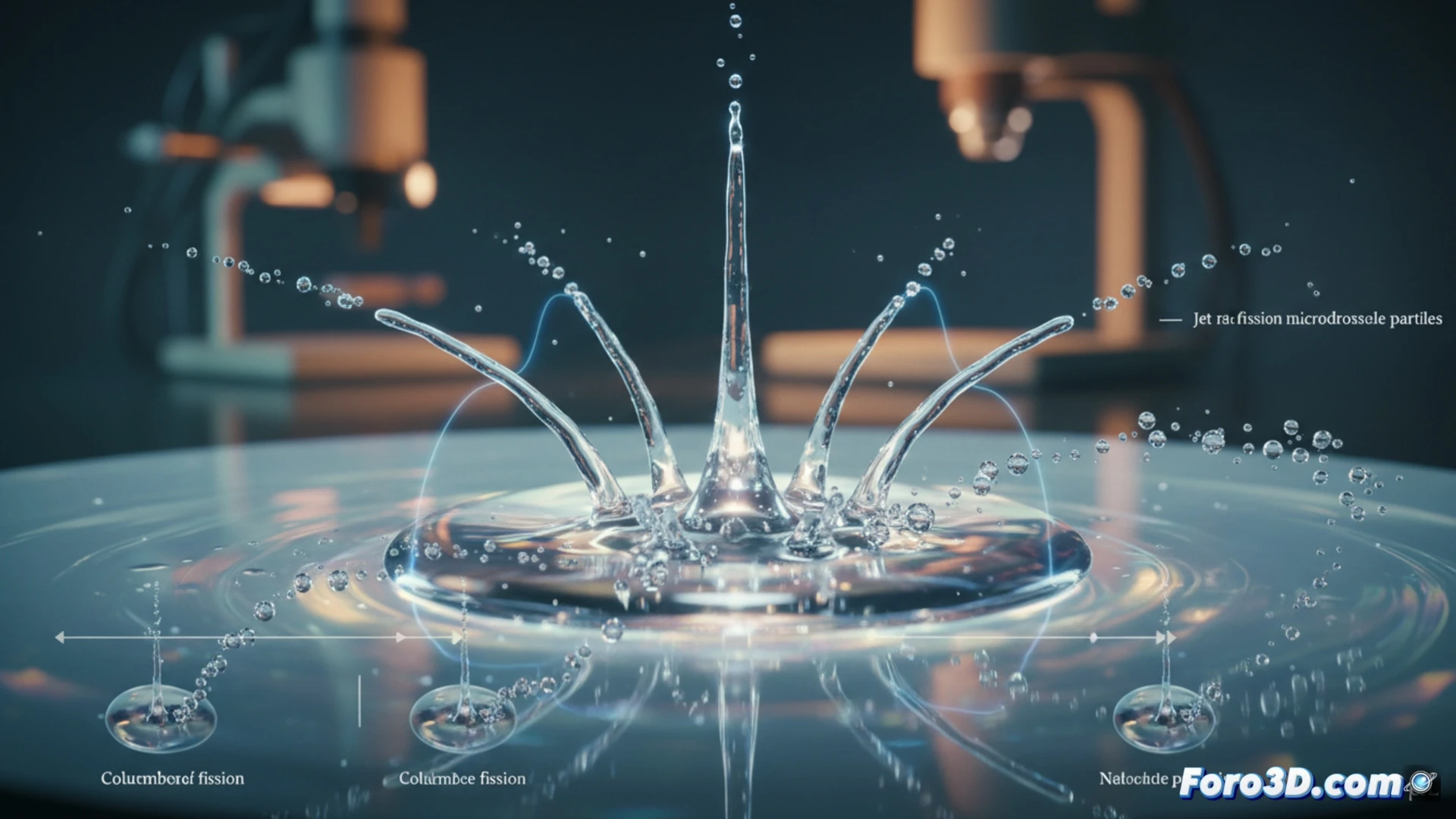
Mechanics of the phenomenon: charge, evaporation, and electrostatic rupture ⚡
The experiment uses deionized water droplets deposited on a Petri dish coated with a 0.5 µm silicone oil film. During pipetting, contact electrification gives the droplet an initial charge of +70 pC. As it evaporates, the volume decreases while the charge remains constant, increasing the surface charge density. When electrostatic repulsion exceeds surface tension, fission initiates after approximately 20 minutes. Each event produces a fine jet that splits into 40 to 50 microdroplets within microseconds. Historically, this behavior was only observed in levitated droplets, as sessile droplets were anchored by the contact line. The lubricated surface eliminates that anchoring, allowing the instability.
3D visualization: simulating the dynamics of chain fission 🧊
For the Scientific Visualization niche, we propose an animated three-dimensional simulation representing the droplet on the lubricated surface, with a visual indicator of the charge density increasing as the volume decreases. The animation should show the first fission with the jet ejection and its fragmentation into microdroplets, repeating the cycle in slow motion. Temporal graphs comparing electrostatic charge versus surface tension will be included, as well as a comparative view between a levitated droplet (which fissions) and a classic sessile one (which does not fission), facilitating understanding of the critical role of surface lubrication.
How could the Coulomb fissions observed in sessile droplets revolutionize current nanofabrication methods by allowing precise control over the morphology of nanostructures?
(PS: fluid physics for simulating the ocean is like the sea: unpredictable and you always run out of RAM)