The rupture of a high-pressure pasteurization (HPP) cylinder at 6,000 bar revealed a brittle fracture in the forged steel. Constant contact with acidic juices (low pH) generated pits that acted as stress concentrators. The 3D pipeline combined scanning with RealityCapture, inspection in GOM Inspect, and simulation in Ansys to validate the hypothesis of corrosion fatigue under extreme cyclic loads.
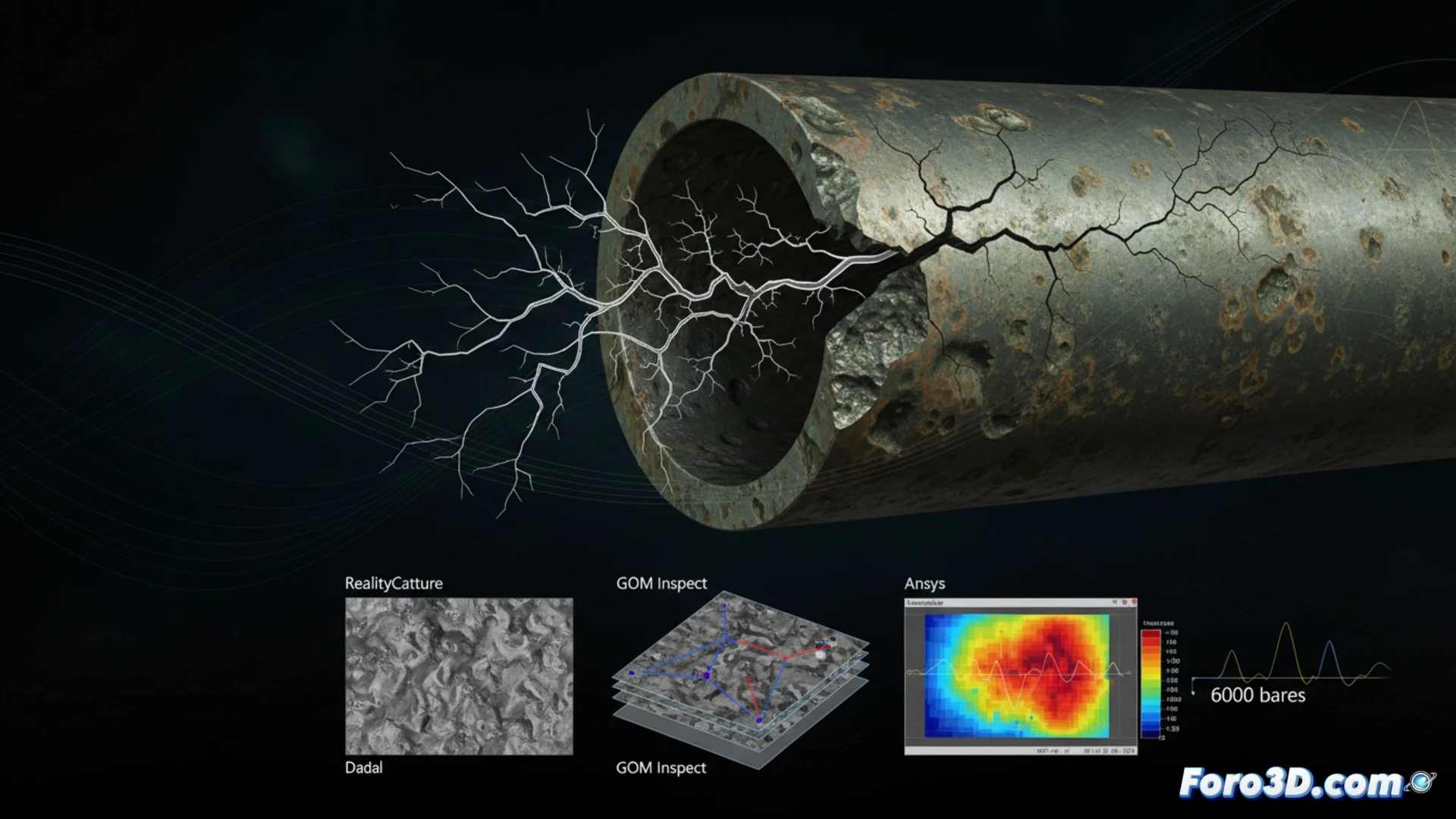
Meshing, S-N curves, and life maps in Ansys Mechanical 🔧
The cylinder was modeled in Ansys Mechanical with a refined hexahedral mesh in the crack zone (element size of 0.5 mm). The cyclic load was applied as a variable internal pressure from 0 to 600 MPa (6,000 bar) over 10,000 cycles. Modified S-N curves for forged steel in an acidic environment were introduced, reducing the fatigue limit by 30% compared to the base material. The life maps showed a concentration of damage in the corroded region, with an estimated life of 8,500 cycles before unstable fracture. Validation in GOM Inspect confirmed that the fracture surface morphology matched the simulated crack growth pattern (initiation at a pit and radial propagation).
Forensic lessons for HPP equipment design 🧠
This case demonstrates that fatigue simulation in Ansys cannot ignore the corrosive environment. The combination of GOM Inspect (to capture the actual crack geometry) and Ansys (to predict its evolution) allows for establishing safer inspection thresholds. For future designs, it is recommended to apply passivating coatings and reduce the maximum pressure cycle in the presence of acids, or alternatively, use steels with greater resistance to pitting corrosion.
How to model in Ansys the transition from a fatigue crack to a brittle fracture in forged steel under corrosion conditions at 6000 bar in an HPP cylinder
(PS: Material fatigue is like yours after 10 hours of simulation.)