The premature failure of a self-cleaning system in a skyscraper has revealed a classic case of chemically induced material fatigue. The photocatalytic coating, designed to break down dirt with sunlight, developed permanent stains and irreversible opacity. The investigation now focuses on identifying how specific atmospheric pollutants degraded the polymer matrix at the micrometric level, a process that fatigue simulation must replicate to prevent future architectural disasters.
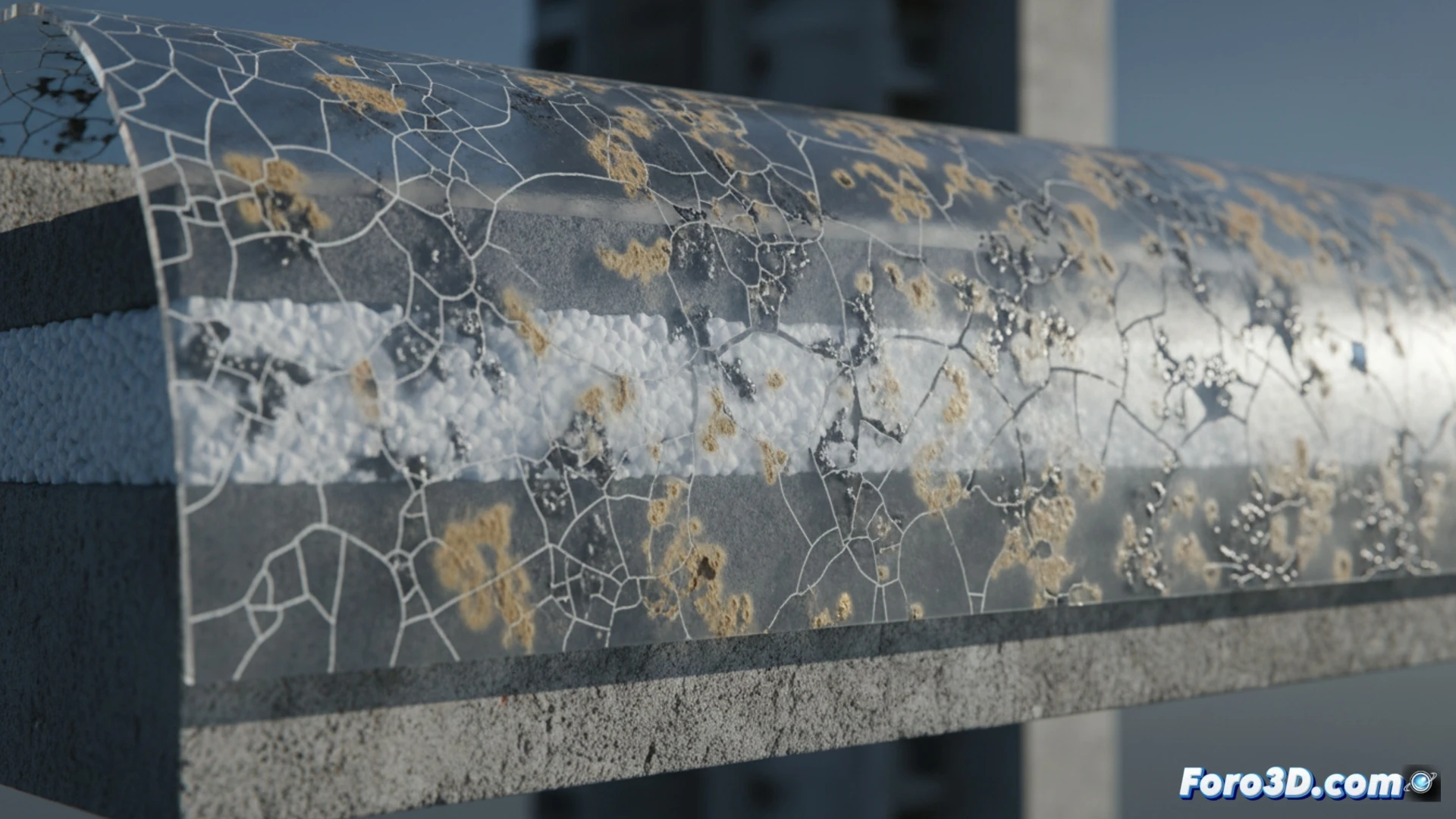
Degradation Mapping by Structured Light Microscopy 🔬
The Keyence VHX-7000 digital microscope, through its structured light function, allows obtaining precise topographies of the damaged surface. This 3D analysis reveals a localized thickness loss in areas of high exposure to nitrogen oxides and sulfur compounds. The elevation data is exported to GOM Inspect, where induced roughness and polymer volume reduction are quantified. It is observed that the fatigue is not uniform; pollutants act as catalysts for microcracks that propagate following the surface tension of the coating, generating a dendritic failure pattern.
Forensic Visualization of the Fatigue Cycle 🏗️
To communicate this degradation mechanism, a digital twin is built in 3ds Max. The original model is textured with a smooth, reflective finish in V-Ray, representing the functional state. The geometry is deformed by applying a displacement map obtained from the microscopic analysis, simulating chemical fatigue. The final render shows the material's transition from a perfect hydrophilic surface to a porous and opaque layer, evidencing how molecular interaction with urban smog destroys the polymer's structural integrity.
As a structural engineer, what 3D simulation methodology do you recommend for modeling the coupling between the photochemical degradation of the coating and the mechanical fatigue induced by thermal cycles in a high-rise concrete facade?
(PS: Material fatigue is like yours after 10 hours of simulation.)