A critical failure in a roller coaster linear synchronous motor (LSM) caused the train to stop abruptly when a neodymium magnet detached from the track. The incident, attributed to epoxy resin encapsulation fatigue, required a multidisciplinary forensic analysis. This article details the simulation pipeline that combined electromagnetic analysis, geometric modeling, and structural validation to identify the root cause of the detachment.
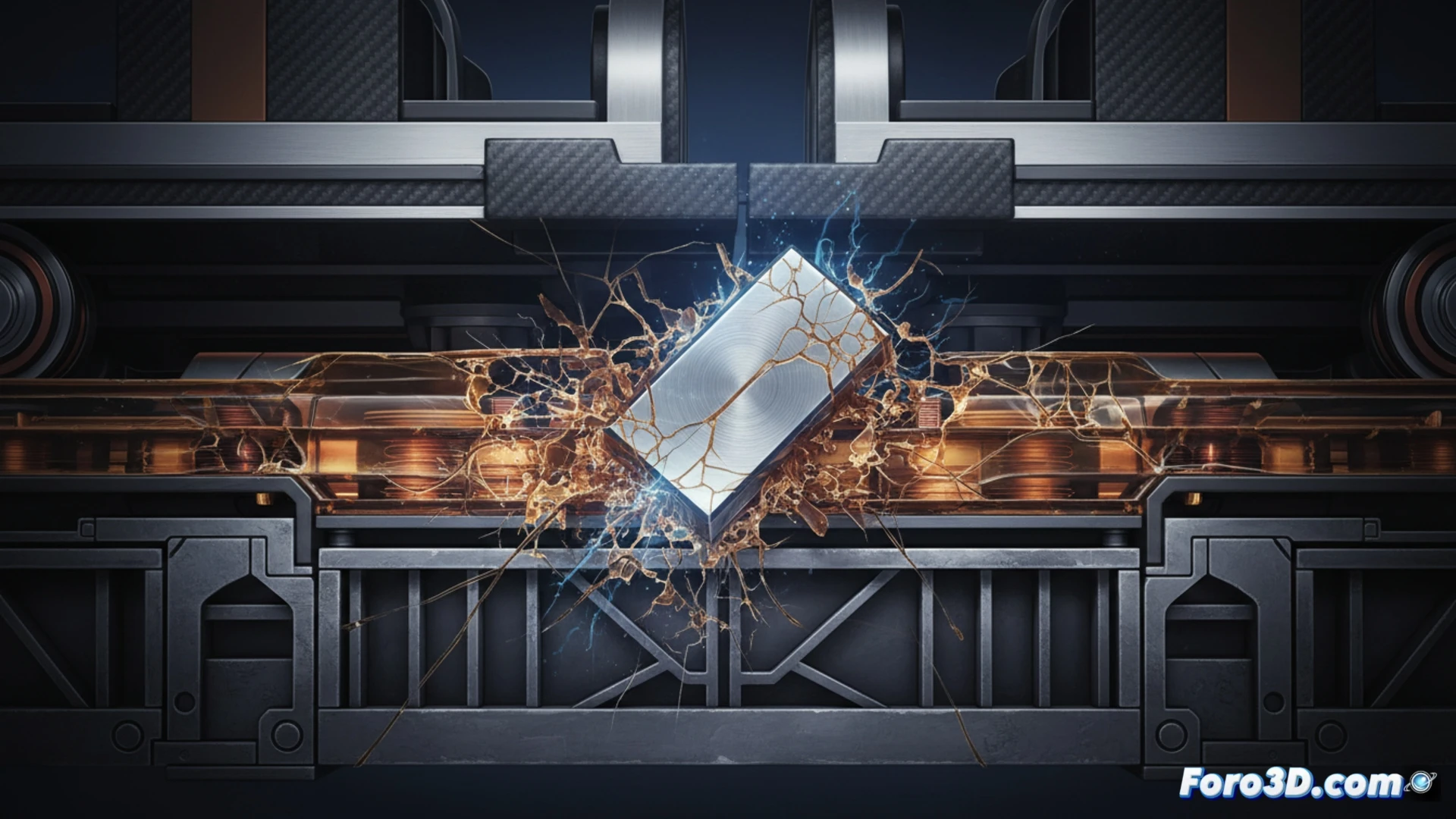
Forensic pipeline: from CST Studio Suite to SolidWorks and PolyWorks 🛠️
The process began in CST Studio Suite, where the magnetic field generated by the neodymium magnet was simulated under normal operating conditions and under current peaks. The magnetic attraction forces on the epoxy resin encapsulation were mapped, reaching stresses of up to 150 MPa in the anchoring zones. Simultaneously, a transient thermal analysis revealed that thermal vibrations induced by braking and acceleration cycles generated temperature gradients of up to 40 degrees Celsius at the magnet-resin interface. SolidWorks modeled the exact geometry of the encapsulation, including pre-existing microcracks, while PolyWorks digitized the surface of the detached magnet using 3D scanning. The overlay of CST stress maps with the PolyWorks point cloud confirmed that thermal and magnetic cycle fatigue concentrated on a 0.3 mm crack in the northeast corner of the encapsulation, the exact point where the resin lost adhesion.
Lessons for fatigue simulation in composite materials 💡
This case demonstrates that fatigue in epoxy encapsulations depends not only on mechanical load but on the synergistic interaction between varying magnetic fields and differential thermal expansion. The forensic pipeline validated that the resin, with a tensile strength of 70 MPa, failed below its static limit due to the accumulation of micro-deformations. For future designs, it is recommended to integrate thermomagnetic fatigue testing into the prototyping phase, using CST to predict hot spots and SolidWorks to redesign encapsulation geometries with larger curvature radii.
Considering that the failure originated from magnet detachment, which factor of cyclic fatigue at the epoxy-neodymium magnet adhesive interface was most decisive for crack initiation: stress concentration due to differences in the coefficient of thermal expansion, degradation from environmental humidity, or the frequency of load peaks during LSM acceleration?
(PS: Material fatigue is like yours after 10 hours of simulation.)