During an aerodynamic test at 250 km/h, the anechoic wedges of a wind tunnel detached, impacting the prototype. The incident was not a simple assembly error; analysis revealed that airflow turbulence generated cyclic suction pressure on the lining. This phenomenon, modeled using CFD in Star-CCM+, caused micro-deformations in the adhesive that, after accumulating, exceeded the material's fatigue limit, leading to detachment.
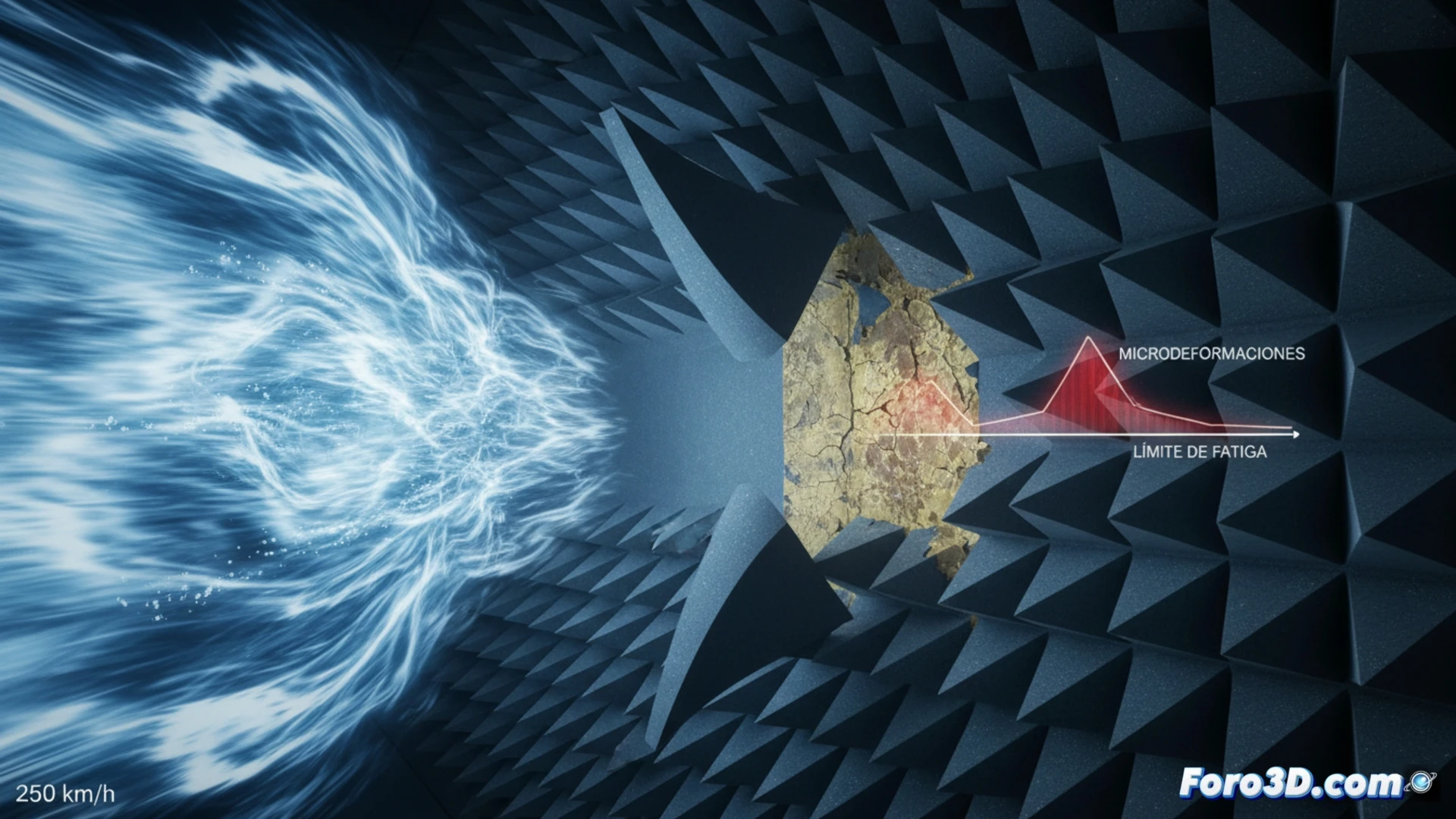
Simulation of load cycles using Star-CCM+ and 3D reconstruction 🔬
The team used Star-CCM+ to discretize the tunnel domain and calculate pressure fluctuations on each wedge. The suction pressure results were translated into a cyclic load signal on the adhesive. To validate the failure geometry, RealityCapture was used for photogrammetry of the damaged area and Revit to integrate the tunnel's BIM model. This allowed correlating the areas of greatest detachment with dynamic pressure peaks, generating a useful life map of the adhesive. Deformation animations showed how the amplitude of the lining vibration progressively increased with each turbulence cycle, until the deformation energy exceeded the toughness of the industrial adhesive.
Lessons for designing adhesive joints in extreme environments ⚙️
This case demonstrates that mechanical fatigue induced by turbulent flow cannot be predicted with static tests alone. The combination of CFD and 3D modeling allows engineers to anticipate failures in adhesive joints before they occur in real tests. The next time you see a detached lining in a test video, remember that behind it lies a hidden load cycle that the simulation software should have already detected.
Which finite element simulation methodology do you recommend for modeling fatigue crack propagation in structural adhesives under fluctuating aerodynamic loads such as those generated in high-speed wind tunnels?
(PS: Material fatigue is like yours after 10 hours of simulation.)