The explosion of a refrigeration unit in a supermarket triggered a forensic investigation focused on the needle valve. Initial analysis pointed to a stainless steel fatigue failure, but 3D reconstruction revealed an unexpected culprit: high-speed jet erosion generated by supercritical CO2. This case demonstrates that transcritical conditions can drastically accelerate the degradation of components designed for subcritical cycles.
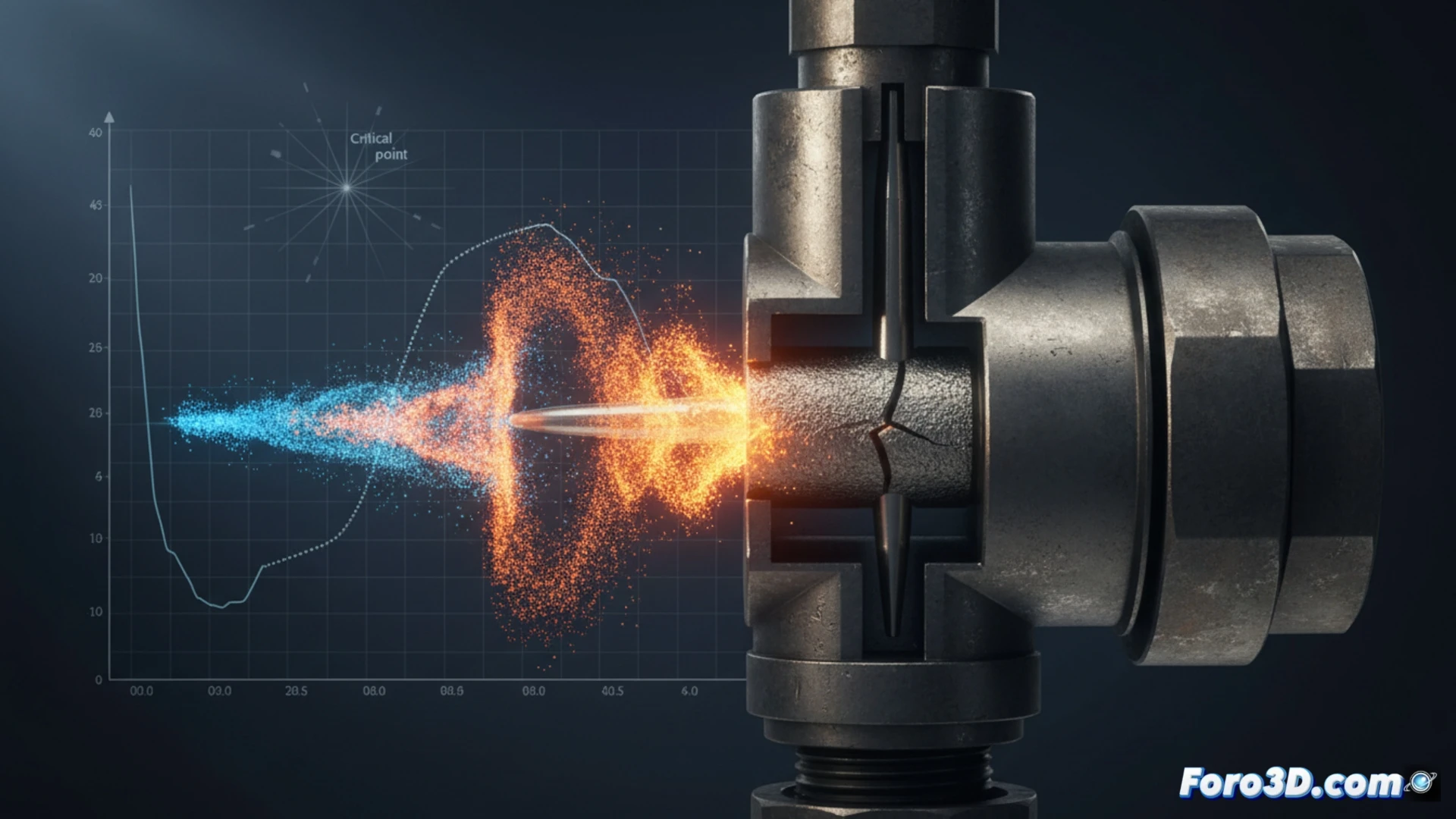
Erosion modeling by CFD and stress analysis in SolidWorks 🔧
To understand the failure, the supercritical CO2 flow was modeled in ANSYS CFX. The simulation showed that, upon reaching conditions near the critical point, the density and viscosity of the fluid generate a high-speed jet that directly impacts the valve needle. This impact causes localized micro-erosion, reducing the material thickness. Subsequently, the eroded geometry was imported into SolidWorks to perform static and fatigue stress analysis. The results indicated that the section thinned by erosion concentrated stresses well above the yield strength of the stainless steel, initiating cracks that led to catastrophic fracture. 3D scanning with GOM Inspect confirmed the morphology of the eroded surface, matching the highest flow velocity zones predicted by the CFD.
Lessons for transcritical system design 💡
The original design assumed homogeneous flow and stable conditions, but the reality of the transcritical cycle introduced an unforeseen erosion regime. The main lesson is that material fatigue in CO2 systems depends not only on mechanical loads but also on the chemical and physical interaction of the fluid in a supercritical state. For future designs, it is crucial to integrate multiphase CFD simulations with fatigue analysis from the conceptual stage, validated by periodic 3D scanning of prototypes. Ignoring this phenomenon can turn an expansion valve into a critical and explosive failure point.
What critical factors identified in the CFD simulation of the needle valve in a transcritical CO2 system explain the nucleation and propagation of fatigue cracks that led to the explosion of the refrigeration unit?
(PS: Material fatigue is like yours after 10 hours of simulation.)