A liquid oxygen tank for aerospace use failed catastrophically during a hydrostatic pressure test. Initial investigation pointed to the friction stir welded (FSW) joint. Volumetric analysis using computed tomography, combined with stress simulation in SolidWorks, revealed the root cause: aluminum oxide inclusions generated by insufficient rotational speed of the welding tool.
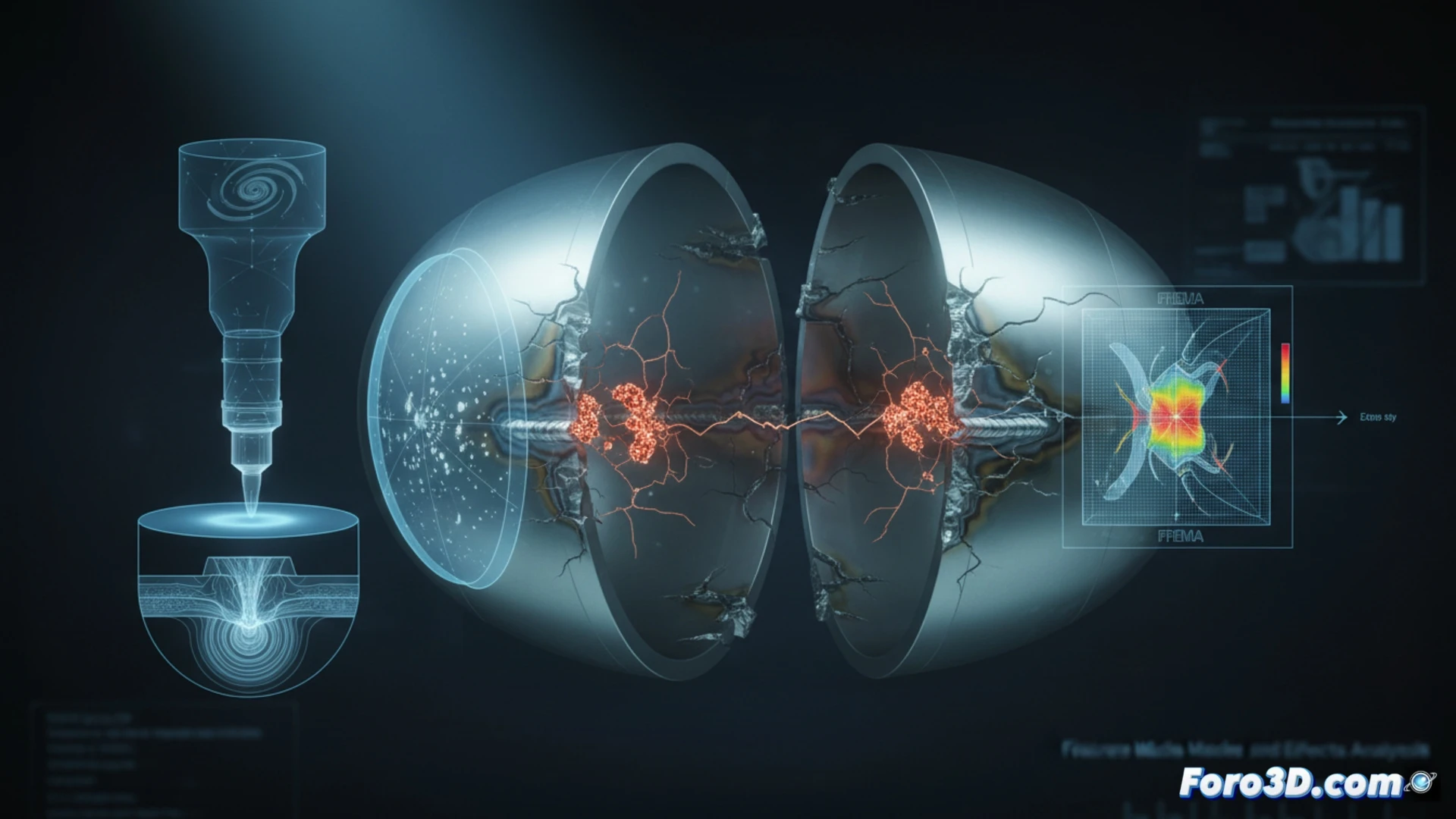
Locating microscopic defects with VGSTUDIO MAX and GOM Inspect 🔬
The forensic process began with a high-resolution X-ray scan of the weld bead in VGSTUDIO MAX. This software allowed identifying clusters of aluminum oxide inclusions, just microns in diameter, distributed along the stir zone. Subsequently, the point cloud was exported to GOM Inspect for geometric deviation analysis. The direct correlation between the areas with the highest concentration of inclusions and the regions of greatest plastic deformation, modeled in SolidWorks, confirmed that the low rotational speed (less than 600 RPM) prevented the proper dissipation of surface oxide, embrittling the joint.
Lessons for fatigue simulation in FSW processes ⚙️
This case demonstrates that fatigue analysis cannot be limited to the nominal properties of the material. The simulation must incorporate real defect models obtained through 3D scanning. The combination of VGSTUDIO MAX for inclusion detection and SolidWorks for residual stress calculation allows accurately predicting crack initiation points in FSW welds, optimizing parameters such as rotational speed to ensure structural integrity in cryogenic applications.
What 3D fatigue simulation techniques allow accurately modeling crack nucleation and propagation from inclusions in aluminum FSW joints for cryogenic tanks under hydrostatic pressure conditions?
(PS: Material fatigue is like yours after 10 hours of simulation.)