The detachment of a blade in an Archimedes screw hydrogenerator exposes a critical problem in low-head plants: accelerated fatigue due to cavitation and sediment abrasion. To understand the causes, a reverse engineering of the central shaft was performed using 3D scanning with Artec Studio, generating a high-precision point cloud. This digital model served as the basis for a CFD simulation in Flow-3D, allowing the correlation of wear zones with flow and pressure patterns.
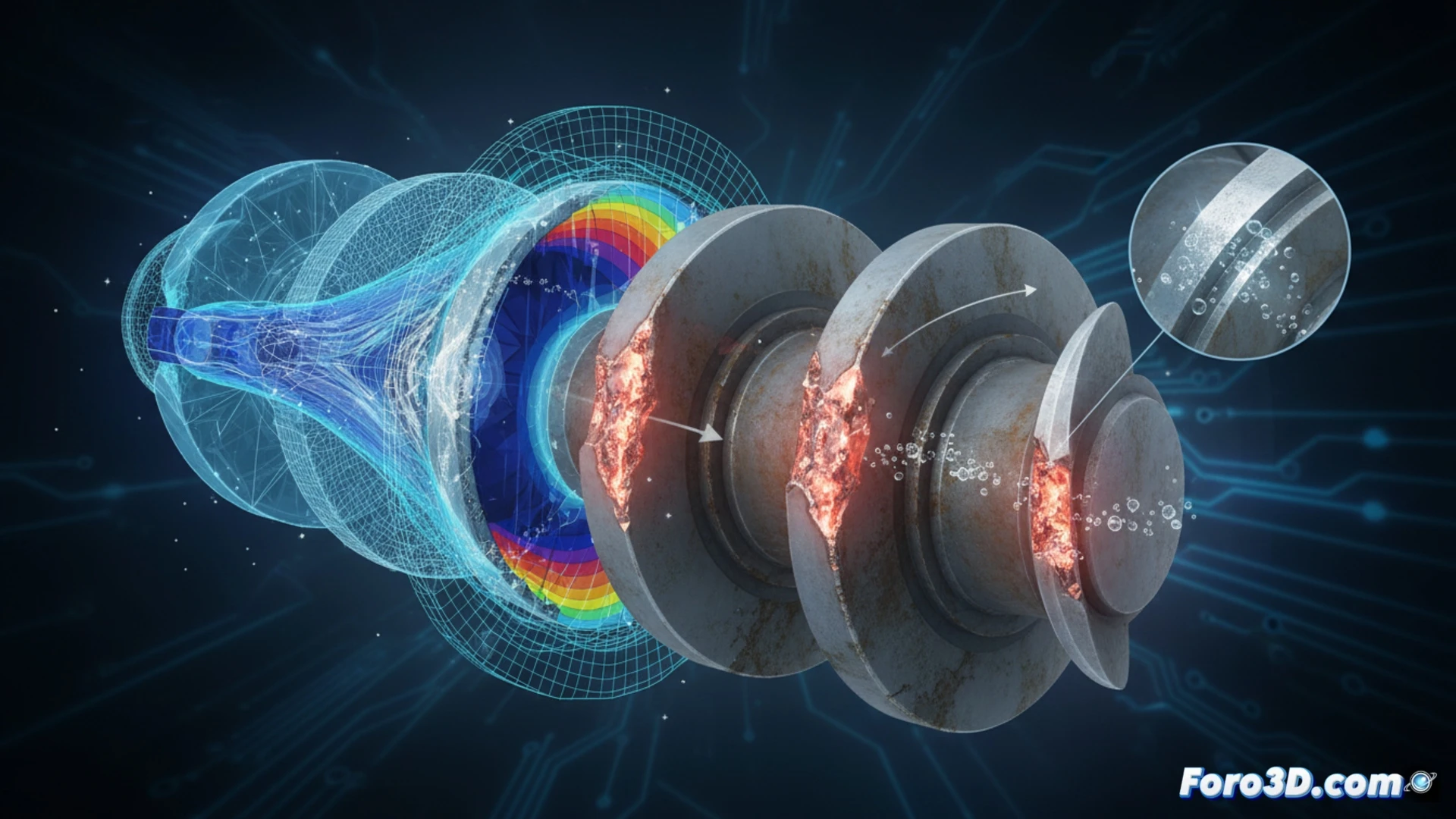
Digital reconstruction and multiphysics simulation of wear 🛠️
The process began with the three-dimensional capture of the damaged shaft, documenting material loss and surface cracks. In Fusion 360, the scan data was aligned with the original CAD design to measure plastic deformation and pit depth. The simulation in Flow-3D modeled the two-phase flow (water and vapor) around the twisted profile of the screw, identifying low-pressure regions where cavitation bubbles form. By overlaying the erosion maps from the scan with the zones of high turbulent kinetic energy, it was confirmed that the collapse of bubbles near the shaft surface caused fatigue from repetitive micro-impacts.
Lessons for lifespan prediction in hydrogenerators 💡
This case demonstrates that the combination of 3D scanning and CFD not only serves to diagnose a failure but also to predict the residual fatigue of the material. By calibrating the erosion model with actual abrasion data, engineers can modify the blade curvature radius or apply hard coatings in critical areas. The methodology allows optimizing the screw design to resist cavitation, extending its service life in environments with high sediment load.
What was the correlation between the cavitation bubble collapse zones predicted by the CFD model and the fracture surfaces observed in the 3D scan of the failed Archimedes screw?
(PS: Material fatigue is like yours after 10 hours of simulation.)