The catastrophe occurred during a deep excavation when a diaphragm wall collapsed, causing a massive flood that inundated the site. Subsequent analysis revealed that the failure was not structural due to overload, but rather due to a mud inclusion in the concrete during pouring. This discontinuity created a water path that, under the hydrostatic pressure of the aquifer, perforated the wall and triggered the disaster.
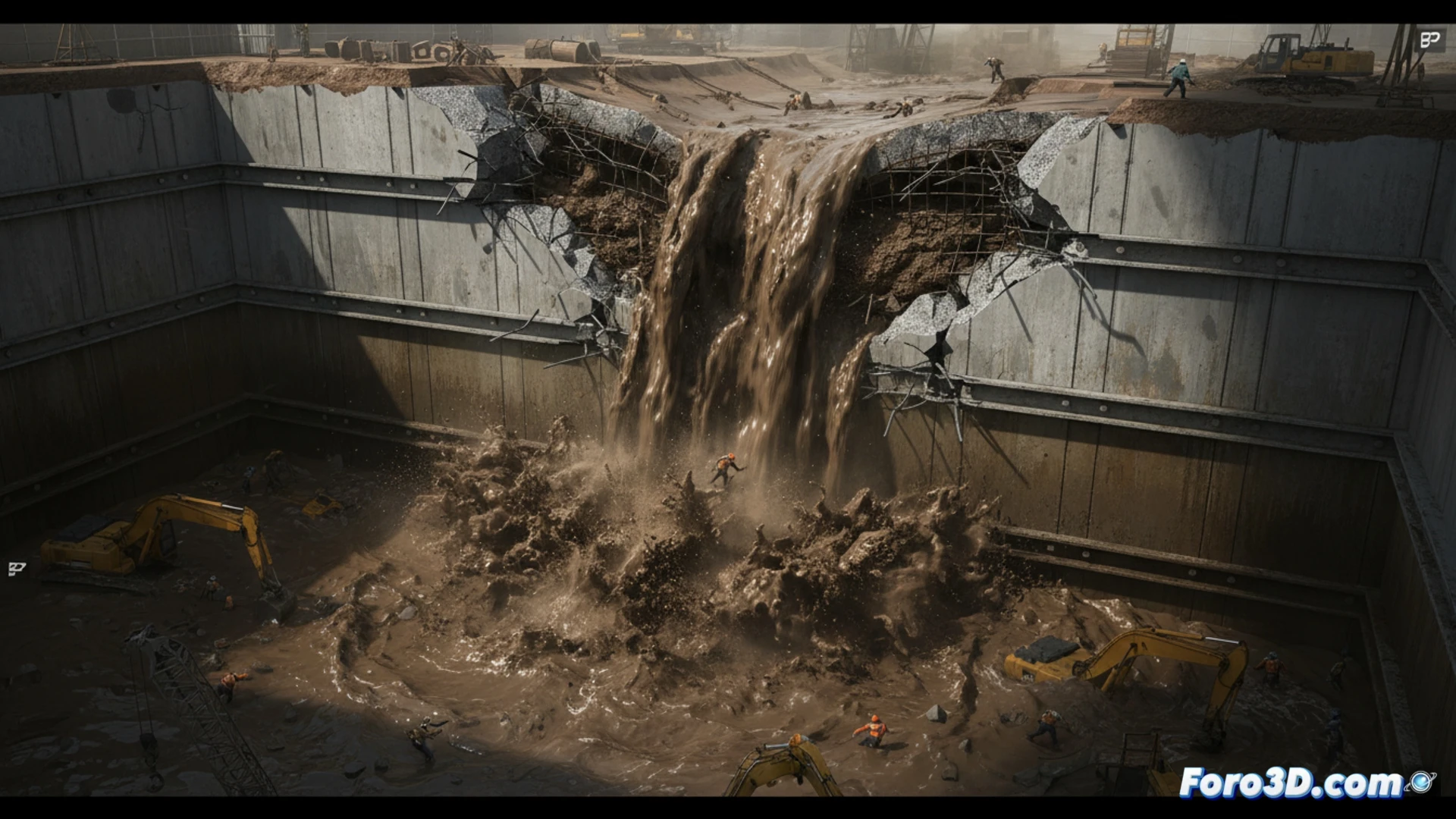
Technical Simulation of the Collapse and Leak 🛠️
To understand the failure mechanics, the soil-structure interaction was modeled in Plaxis 3D, simulating the earth and water pressures acting on the wall. The model revealed that the mud-contaminated zone had almost zero shear strength, acting as a defective plug. In parallel, Trimble RealWorks was used to scan the collapsed excavation, generating a point cloud that documented the exact flood volume and the geometry of the breach. Finally, Civil 3D allowed comparing the original wall design with the deformed reality, quantifying the deviation and validating the construction defect hypothesis.
Catastrophe Prevention with Digital Twins 🚧
This incident underscores the need to implement digital twins during diaphragm wall execution. A BIM model in Civil 3D, fed with real-time sensor data and verified with RealWorks point clouds, could have detected the thermal or strength anomaly in the concrete before the disaster. Predictive simulation in Plaxis 3D of failure scenarios, such as mud inclusion, should be a safety standard to prevent a localized defect from turning into a hydraulic catastrophe.
What variables would you consider to model this disaster?