A team from the University of Navarra, together with IKOR, GAIKER and the International University of Valencia, has reviewed 67 studies on the use of additive manufacturing in inserts for plastic injection molds. The analysis, published in Rapid Prototyping Journal, covers works from 2013 to 2024 and highlights the most commonly used routes: material jetting, vat photopolymerization, and metal laser powder bed fusion.
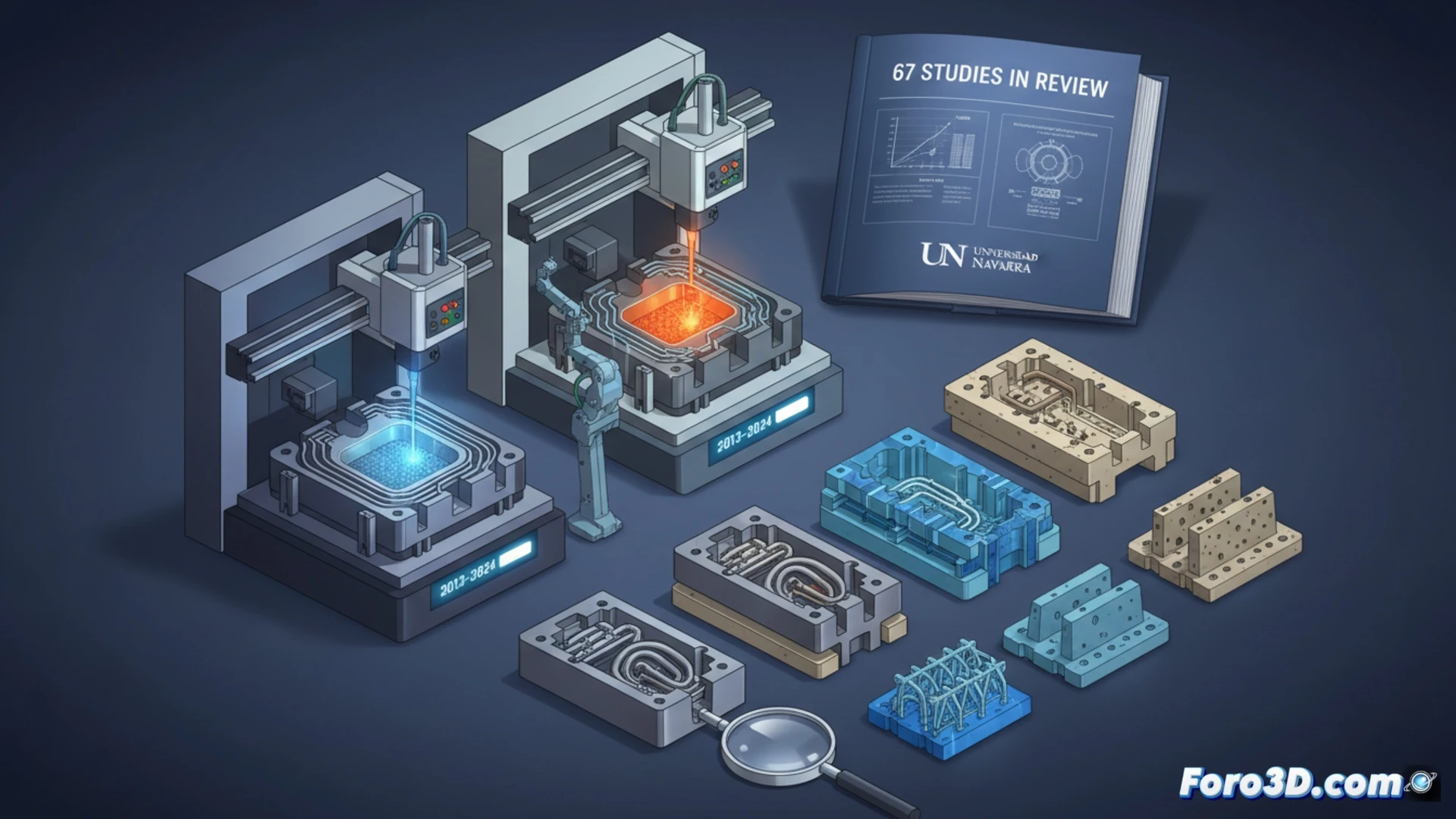
Three additive routes dominate insert manufacturing 🛠️
The systematic review confirms that additive manufacturing is viable for prototypes, temporary tooling, short runs, and applications with specific design requirements. The three main technologies allow for the creation of conformal cooling channels and complex geometries impossible with conventional methods. However, researchers warn that durability and surface finish still limit their use in mass production. The study highlights the need to standardize process parameters and materials to improve repeatability.
The printed mold: the missing piece in your puzzle 🧩
Like that Swedish furniture you assemble with an Allen key and faith, 3D-printed inserts promise to revolutionize injection molding. That is, as long as you don't end up with a part warped by heat or with a surface as rough as fine sandpaper. Because, let's be honest, if the mold wears out after the third injection, you might have to go back to the workshop with the milling machine and give the intern a piece of your mind.