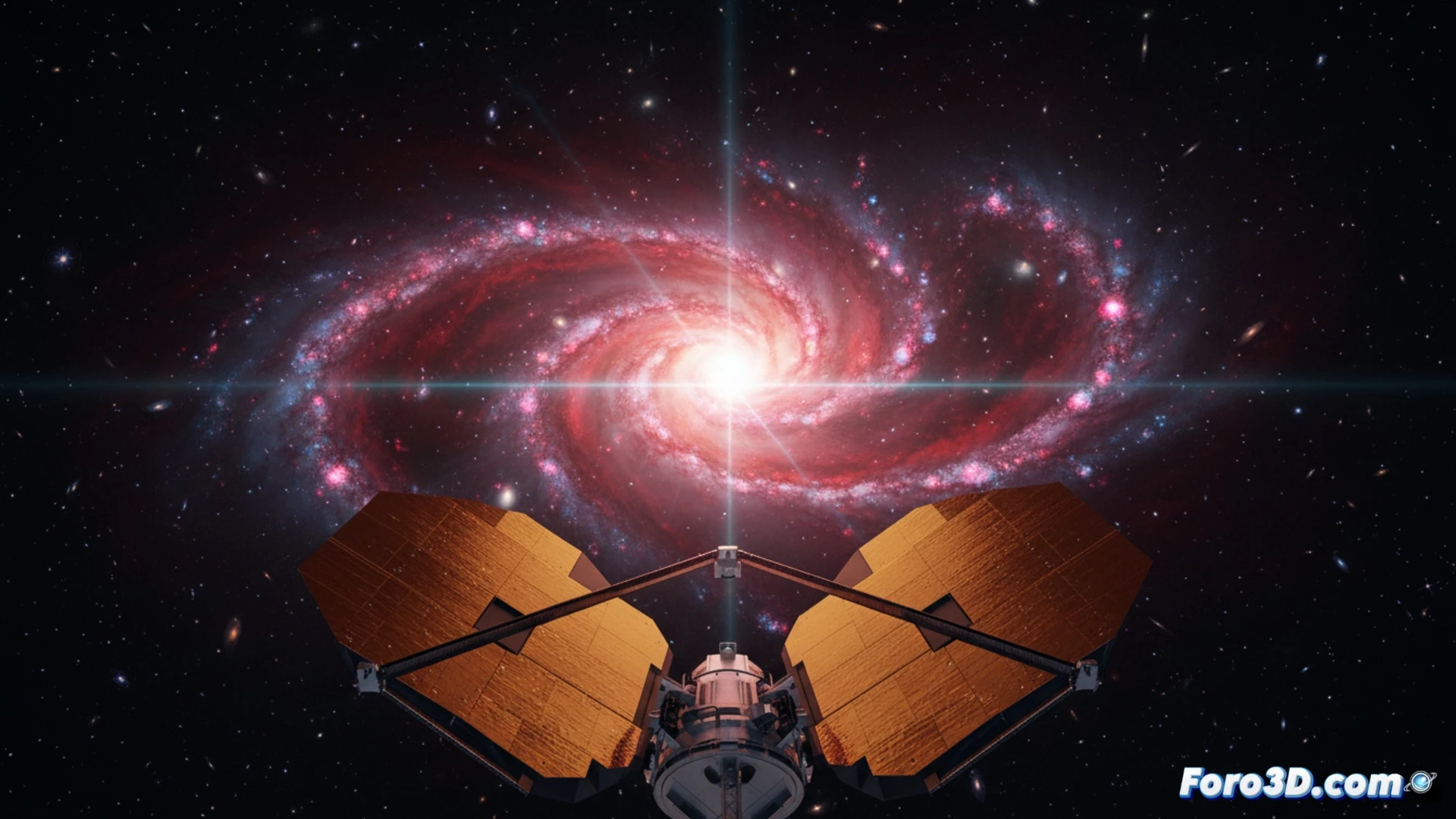
The James Webb Space Telescope has done it again. This time, its MIRI instrument has captured an image of the spiral galaxy Messier 77, also known as the Squid, located 45 million light-years away. The mid-infrared photograph shows its spiral arms, a disk of dust, and an active nucleus so bright that it saturates the telescope's cameras.
A black hole of 8 million suns in charge 🕳️
At the center of M77 hides a supermassive black hole of 8 million solar masses. It pulls gas into a fast orbit, generating violent collisions and intense radiation that outshines the rest of the galaxy. This compact region of hot gas is so powerful that it causes optical diffraction artifacts, visible as bright orange lines that are not part of the galaxy, but of the telescope itself.
The Squid that can't handle its own brightness 📸
The galaxy has an exposure problem, literally. Its center is so dazzling that the James Webb, with all its technology, ends up seeing spots. It's like trying to take a photo of a lighthouse with your phone: the result is light rays that aren't really there. At least the Squid has the excuse of having a black hole at its center; we just have shaky hands.