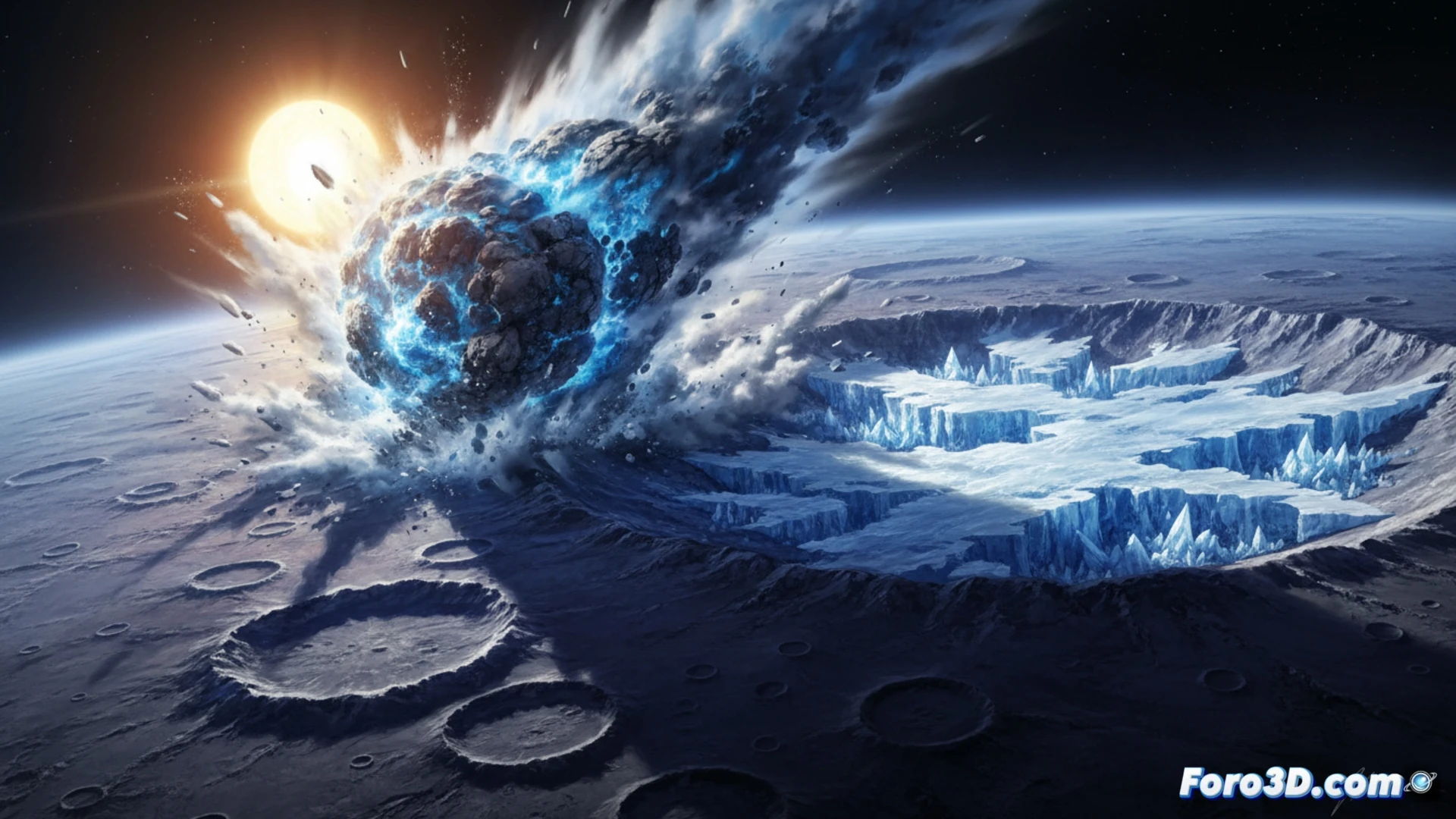
A new study proposes an unconventional origin for the ice deposits at Mercury's poles. According to researchers, an impact from a comet or icy asteroid could have released water vapor into the planet's atmosphere. Due to the low gravity, the vapor did not immediately escape into space, but instead condensed in permanently shadowed polar craters, forming thick layers in a single planetary day.
How low gravity trapped water vapor 🧊
The key to the process lies in Mercury's tenuous atmosphere and its weak gravity, which barely retains gases. After the impact, the water vapor expanded but could not escape into space quickly. Within hours, the vapor condensed into ice particles that fell onto the poles, where the total absence of sunlight prevents them from melting. Models indicate that this mechanism, in a single cycle of 88 Earth days, could have accumulated enough ice as observed by the MESSENGER probe.
Mercury: the icy paradise no one expected 🚀
That the planet closest to the Sun has ice already sounded like a cosmic joke. But that all this ice formed in a single Mercury day is like if on Earth, in the middle of August, a comet dropped an ice cube in the Sahara Desert and the next day there was an ice skating rink. At least, if some space tourist gets lost, they'll know where to look for water for their thermos.