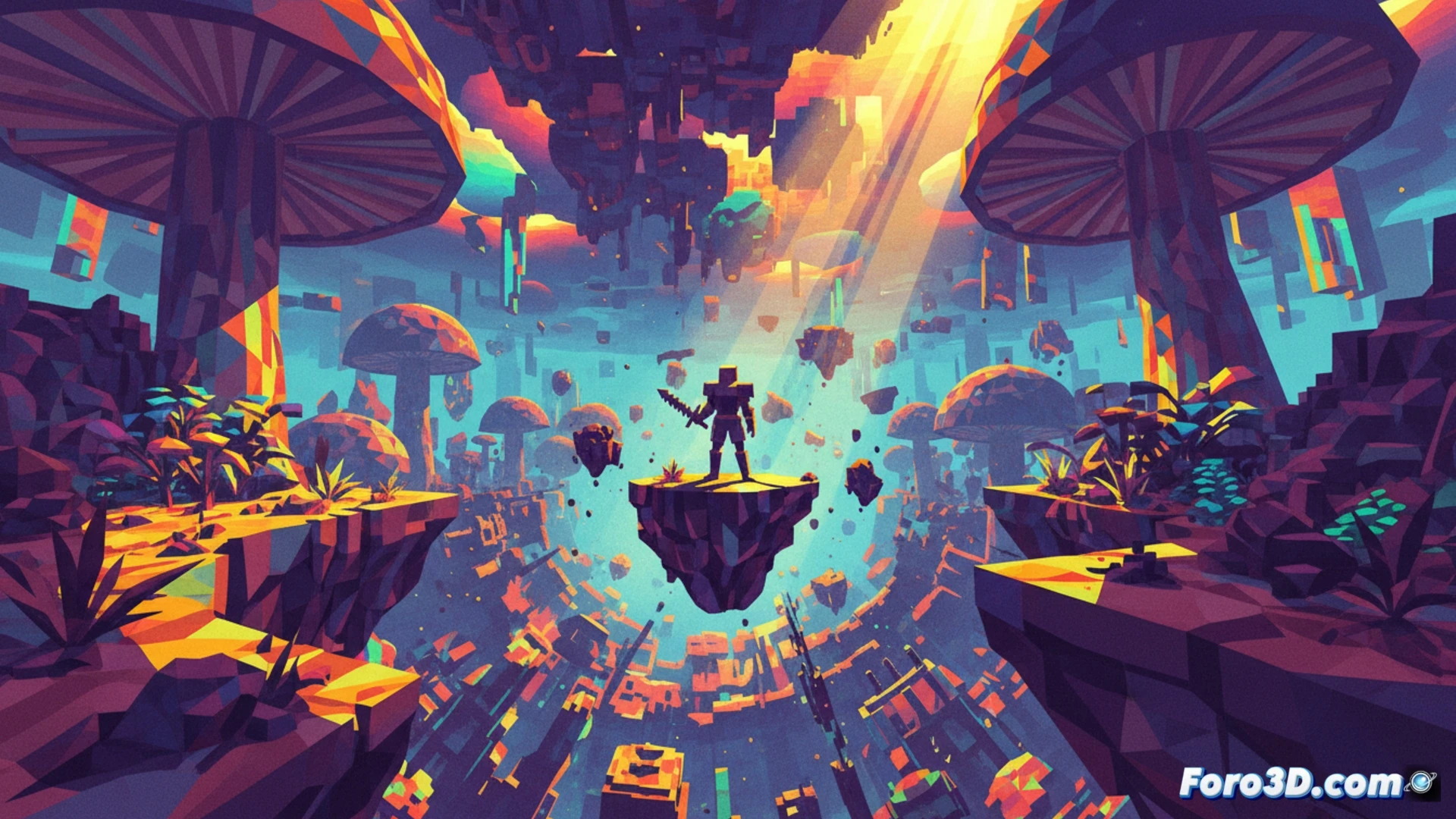
The rise of the lo-fi style in indie development has found a new exponent in Dread Delusion, a title that blends the nostalgia of the first PlayStation with a saturated and psychedelic color palette. This article breaks down the techniques used by its creators to achieve this unique retro look using Unity, Blender, and Aseprite. We will analyze how to combine pixelated textures, low-poly modeling, and dynamic lighting so that any developer can replicate this dreamlike aesthetic in their own projects.
Technical Pipeline: From Blender to Unity with Pixelated Textures 🎨
The process begins in Blender, where modeling must be intentionally simple, avoiding smoothing and using angular geometry to evoke the limitations of the PS1 era. The key is to export these models with a very low texture resolution, created in Aseprite. By working with limited palettes (16 to 32 colors) and a texture size of 32x32 or 64x64 pixels, that rough, pixelated look is achieved. Inside Unity, it is crucial to disable bilinear or trilinear filtering in the texture import settings, forcing the Point (no filter) filter so that pixels appear sharp and hard. Additionally, mipmapping should be disabled to prevent the image from blurring at a distance.
Lighting and Color: The Psychedelic Soul of the Project 🌈
The dynamic lighting of Dread Delusion is what transforms a simple retro game into a surreal experience. Instead of using realistic lights, the team applies point and directional lights with highly saturated colors (lime greens, intense magentas, or electric blues). To emulate the vertex shading of the PS1, it is recommended to use flat shading in Unity's shaders, avoiding smooth normals. The color palette should be deliberately jarring, combining complementary tones to create an uncomfortable and dreamlike atmosphere. The result is a world that feels familiar due to its low fidelity, yet completely alien due to its chromatic explosion.
In Dread Delusion, what lighting and post-processing techniques in Unity allow replicating the psychedelic aesthetic and oppressive atmosphere of PS1 games without sacrificing performance?
(PS: a game developer is someone who spends 1000 hours making a game that people complete in 2)